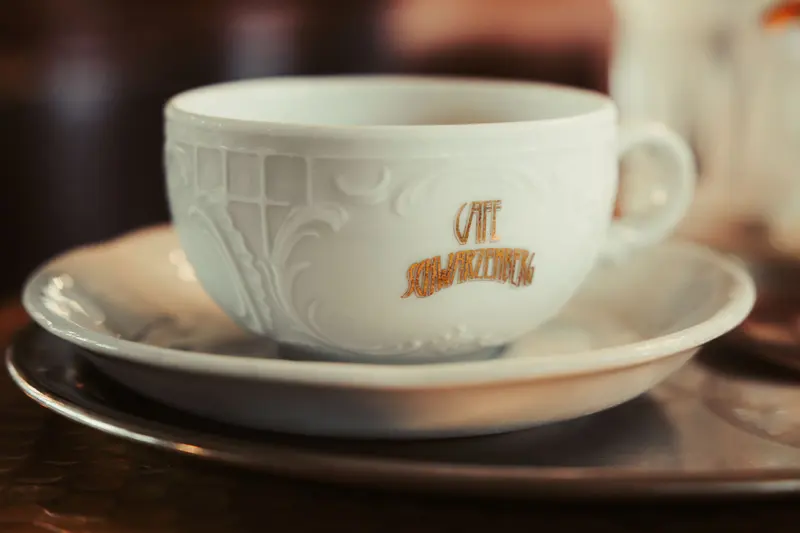
Cafés in Austria Vienna
The Verlängerter and Melange, Julius Meinl, Salzburg's Café Tomaselli and the 1683 siege legend, plus Vienna's Kaffeehäuser.
Photo: Jonas Horsch, Pexels License
Three in four Austrians drink coffee every day. In a February 2025 survey of 1,022 coffee drinkers aged 15 and over, run by NIQ/GfK for Tchibo, the average was 2.75 cups a day, and 74.8% of the wider sample drank coffee daily.1 At home, 47.9% of coffee drinkers use a Vollautomat (bean-to-cup machine) and 26% a capsule machine. Coffee to go has caught on as well: 61.3% buy it at least occasionally, and 80.2% of those in their thirties.1
The cup most of them reach for is a long black one. The Caffè Crema or Verlängerter was the coffee 35% of respondents drank regularly, ahead of espresso at 33.4%, cappuccino at 24.3% and Melange or other milk coffee at 22.2%.1 The industry's trade body, the Österreichischer Kaffee- und Tee-Verband, was founded in 1952; in 2025 its president was the chief executive of the Julius Meinl coffee group. Its Tag des Kaffees, the national coffee day, falls on 1 October; the 2025 edition was the 24th.2
Austria's café cities
The siege of 1683: legend and record
Austria's favorite coffee story is a legend. After the Ottoman army was beaten at the Kahlenberg on 12 September 1683, the tale goes, it left sacks of coffee beans behind, and Georg Franz Kolschitzky, who had fought on the Austrian side, received them along with permission to sell coffee and opened Vienna's first coffee house.3
The real Kolschitzky, born around 1640 in Poland, was an interpreter and courier who spied for Vienna during the siege and was among the first to receive a privilege to serve coffee.4 The Neue Deutsche Biographie calls the first-coffee-house tradition unattested. Armenian merchants set the pace: Johannes Diodato held a personal privilege from 1685, and Isaak de Luca, a Viennese citizen from 23 March 1697, helped establish Kaffeesiederei, coffee boiling, as a regular trade.8
Kaffeesieder, blockades and a heritage listing
Café owners once roasted their own beans and mixed their own blends, which is why Viennese proprietors still call themselves Kaffeesieder (coffee boilers).3
Napoleon's Continental Blockade of 1803 to 1813 made beans so expensive that it nearly ruined the trade. After Austria joined the blockade in 1808, coffee houses were allowed to serve wine and warm food for the first time.5 The owners' association, the Klub der Wiener Kaffeehausbesitzer, was formed in 1956, and Viennese coffee house culture entered Austria's inventory of intangible cultural heritage, kept by the Austrian UNESCO Commission, in 2011.5
Julius Meinl and the roasters
Julius Meinl began as a grocer. The first Julius Meinl opened a spice shop in central Vienna in 1862, selling green coffee beans along with cocoa, tea, spices, rice and sugar, and in 1877 he introduced a roasting process of his own design.6 By 1913 the firm was the largest coffee roaster in the Austro-Hungarian Empire. Its flagship store at Graben 19 opened in 1950.6
Salzburg's Café Tomaselli and the west
Salzburg's tourist board calls Café Tomaselli Austria's oldest coffee house. It traces its roots to 1700, when the Frenchman Johann Fontaine opened the Cafegewölb Fontaine in the Goldgasse, more a meeting place for students and bohemians than a café.7 Anton Staiger took over the licence in 1764 and moved it to the Alter Markt; the confectioner Carl Tomaselli bought the business in 1852 and renamed it. Mozart is said to have been a regular, drinking almond milk, and the pastry waitress has been a fixture since 1853.7
The west also drinks the most. In the 2025 survey, Tyrol, Vorarlberg and Salzburg averaged 2.98 cups a day, the highest of any region.1
Vienna
The capital of the coffee house drinks less coffee than the rest of Austria. Viennese respondents averaged 2.58 cups a day in 2025, against 2.75 nationally, and 69.0% of Viennese drank coffee daily, the lowest share of any region.1 The coffee houses themselves multiplied in the 19th century, from about 150 in 1819 to about 600 around 1900.3 Julius Meinl's flagship store has stood at Graben 19, in the 1st district, since 1950.6
Sources
- Tchibo Kaffee-Fakten 2025 (NIQ/GfK survey, February 2025), Tchibo Österreich, accessed October 2026
- Lebenselixier Kaffee: Tag des Kaffees 2025 (press release, 13 August 2025), Österreichischer Kaffee- und Tee-Verband, via WKO, accessed October 2026
- Wiener Kaffeehauskultur, Planet Wissen (WDR/SWR/ARD-alpha), accessed October 2026
- Kolschitzky, Georg Franz, Austria-Forum (AEIOU), accessed October 2026
- Wiener Kaffeehauskultur, Österreichische UNESCO-Kommission, accessed October 2026
- Our History, Julius Meinl, accessed October 2026
- A good day begins at Tomaselli's, Tourismus Salzburg (salzburg.info), accessed October 2026
- Luca, Isaak de (Karl Teply), Neue Deutsche Biographie 15 (1987), Deutsche Biographie, accessed October 2026
Cafés in Austria: questions
Did coffee come to Vienna after the Turkish siege of 1683?
That is the legend: the Ottoman army supposedly left sacks of beans behind in 1683, and Georg Franz Kolschitzky opened Vienna's first coffee house. The record is different. Kolschitzky was among the first to get a coffee privilege, but Armenian merchants led the way: Johannes Diodato held a privilege from 1685, and Isaak de Luca helped make coffee boiling a regular trade from 1697.
What coffee do people in Austria drink most?
In a 2025 survey of Austrian coffee drinkers, 35% regularly drank a Caffè Crema or Verlängerter, a longer black coffee, ahead of espresso at 33.4%, cappuccino at 24.3% and Melange or other milk coffee at 22.2%. Austrians averaged 2.75 cups a day, with Tyrol, Vorarlberg and Salzburg highest at 2.98 and Vienna lowest at 2.58.
What is the oldest coffee house in Austria?
Salzburg's tourist board calls Café Tomaselli Austria's oldest coffee house. Its roots go back to 1700, when Johann Fontaine opened a coffee vault in the Goldgasse. Anton Staiger moved the business to the Alter Markt in 1764, and the confectioner Carl Tomaselli bought it in 1852 and gave it his name.
Your café deserves better than a pin someone else dropped
Free listings are free for good. A featured page gives you photos, a menu and your own URL, in your café's own design, for less than a coffee a day.