
Cafés in Kazakhstan Almaty
Milky shai poured half-full into a kese, beans from Brazil roasted at home, and Almaty's coffee houses in the foothills of the Tian Shan.
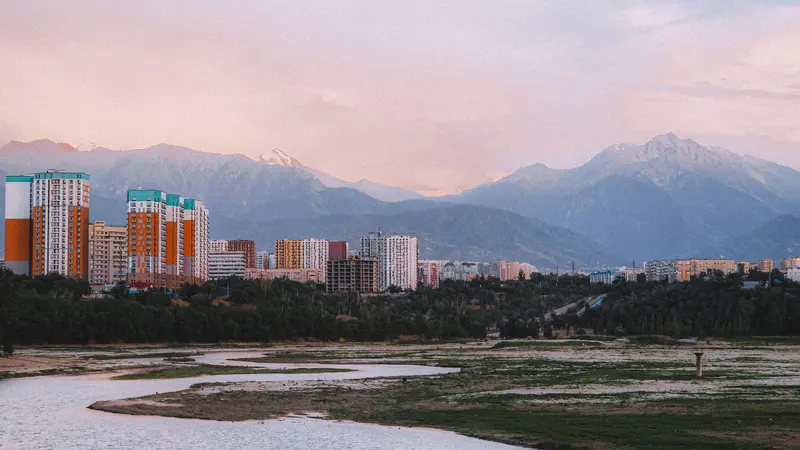
Photo: Naimish Verma, Pexels License
Kazakhstan grows no coffee and has long been a tea country, but coffee is gaining ground. In 2024 it imported about 3,600 tonnes of green and roasted coffee, 13% more than a year earlier, mostly from Brazil (48%) and Russia (19%).2 By early 2025, 66% of imports by volume was unroasted coffee, up from roughly half at the start of 2024.2
Household statistics show the shift. In 2024 the average Kazakhstani consumed 1.9 kg of coffee, tea and cocoa combined; black tea fell 6.1% to 1.3 kg per person, while instant coffee rose 12.8% to 291 grams.3 Euromonitor estimates that coffee consumption grows by about 5–7% a year.1
Kazakhstan's café cities
Shai in the kese
Tea reached the steppe along the Silk Road: caravans carried Chinese tea through Semirechye and southern Kazakhstan, and it stayed a luxury for centuries; supplies almost stopped when the Silk Road declined in the 14th century.4 Tea-drinking customs arrived from Russia in the late 19th century, first among the elite.4
Shai (tea) usually means black tea with milk, and strong tea mixed with milk is called qyzyl shai, "red tea".4 In the south and in the Kyzylorda, Atyrau and Mangystau regions it is served in small bowls called kese or piyala, filled only halfway so guests can sip it hot and the host can refill it often.4
Every guest is offered a cup, and a short visit can last hours. When the guests have gone, families often say "ozimiz shai isheik" ("let's drink tea by ourselves") and pour their own round.4
Almaty's first coffee houses
Coffee houses are a 21st-century arrival. Writing in 2019, Forbes Kazakhstan dated Almaty's first, Coffeedelia and Biskvit, to about 15 years earlier.6 Coffeedelia's original café on Kabanbay Batyr Street, still known by the street's former name, Kalinina, opened in 2005 and closed on October 20, 2024.7
By 2019 one café owner counted 30 to 40 coffee shops per square kilometer in central Almaty's "golden square". Americano, cappuccino and latte outsold espresso, most trade came between morning and lunch, and hot drinks sold less in the summer heat. A cup from a mobile coffee stand then cost 450–500 ₸, one from a café 700–800 ₸ and up, and a kilo of roasted coffee about 7,000 ₸.6
Roasting at home
The rising share of green coffee reflects a young roasting trade. A 2025 survey by Poster, a café-software company, counted more than two dozen roasters in Kazakhstan, in Almaty, Karaganda and other cities, where five years earlier there had been only a few suppliers of fresh-roasted beans. Of those surveyed, 64% run their own cafés, two on average.8 Demand kept rising into 2025: imports in January and February reached 786.9 tonnes, 45% more than a year earlier and the most for those months in at least six years.2
As of 2025, roasters charged about 10,000 ₸ a kilo for base-grade beans, up to 35,000 ₸ for premium coffee and up to 239,000 ₸ for exclusive specialty lots.8 Some of the beans go back out: in January and February 2025 Kazakhstan exported 205.5 tonnes of roasted coffee, more than four times the year before.2
What a cup costs, and where it is packed
Café prices have climbed. In 2024 a latte cost 1,200 ₸ on average across Kazakhstan, 13% more than in 2023; a cappuccino cost 1,050 ₸, up 5%, and an Americano rose 11.3%.1 Retail coffee as a whole rose almost 12% over the year.1
Almaty, the largest city and the capital until 1997, sits in the foothills of the Trans-Ili Alatau, part of the Tian Shan, at about 700 to 900 m.910 It is also where the country's tea and coffee is processed and packed: in 2018 the city produced 87.4% of Kazakhstan's output of both.5
Earthquakes in 1887 and 1911 caused heavy damage in the city. The Ascension Cathedral in Panfilov Park, 56 m tall and built of Tian Shan spruce in 1907, withstood the 1911 quake.9
Sources
- Кофейный бум: Казахстан нарастил импорт кофе, 24.kz (Nursaya Elbrusova, April 24, 2025), accessed October 2026
- Казахстан заметно нарастил импорт кофе, Zakon.kz (April 23, 2025), accessed October 2026
- Черного чая все меньше пьют казахстанцы: аналитики назвали причины, Azattyq Rýhy (June 3, 2025), accessed October 2026
- Tea Ceremony Remains at Heart of Kazakh Hospitality, The Astana Times (Aiman Nakispekova, March 24, 2025), accessed October 2026
- Қазақ шай ішуден қалып барады, Inbusiness.kz (Zhanat Ardaq, November 26, 2018), accessed October 2026
- Некоторые любят погорячее. Рынок кофеен в Казахстане, Forbes Kazakhstan (August 29, 2019), accessed October 2026
- Что будет на месте закрывшегося в Алматы кафе Coffeedelia, Forbes Kazakhstan (October 22, 2024), accessed October 2026
- Узнали, как выглядит типичный казахстанский обжарщик кофе, DigitalBusiness.kz (Aliya Rakhimova, October 7, 2025), accessed October 2026
- Almaty, Wikipedia, accessed October 2026
- Trans-Ili Alatau, Wikipedia, accessed October 2026
Cafés in Kazakhstan: questions
How is tea served in Kazakhstan?
Kazakh shai is usually black tea with milk; strong tea mixed with milk is called qyzyl shai, or red tea. In the south and west it is poured into small bowls called kese or piyala, filled only halfway so guests drink it hot and the host refills it often. Every guest in Kazakhstan is offered a cup.
How much does a latte cost in Kazakhstan?
In 2024 a latte cost 1,200 tenge on average in Kazakhstan, 13% more than in 2023, and a cappuccino 1,050 tenge. Retail coffee prices rose almost 12% over the year.
Where does Kazakhstan's coffee come from?
Kazakhstan grows no coffee. In 2024 it imported about 3,600 tonnes of green and roasted coffee, 48% of it from Brazil and 19% from Russia. By early 2025 two-thirds of imports were unroasted beans, roasted by a trade of more than two dozen local roasters in Almaty, Karaganda and other cities.
Your café deserves better than a pin someone else dropped
Free listings are free for good. A featured page gives you photos, a menu and your own URL, in your café's own design, for less than a coffee a day.