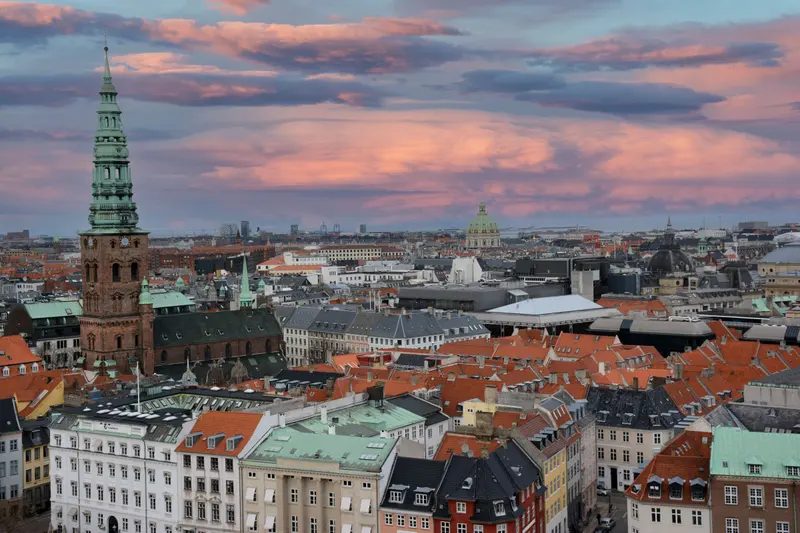
Cafés in Denmark Copenhagen
Filter coffee at home, light roasts and world barista titles, wienerbrød from the bakery, and Copenhagen's coffee bars and bakeries.
Photo: Filip Filipovic, Pexels License
Few countries drink more coffee than Denmark. BKT (Brancheforeningen for kaffe og te), the coffee and tea trade association, ranks Danes fourth in the world after Finland, Norway and Iceland, at an average of 4.2 cups a day, and 84% of them drink coffee in the morning.1
Most of it is brewed at home: 75% drink coffee at home and 74% away from it, mainly at work, in cafés and in restaurants.1 Supermarket sales are shrinking, from 23,159 tonnes in 2021 to 18,869 tonnes in 2025, about 3.68 billion cups, which BKT puts down to drinking moving to workplaces and cafés rather than to Danes drinking less.1 Ground coffee is still the best seller.1
Coffee also carries its own duty. The kaffeafgift was introduced in 1930 as a tax on luxury goods, and in 2024 it stood at 7.67 kr. per kg of roasted coffee and 6.39 kr. per kg of raw beans.2 In October 2026 the government proposed abolishing it from 1 January 2027.3 The economy ministry's figures show coffee prices rising faster in Denmark than in the euro area since January 2022.4
Denmark's café cities
From 1665 to the end of rationing
Coffee is believed to have reached Denmark in 1665, but it took until about 1820 to win over the farmers of Zealand.5 Merchants stretched it: an 1863 book on the chemistry of everyday life warned of coffee cut with chicory to raise the seller's profit.5
The Second World War almost stopped imports. Coffee stayed rationed until October 1952, and Danes made do with erstatningskaffe (substitute coffee), brewed from chicory root among other things.5
The sønderjysk kaffebord
Southern Jutland turned coffee into a feast. The sønderjysk kaffebord (South Jutland coffee table) took shape in the mid-1800s, once coffee had become cheaper and bread ovens more reliable: soft cakes first, then layer cakes, and at least seven kinds of småkager (cookies) to finish.6 Hosts aimed to have enough for twice the number of guests invited.6
After the region became part of Prussia in 1864, the authorities often refused liquor licenses to inns where Danish-minded people met, so the community built its own forsamlingshuse (assembly halls) and served coffee and cake there.6 During the First World War meetings were banned but coffee tables were not, and people gathered around those instead.6
Wienerbrød, the Viennese bread
Wienerbrød means Viennese bread. The usual origin story is a bakery workers' strike in 1850, when owners hired foreign bakers, several of them Austrian; after the dispute, Danish bakers kept recipes such as the kolatsche and added more egg and fat.7 In Vienna the same pastry is called Kopenhagener Plunder or Dänischer Plunder.8
Bakers have a name for the hollow in the middle of a round pastry, where the cream or jam goes: bagerens dårlige øje, the baker's bad eye.8 The pastry also traveled: Lauritz C. Klitteng promoted "Danish pastry" in the United States from 1915 to 1920, and is said to have baked it for Woodrow Wilson in December 1915.8
Barista titles and the brands on the shelf
Between 2001 and 2006 Danish baristas won the World Barista Championship four times, the last of them Klaus Thomsen.9 The roastery he co-founded, Coffee Collective, made its first two purchases from farms in Guatemala and Brazil and still buys from both.10
For filter coffee, the Scandinavian countries have long bought more washed arabica than robusta, which Thomsen links to a public that prefers cleaner-tasting cups.10 Coffee became a staple across the region partly through Norway's early-1900s prohibition and high alcohol taxes in its neighbors, and offering coffee to guests is still the custom.10
The supermarket brands are older. BKI, short for Brasil Kaffe Import, was founded by Svend Mathiesen in 1960, moved to Højbjerg near Aarhus in 1963 and is still owned by his three children.11 Merrild grew out of a shop in Kolding; Douwe Egberts bought it in 1979, Lavazza took it over in 2015, and the Kolding roastery closed that year.12
Copenhagen, where Bodum began
Copenhagen has its own place in the story. Peter Bodum founded his housewares firm here in 1944; it sold its first vacuum coffee maker, the Mocca, in the mid-1950s and moved to Lucerne in 1978.13 Today the city's cafés run from light-roast filter bars in Nørrebro and Vesterbro's old meat-packing district to bakeries on Refshaleøen and tables along the Lakes.
Sources
- Kaffe i tal, BKT, Brancheforeningen for kaffe og te, accessed October 2026
- Afgiften er fra 1930 og skaber unødvendigt bureaukrati: Derfor skal den afskaffes, Dansk Erhverv (May 3, 2024), accessed October 2026
- Nye afgiftsregler på vej, Deloitte Danmark (October 8, 2026), accessed October 2026
- Faktaark: Udvikling i forbrugerpriser og fødevarepriser, Økonomiministeriet (November 7, 2025), accessed October 2026
- Kaffe, Wikipedia (Danish), accessed October 2026
- Sønderjysk kaffebord, Wikipedia (Danish), accessed October 2026
- Danish pastry, Wikipedia, accessed October 2026
- Wienerbrød, Wikipedia (Danish), accessed October 2026
- World Barista Championship, Wikipedia, accessed October 2026
- Are Nordic specialty coffee roasters still as innovative as they once were?, Perfect Daily Grind (Benedicte Gyllensten, February 27, 2023), accessed October 2026
- BKI foods, Wikipedia (Danish), accessed October 2026
- Merrild Kaffe, Wikipedia (Danish), accessed October 2026
- Bodum, Wikipedia, accessed October 2026
Cafés in Denmark: questions
How much coffee do people drink in Denmark?
Danes drink an average of 4.2 cups of coffee a day, according to the trade association BKT, which ranks Denmark fourth in the world after Finland, Norway and Iceland. 84% drink coffee in the morning, and 75% drink it at home. Supermarket sales fell to 18,869 tonnes in 2025 as more drinking moved to workplaces and cafés.
Why is a Danish pastry called wienerbrød in Denmark?
Wienerbrød means Viennese bread. The usual story is that during a Danish bakery workers' strike in 1850, owners hired foreign bakers, several from Austria, and Danish bakers later adapted their recipes with more egg and fat. In Vienna the pastry is known the other way round, as Kopenhagener Plunder or Dänischer Plunder.
Is there a tax on coffee in Denmark?
Yes. Denmark's kaffeafgift was introduced in 1930 as a tax on luxury goods, and in 2024 it came to 7.67 kr. per kg of roasted coffee and 6.39 kr. per kg of raw beans. In October 2026 the government proposed abolishing it from 1 January 2027. Coffee prices have risen faster in Denmark than in the euro area since January 2022.
Your café deserves better than a pin someone else dropped
Free listings are free for good. A featured page gives you photos, a menu and your own URL, in your café's own design, for less than a coffee a day.