
Cafés in Jordan Amman
Cardamom coffee and bitter qahwa sada, the Bedouin mihbash, roadside kiosks and Amman's cafés on Jabal Amman and Jabal al-Weibdeh.
Photo: Nikola Čedíková, Pexels License
Jordan buys its coffee as green beans, and it is buying more. In 2024 it imported 43,374 tonnes of unroasted coffee worth US$193.7 million, against 31,511 tonnes in 2023, according to UN Comtrade data published by the World Bank.12 Brazil supplied 17,856 tonnes, Ethiopia 11,148 and India 8,009, with Colombia and Nicaragua far behind.1
Consumption has risen steadily since the 1980s and reached one of its highest points in 2021, according to market data cited by the Friedrich Naumann Foundation, in a country where half the population is under 24.7 The older ritual has official standing: in 2024 UNESCO extended its inscription of Arabic coffee as intangible heritage to include Jordan, which joined the 2015 file of the UAE, Saudi Arabia, Oman and Qatar.3
Jordan's café cities
Qahwa sada and the Bedouin coffee ritual
Qahwa sada (قهوة سادة), black and flavored with cardamom, is Jordan's welcome coffee, offered as a sign of respect.4 Among Bedouin and rural families the bitter form, qahwa murra, is kept for special occasions: coarsely ground beans and whole cardamom are brewed for up to several hours, never sweetened, and large batches go into a long-spouted pot called a bakraj.4
At a Bedouin camp in the Dana reserve, the host roasts the beans over a fire of white broom or acacia wood, pounds them with a pestle and boils them with green cardamom in a long-beaked brass pot.5 Only men make the coffee there, and the host tastes the first cup himself to show it is good before pouring small, very hot cups guest by guest.5
The mihbash and the rules of the cup
The mortar is the mihbash (مهباش), also called mihbaj: a wooden mortar for grinding coffee, traditionally cut from terebinth wood near the root, its hardest part, hollowed about 30 cm deep and often rimmed with brass or silver.6 Struck with skill it becomes a musical instrument, and its rhythm once told neighbors that guests were welcome.64
UNESCO's file sets out the etiquette: older people and guests are served first, the coffee is poured with the right hand, and a guest shakes the cup to signal they are done.3 Hand the cup back without shaking it and it is refilled; the ritual stops at three cups.5 In Jordan the coffee is a fixture of government offices and homes as well as weddings and tribal gatherings.3
Sada, wasat, hilwe: everyday coffee and its price
Outside the ceremony, Levantine coffee is close to Turkish coffee but spiced with cardamom, and it is brewed in a long-handled pot called a rakwa.4 It is ordered by sweetness: sada (unsweetened), wasat (medium) or hilwe (sweet).4
Cardamom is part of the bill. In April 2025 distributors raised a kilo of coffee from JD 12.60 to JD 14.80 including sales tax, and a 250 g pack from JD 3.15 to JD 3.70, Roya News reported, after cardamom rose 58% in a year.8
Amman spread fast and unevenly into a car-dependent city with few walkable places to gather, and early mornings bring lines of cars at roadside coffee kiosks.7
Amman, from the kiosk to the roaster
Amman became the capital in 1921 and now has more than four million people.9 Its specialty trend gained momentum around 2015, and cafés with smoke-free sections and mixed seating draw young women and men alike.7 Dimitri's Coffee Roasters was founded in 2014 by three brothers, roasting on a machine one of them designed and local engineers built.9
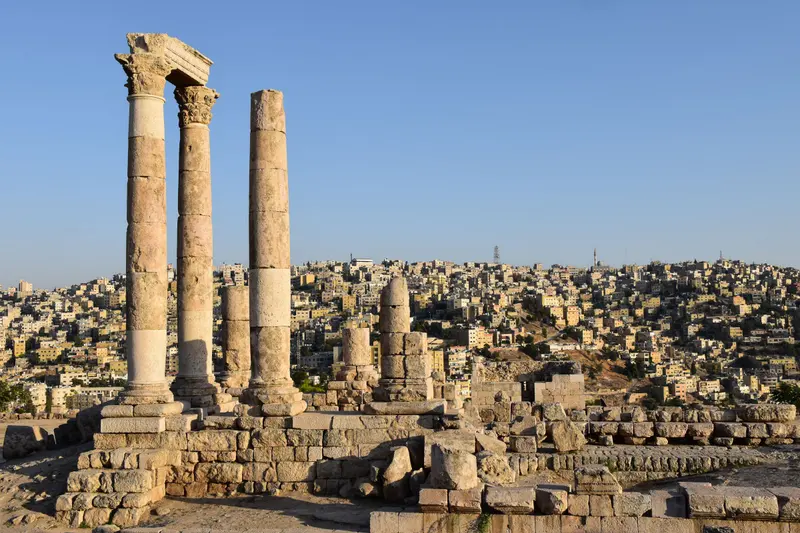
Jabal al-Weibdeh dates from the 1920s, when residents began moving up from downtown, and has been home to writers, poets and politicians.9 Paris Square, with a copy of a Wallace fountain, is its center, and the Jordan National Gallery of Fine Arts and the Jordanian Writers Society are there.10 On Jabal Amman, Rainbow Street, formerly Abu Bakr al-Siddiq Street, runs east from the First Circle past the al-Mufti House and Teta Alice's House, once King Talal's residence.11
Sources
- Jordan coffee, not roasted, not decaffeinated (HS 090111) imports by country, 2024, World Bank WITS (UN Comtrade data), accessed October 2026
- Jordan coffee, not roasted, not decaffeinated (HS 090111) imports by country, 2023, World Bank WITS (UN Comtrade data), accessed October 2026
- Arabic coffee, a symbol of generosity (extension to Jordan, 19.COM 7.b.55), UNESCO Intangible Cultural Heritage (inscribed 2024), accessed October 2026
- Arabic coffee, Wikipedia, accessed October 2026
- Bedouin coffee ceremony in Jordan, Fathom (Anja Mutic, September 29, 2017), accessed October 2026
- المهباج, ويكيبيديا (Arabic Wikipedia), accessed October 2026
- A City of Coffee: Youth, Choice & Public Life in Amman's Café Boom, Friedrich Naumann Foundation for Freedom, Jordan (Gloria Halasa, December 1, 2025), accessed October 2026
- Public outcry in Jordan over 50% increase in coffee prices, Roya News English (April 9, 2025), accessed October 2026
- Amman, Jordan: The Sprudge Coffee Guide, Sprudge (William Cotter, June 24, 2019), accessed October 2026
- Jabal al-Lweibdeh, Wikipedia, accessed October 2026
- Rainbow Street, Wikipedia, accessed October 2026
Cafés in Jordan: questions
How is Arabic coffee served in Jordan?
In Jordan, older people and guests are served first and the coffee is poured with the right hand. At a Bedouin camp the host tastes the first cup, then pours small, very hot cups guest by guest. Hand the cup back still for a refill, shake it when you are done, and stop at three cups.
What is qahwa sada in Jordan?
Qahwa sada is Jordan's welcome coffee, black and flavored with cardamom. Bedouin and rural families make a bitter version, qahwa murra, from coarsely ground beans and whole cardamom brewed for up to several hours and never sweetened. Beans are traditionally pounded in a wooden mortar called a mihbash, whose rhythm once told neighbors that guests were welcome.
How much coffee does Jordan import?
Jordan imported 43,374 tonnes of green coffee worth US$193.7 million in 2024, up from 31,511 tonnes in 2023, according to UN Comtrade data. Brazil was the largest supplier with 17,856 tonnes, followed by Ethiopia and India. In April 2025 a kilo of coffee from distributors rose from JD 12.60 to JD 14.80.
Your café deserves better than a pin someone else dropped
Free listings are free for good. A featured page gives you photos, a menu and your own URL, in your café's own design, for less than a coffee a day.