
Cafés in Ghana Accra
Robusta from the Volta Region, Accra roasters, Osu and Jamestown, espresso with condensed milk, and cocoa from the No. 2 exporter.
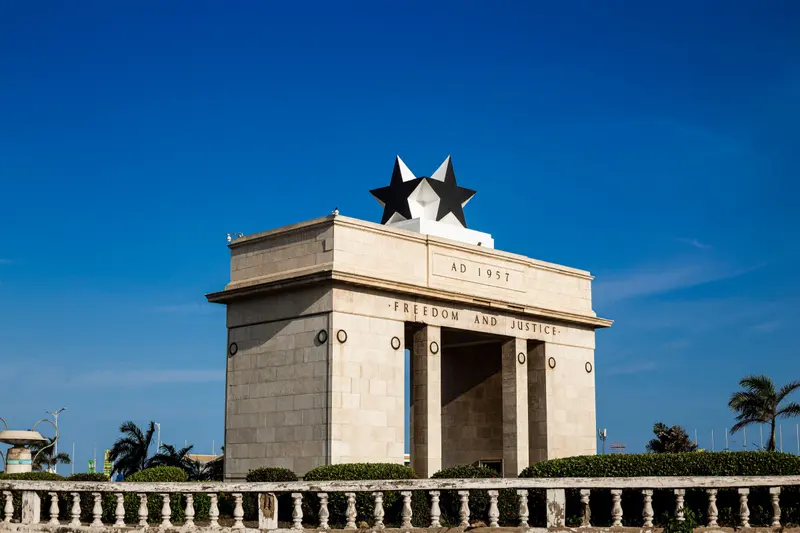
Photo: Joshua Dery, Pexels License
Ghana is a cocoa country that grew coffee first. Missionaries introduced coffee in the mid-eighteenth century,1 more than a century before the blacksmith Tetteh Quarsie brought cacao pods from Spain in 1879.2 Today Ghana is the world's second-largest cocoa exporter after Côte d'Ivoire, and coffee trails far behind.3
Ghana grows robusta on about 17,000 hectares and produces about 37,000 bags of 60 kg a year; around 8,000 smallholders depend on it.4 It ranked 40th among the world's coffee exporters on the International Coffee Organization's 2022–2024 average,5 and much of its coffee is sold within West Africa without appearing in export statistics.3
Ghana's café cities
Why Ghana grows robusta
Colonial settlers tried arabica, but robusta did better on farmland at 400–800 m, and arabica suffered from pests and disease.2 Robusta grows mainly in the Ashanti, Brong Ahafo, Eastern, Central, Western and Volta regions. The coffee season runs from October to September, with planting in May at the start of the rains.1
Coffee and cocoa share the land. Most coffee farms cover half an acre to 1.5 acres, and the coffee is usually processed natural, sun-dried on the raised beds built for cocoa.4 Smallholders average about 300 kg of cherries per hectare, against about 1,500 kg on large farms.4
Collapse and revival
A fall in coffee prices in the 1980s led many Ghanaian farmers to abandon the crop for cocoa.3 The government set up 19 coffee plantations in that decade and later sold them to private owners.1 A 1991 agricultural diversification project liberalized the market and improved prices and research, and COCOBOD's Coffee Development Project, from 2010, spent GH₵4.2 million (about US$2.8 million) over four years to add more than 2,500 hectares with over 4,500 registered farmers.1
COCOBOD, the cocoa board, still runs coffee's recovery. At the start of the 2024/25 season its Seed Production Division gave out one million free hybrid coffee seedlings.2 Its research arm, the Cocoa Research Institute of Ghana, founded in 1938 at Tafo-Akim, also breeds coffee and represents Ghana in World Coffee Research's robusta breeding network.5
Tea, Milo and instant coffee
Under British rule Ghanaians took to black tea with milk and sugar, and "tea" came to mean most warm breakfast drinks, Nestlé's cocoa-malt Milo included.2 Coffee at home was traditionally hand-milled, roasted over an open fire, boiled and strained; today most Ghanaians drink instant.2 In 2023 an International Trade Centre adviser told the Daily Graphic that "Ghana doesn't have a coffee culture," while adding that local demand could be built.4
Cocoa has its own date. Since 2005, 14 February has been National Chocolate Day, set to promote Ghanaian chocolate and cocoa products, and in 2022 it became a National Chocolate Week; the 2024 edition ran from 9 to 14 February.6
Accra's roasters
Accra's coffee scene is young. By 2018 local cafés were opening in the city, alongside international chains from South Africa and Canada.3 One Accra roaster told Standart that Ghana had "almost lost" its coffee culture until local roasters gained momentum in the late 2010s.2 In October 2024 the Coffee Roasters Association of Ghana held the first Ghana Coffee Fair & Exhibition in Accra, during a Ghana Coffee Week with a barista championship and farm trips to the Volta Region.2
Roasters here cook to the local sweet tooth: one names its drinks after Accra neighborhoods, and its Kaneshie coffee is espresso with sweetened condensed milk, hot or iced. Not every Accra café serves Ghanaian beans.2
Osu, about 3 km east of the business district and known locally as Accra's "West End," grew from a 17th-century settlement.7 Jamestown, with Usshertown one of the city's two oldest districts, is a Ga fishing community; its lighthouse was first built at James Fort in 1871 and replaced by the current 28 m tower in the 1930s.8
Sources
- Coffee, Ghana Cocoa Board (COCOBOD), accessed October 2026
- Ghana's coffee industry is awakening, Standart (Chloé Skye Weiser, July 26, 2026), accessed October 2026
- Ghana wakes up and smells the coffee, AFP via Gulf News (November 1, 2018), accessed October 2026
- Boost coffee production to increase export revenue – Food Research Institute to farmers, Daily Graphic (Elizabeth Nyaadu Adu, April 25, 2023), accessed October 2026
- Ghana, World Coffee Research, accessed October 2026
- Ghana celebrates National Chocolate Day, Ghana News Agency (February 14, 2024), accessed October 2026
- Osu, Accra, Wikipedia, accessed October 2026
- Jamestown, Accra, Wikipedia, accessed October 2026
Cafés in Ghana: questions
Where is coffee grown in Ghana?
Ghana grows robusta on about 17,000 hectares, producing about 37,000 bags of 60 kg a year, mostly in the Ashanti, Brong Ahafo, Eastern, Central, Western and Volta regions. Missionaries introduced coffee in the mid-eighteenth century, before cacao arrived in 1879, but a price fall in the 1980s led many farmers to switch to cocoa.
What do people in Ghana drink instead of coffee?
Most Ghanaians drink black tea with milk and sugar, a habit from British rule, and "tea" means most warm breakfast drinks, including Nestlé's cocoa-malt Milo. Coffee drinkers mostly take instant. Ghana also promotes its own cocoa: 14 February has been National Chocolate Day since 2005, and a National Chocolate Week since 2022.
When did the Accra coffee scene start?
Accra's coffee scene began in the late 2010s, when local roasters gained momentum; by 2018 local cafés were opening alongside international chains from South Africa and Canada. In October 2024 the Coffee Roasters Association of Ghana held the first Ghana Coffee Fair & Exhibition in Accra, during Ghana Coffee Week.
Your café deserves better than a pin someone else dropped
Free listings are free for good. A featured page gives you photos, a menu and your own URL, in your café's own design, for less than a coffee a day.