Cafés in South Korea Seoul and Busan
Seoul's hanok cafés and Seongsu roasters, Busan's port and champion baristas, Gangneung's coffee street and the coffee-mix habit.
Photo: Constantine Kim, Pexels License
South Korea drinks imported coffee in quantity. Euromonitor put consumption at 405 cups per person in 2023, against 318 in the United States and a world average of 152, and at 416 cups in 2024, about 1.1 a day.12 The Korea Customs Service counted a record 200,000 tonnes of coffee imports in 2022, 180,000 tonnes of them green beans, worth US$1.3 billion, 42.4% more than a year earlier; Brazil, Vietnam and Colombia were the largest suppliers.3
A good share of Korean coffee still comes from a paper stick. Dongsuh Foods put the world's first coffee mix (커피믹스, keopi mikseu: instant coffee, creamer and sugar in one sachet) on sale in December 1976.4 The company sold about 9 billion sticks in 2025, roughly 180 cups for every person in the country, with sales of about ₩900 billion.5
The market is concentrated. In 2023 Dongsuh's Maxim brand held 73.3% of retail instant-coffee sales and 87.4% of prepared (mixed) coffee.1 Coffee also leaves the country: exports rose more than 30% in four years, to about US$231 million in 2022, by Korea Customs Service figures.1
From PX coffee to a manufacturing license
Postwar coffee came through the army. Instant coffee arrived with American troops after liberation in 1945, and goods from the US Army PX were sold widely on the black market.4 By 1960 Seoul had about 1,000 dabang (다방, tearooms), and smuggled coffee was estimated at about 95% of what they served.4 After the May 16 coup of 1961, coffee was banned in dabang under a campaign for domestic products.6
The state then chose to make coffee at home. In 1968, to stop foreign currency leaving the country, the government licensed Dongsuh Foods and Mijoo Industry to manufacture it.4 The coffee mix became a national habit in the late 1990s, during the IMF crisis, when companies cut costs and office staff began making their own cups next to the new hot-and-cold water dispensers.5
Paik's Dabang, Mega and the chain map
The chain map has split in two. Budget brands grew fastest: Mega MGC Coffee went from 2,173 stores in 2022 to 3,998 in 2025, Compose Coffee from 1,901 to 2,844, and Paik's Dabang (빽다방), whose name borrows the old tearoom word, from 1,231 to 1,844.7 Starbucks reached 2,076 stores in the third quarter of 2025.7
The middle shrank. Ediya, which had 3,019 stores in 2022, was down to 2,562 in 2024, and Hollys and Coffee Bean also had fewer stores in 2025 than in 2022.7 Instant coffee is losing ground in shops too: retail sales of instant fell 26.1% over three years in Market Link's data, while sales of whole beans rose about 20%.1
Gangneung and the competition circuit
Coffee vending machines were a common way to get a cup in 1980s Korea, and some, rebuilt in vintage style or kept in their original form, still stand along the seafront in Gangneung, in Gangwon Province.8
The cafés of Gangneung Coffee Street now line Anmok Beach, and Park Ichu, described as one of Korea's first-generation coffee makers, runs Bohemian Coffee Roasters at Yeongjin Beach.8 Terarosa, one of the best-known Korean coffee brands, keeps its full brand experience for its Gangneung locations.8 The city has hosted the Gangneung Coffee Festival since 2009, and it draws more than 400,000 people.8
Korean baristas compete at the top. At the World Barista Championship in Boston on 11–14 April 2019, Jeon Joo-yeon of Momos Coffee in Busan presented on how carbohydrates shape sweetness in coffee, using a Sidra from the Colombian farm La Palma y El Tucán, and sat at a low table facing the judges.9 She was the second woman to win the title, a year after Agnieszka Rojewska of Poland.10
Seoul and Busan
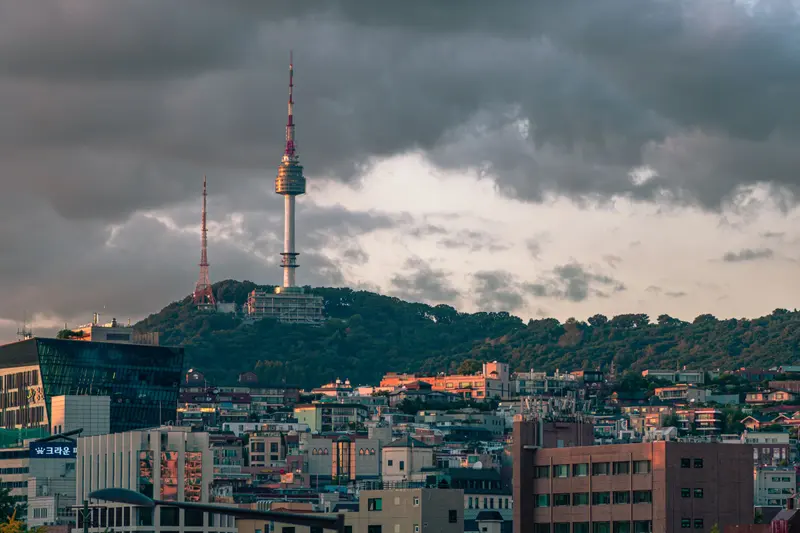
The dabang grew up in Seoul. Its modern type appeared in Myeong-dong in 1927 and spread to Jongno and Chungmuro, and in the 1970s music dabang, where a DJ played requests, were probably the first themed cafés.6 Seoul's cafés now run from roasters in old factories around Seongsu to tea and coffee in hanok houses in Bukchon, late cafés around Hongik University and coffee bars up the stairs of Euljiro's print-shop buildings.
Busan had a dabang era of its own. During the Korean War, when it was the refugee capital, artists escaping the bombing crowded into the city and tearooms sprang up around Gwangbok-dong, next to Gukje Market; painters used them as galleries, writers as places to present new work, and refugees as an address and a telephone.11
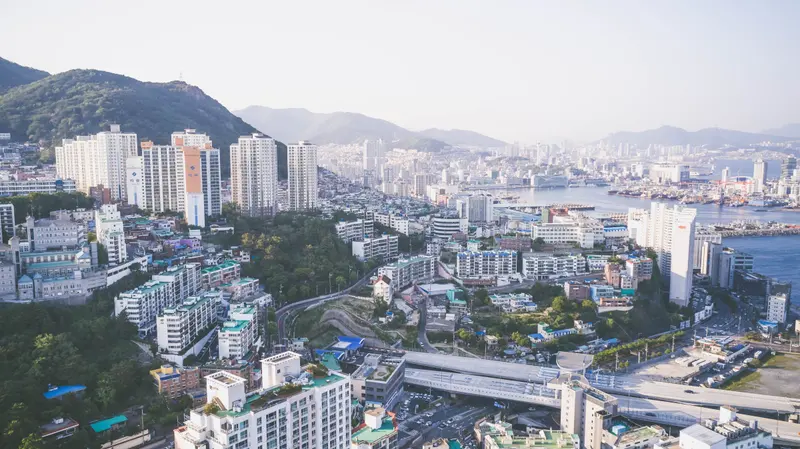
The port now carries the trade: more than 90% of South Korea's imported coffee clears customs at Busan, and the budget chain Compose Coffee was founded in the city.1213 Its baristas keep winning. Lim Jeong-hwan of Aery Coffee took the 2024 Korea National Barista Championship and placed fifth at the world final, and Moon Heon-gwan of Month Coffee won the 2022 World Cup Tasters Championship.12
Sources
- 'A Society Needing Caffeine'... South Korea's Coffee Consumption This Year Twice the Global Average, Asia Economy (December 25, 2023, citing Euromonitor and Market Link), accessed October 2026
- South Koreans Drink 416 Cups of Coffee Per Capita Annually, Korea Business Review (August 13, 2026), accessed October 2026
- 더 진해진 한국인 커피사랑…'가배' 수입액 사상최대, SBS Biz (January 31, 2023, citing the Korea Customs Service), accessed October 2026
- [우리 식생활 바꾼 음식 이야기] '국민 후식' 커피, 한때는 왕의 음료·인기 밀수품, Seoul Shinmun (December 19, 2016), accessed October 2026
- 사무실 정수기 옆엔 꼭 있어…IMF 같이 극복한 '국민커피' 벌써 50살, Money Today (March 7, 2026), accessed October 2026
- Coffee in South Korea, Wikipedia, accessed October 2026
- 커피 시장 '가성비' vs '프리미엄' 재편…중저가 브랜드 성장 정체, Aju Business Daily (November 16, 2025), accessed October 2026
- 'Coffee City' Gangneung in Gangwon-do Province, Korean Culture and Information Service, Korea webzine (March 2021), accessed October 2026
- Judges wowed by Korean barista, Korea JoongAng Daily (April 22, 2019), accessed October 2026
- Korea's Jooyeon Jeon Wins 2019 World Barista Championship, Daily Coffee News (April 14, 2019), accessed October 2026
- [한국전쟁 정전 70년] 피란수도 부산, 1023일의 기록 (하), Jeonbuk Ilbo, from Busan Ilbo (August 13, 2023), accessed October 2026
- Busan emerges as Korea's coffee capital, fueled by champion baristas and coastal charm, The Korea Times, from Hankook Ilbo (May 24, 2025), accessed October 2026
- Jollibee to acquire Korea's Compose Coffee in $340 mn deal, The Korea Economic Daily Global Edition (July 3, 2024), accessed October 2026
Guides
Café opening hours around the world
When cafés open and close: 06:00 coffee in Vietnam, Italian bars shut by 20:00, Melbourne cafés done by 15:00, Sundays in Berlin, Ramadan in Dubai.
Coffee culturesKorean café culture from the kiosk to the buzzer
How Korean cafés work: kiosk ordering, the vibrating buzzer, ah-ah and tteu-ah, cup rules for drinking in, tumbler discounts and 2026 prices in won.
Cafés in South Korea: questions
How much coffee do people drink in South Korea?
South Koreans drank about 405 cups of coffee per person in 2023 and 416 cups in 2024, according to Euromonitor, about 1.1 cups a day. The world average in 2023 was 152 cups and the United States 318. In 2022 South Korea imported a record 200,000 tonnes of coffee worth US$1.3 billion, mostly from Brazil, Vietnam and Colombia.
What is Korean coffee mix?
Coffee mix (커피믹스) is a single-serve stick of instant coffee, creamer and sugar that you stir into hot water. Dongsuh Foods launched the world's first in South Korea in December 1976, and it became an office staple during the late-1990s IMF crisis. The company sold about 9 billion sticks in 2025, and its Maxim Mocha Gold dates from 1989.
What are the biggest coffee chains in South Korea?
By store count in 2025, the budget chain Mega MGC Coffee led South Korea with 3,998 stores, followed by Compose Coffee with 2,844, Starbucks with 2,076 in the third quarter and Paik's Dabang with 1,844. Ediya, once the largest with 3,019 stores in 2022, had fallen to 2,562 by 2024.
Your café deserves better than a pin someone else dropped
Free listings are free for good. A featured page gives you photos, a menu and your own URL, in your café's own design, for less than a coffee a day.