
Cafés in Ireland Dublin
Dublin's coffee houses since 1664, Bewley's on Grafton Street, Irish coffee from Foynes, flat whites and the specialty roasters of Dublin.
Photo: K, Pexels License
Ireland drinks more tea per person than any country except Türkiye, about 2.9 kg a year, or roughly three cups a day for every resident, children included.1 Barry's, founded in 1901, and Lyons, founded in 1904, are still the two best-selling brands.1 Coffee has a long history here too: a trade token dated 1664 is the earliest known reference to a coffee house in Dublin.2
In cafés, the flat white leads. Square's sales data from 646 Irish businesses over 2022 and 2023 gave it 25.4% of coffee sales, ahead of the americano at 22.1%, the cappuccino at 22% and the latte at 19.4%; espresso made up 1.7%.3 As of 2023 the average flat white cost €3.60, a cappuccino or latte €3.70 and an americano €3.30. Among coffee drinkers who prefer a plant milk, 77% choose oat.3
Ireland's café cities
Dublin's first coffee houses
The 1664 token was issued by Lionell Newman. It reads 'The Coffee House in Dublin' and shows a Turk's head, thought to be Sultan Murad IV. Newman was the only Dublin coffee-house keeper to issue tokens in the 17th century, and his house probably stood near the Custom House, Essex Street and Temple Bar.2
Later houses lasted longer. Dick's, on Skinner's Row, was set up by the bookseller Richard Pue before July 1698. Fashionable young men went to Lucas's on Cork Hill, political dinners were held at the Phoenix on Werburgh Street, and the Volunteers met at the Eagle on Eustace Street.2
Bewley's, from tea chests to Grafton Street
Dublin's best-known café name began in tea. In 1835 the Quaker merchant Samuel Bewley and his son Charles landed 2,099 chests of tea shipped from Canton. The family moved into coffee and opened cafés on South Great George's Street in 1894 and Westmoreland Street in 1896.4 Ernest Bewley opened the Grafton Street café in 1927, in a building that had once housed Whyte's Academy, whose pupils included Robert Emmet and the Duke of Wellington.4
Its six stained-glass windows by Harry Clarke were finished shortly before the artist died in 1931. Coffee is still roasted in the building, on the fourth floor.5
Irish coffee, from Foynes to San Francisco
Irish coffee was first served on the Shannon estuary. In the winter of 1943 a flying boat bound for New York turned back to Foynes, County Limerick, in bad weather, and the chef Joe Sheridan gave the stranded passengers coffee laced with Irish whiskey. When one asked whether the beans were Brazilian, he said it was Irish coffee.6 After Foynes closed in 1945, the drink moved with the flights to Rineanna, now Shannon Airport.6
The travel writer Stan Delaplane drank one there in 1951 and told Jack Koeppler of the Buena Vista café in San Francisco. Koeppler's staff could not get the cream to float, so in 1952 he hired Sheridan.6 The Foynes Flying Boat Museum's recipe: a warmed glass, a teaspoon of brown sugar, a measure of whiskey, hot strong coffee almost to the brim, then lightly whipped cream poured over the back of a spoon.6
Flat whites and the specialty turn
Dublin's specialty scene goes back to the 2000s, when 3FE, Coffee Angel and Roasted Brown began paying attention to what was in the cup. Irish people coming home from abroad, and newcomers to Ireland, brought the habit of good daily coffee with them.7
3FE opened in 2009 as a small bar inside the Twisted Pepper, a nightclub on Middle Abbey Street now called Wigwam.78 Its founder, Colin Harmon, was a four-time Irish Barista Champion, and in 2013 the company prepared to roast its own coffee after years of serving beans from the English roaster Has Bean.8 Harmon has linked the café boom to the city's economic recovery and its tech sector, with cafés serving as meeting points for startups.9
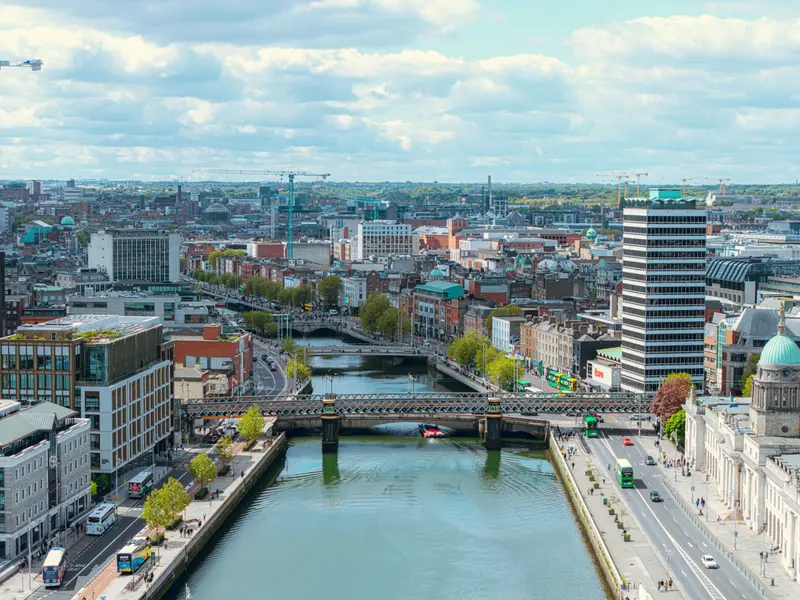
Dublin
Away from Grafton Street, specialty cafés have spread through the older neighborhoods on both sides of the Liffey. Proper Order, opened in January 2016 by former Irish coffee champions, works as a takeaway on Haymarket by Smithfield Square. Two Boys Brew opened on the North Circular Road in Phibsborough in 2016, started by a couple back from nearly five years in Australia, and pours espresso roasted in Belfast.7
Stoneybatter has the Little Cactus on Prussia Street, a café full of plants since 2021, and the Liberties have the Fumbally on Fumbally Lane.7 On Middle Abbey Street, near the GPO, Vice Coffee took over the Twisted Pepper's ground floor and serves Irish coffee all year.7
Sources
- Ah, Go On: Ireland's Top 5 Tea Brands (Sarah O'Sullivan, 4 April 2024), Checkout.ie, accessed October 2026
- The Trade Token of Lionell Newman (Dublin, 1664) (24 October 2023), The Old Currency Exchange, accessed October 2026
- Flat whites reign supreme in Irish coffee culture, new research shows (15 May 2024), Square Ireland, accessed October 2026
- Bewley's, Wikipedia, accessed October 2026
- Bewley's Café Grafton Street, Dublin Guide, accessed October 2026
- The history of Irish coffee (Gráinne Ní Aodha, 22 July 2017), TheJournal.ie, accessed October 2026
- The Sprudge Guide To Coffee In Dublin For 2023 (Susie Kealy, 20 June 2023), Sprudge, accessed October 2026
- Dublin: An Interview With Colin Harmon, Soon To Be Roasting At 3FE (Elyse Bouvier, 24 July 2013), Sprudge, accessed October 2026
- The New Irish Coffee: Where to Café-Hop in Dublin (Adam Erace, 14 November 2019), Yahoo News, accessed October 2026
Cafés in Ireland: questions
Where was Irish coffee invented?
Irish coffee was first served at Foynes, County Limerick, in the winter of 1943, when chef Joe Sheridan gave coffee with Irish whiskey to passengers of a New York flight that had turned back in bad weather. The drink moved to Shannon after 1945 and reached San Francisco's Buena Vista café in 1952.
What coffee do people order most in Ireland?
The flat white is the most ordered coffee in Irish cafés. Square's sales data for 2022 and 2023 gave it 25.4% of coffee sales, ahead of the americano and the cappuccino. As of 2023 a flat white cost €3.60 on average, a cappuccino or latte €3.70 and an americano €3.30.
When did Bewley's café on Grafton Street in Dublin open?
Ernest Bewley opened the Grafton Street café in Dublin in 1927, after earlier Bewley's cafés on South Great George's Street in 1894 and Westmoreland Street in 1896. The building once housed Whyte's Academy. Its six Harry Clarke stained-glass windows date from just before 1931, and coffee is roasted on the fourth floor.
Your café deserves better than a pin someone else dropped
Free listings are free for good. A featured page gives you photos, a menu and your own URL, in your café's own design, for less than a coffee a day.