
Cafés in Slovenia Ljubljana
Ljubljana's first café of 1713, Kavarna Union, džezva coffee at home, espresso at the bar, and Cankar's guilty cup of coffee.
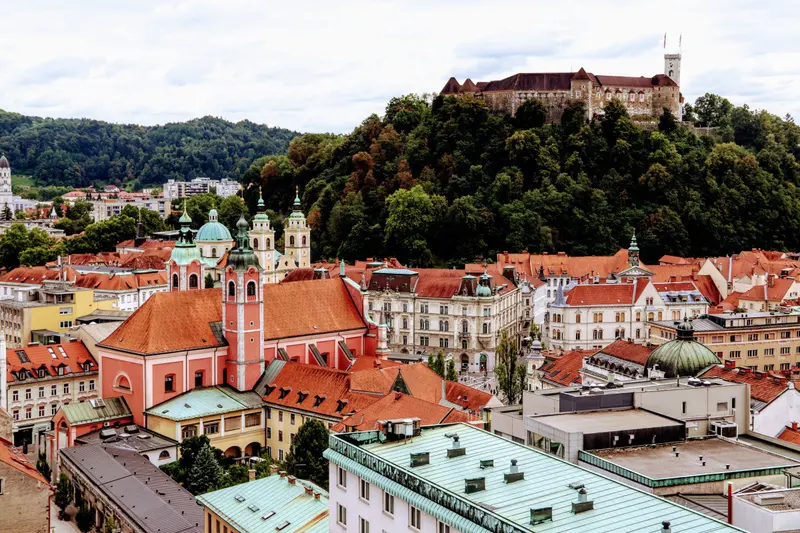
Photo: Fábio Rocha, Pexels License
Slovenia imported 21,421 tonnes of coffee in 2024, worth €103 million; by value, Brazil supplied 29% and Italy 25%.1 At home, each resident goes through about three kilograms a year, by the national statistics office's figures reported in 2024.3 In cafés, an espresso cost €1.63 on average in 2023 and €1.74 in 2024, and the price rose another 6.9% in 2025.312
Shop prices have climbed faster. A kilogram of classic ground coffee averaged €12.19 in 2024 and €16.20 in 2025, a rise of 32.9%.12 In 2025 the average monthly net wage bought 99 kg of it, against 139 kg at the 2021 peak and 36 kg in 1991.23
Slovenia's café cities
From Trieste to the first kavarna
Coffee reached the Slovene lands in the 17th century and stayed a drink of the rich until the 19th, when well-off country people, and women, took it up. Most of it came in through Trieste.4 Ljubljana's first café opened in 1713.4 The kavarne (cafés) that followed took the Viennese coffeehouse as their model.5
Kavarna Union opened in 1905, the same year as the Grand Hotel Union at Miklošičeva cesta 1, and Slovene painters and writers met there.6 It has kept the manner of a bourgeois café for more than 115 years, with Art Nouveau interiors.5
Džezva at home, espresso at the bar
Slovenes split their coffee by place. At breakfast it is usually Turkish-style coffee, boiled in a džezva (a small brass pot), and out at a bar it is espresso, a habit taken from Italy.85 In 2019, ground coffee for Turkish-style brewing made up 86% of the roughly 8,800 tonnes sold in Slovenia each year, and the Barcaffè brand held about three-quarters of that.8
Barcaffè has been made since 1970, first in Yugoslavia and then in Slovenia, starting with 100-gram bags.9 A bag of it is a standard gift when you visit friends.8 Many cups take milk or cream, and the Viennese Eiskaffee (iced coffee) has home-made versions.5
Gremo na kavo
Going na kavo (for coffee) is how Slovenes arrange a chat, a business meeting or a date, and a long, unhurried session has its own word, kofetkanje.4 Ljubljana's tourist board calls coffee a social ritual rather than a drink: people pick a café for where it is, not for its beans, and may sit for hours.7
"Gremo na kavo!" (let's go for coffee) belongs to the morning and afternoon. After about 19:00, the invitation turns into "Gremo na pivo!" (let's go for a beer).7
A cup of coffee in Slovene art and letters
The best-known cup of coffee in Slovenia is a guilty one. Ivan Cankar, born in 1876 and counted as the most important writer in the Slovene language, wrote a short story called Skodelica kave (A Cup of Coffee).1211 In it, the writer asks his mother for black coffee she can barely afford, and when she brings it, he sends her away rudely.11 Vrhnika, Cankar's hometown, holds a coffee festival, and its local roaster sells a blend named after the story.1112
Ivana Kobilca painted Kofetarica (The Coffee Drinker) in Munich in 1888, at 26.410 Rado Hribar, owner of Strmol Castle, bought the painting, and it stayed at the castle until 1970, when it went to the National Gallery in Ljubljana.11 It is now one of the gallery's biggest draws, and the gallery shop sells cups printed with it.1011
Ljubljana's coffee
Ljubljana's specialty coffee traces back to Café Stow in the Museum of Ljubljana, which ran the first coffee events and festivals and trained the city's first baristas; it roasts in Kamnik.7 Tine Čokl, whose tiny bar stands near Ljubljana Castle, was another of the first specialty-coffee names in the city.8
Slovenia grows no coffee, but small roasters work from Ljubljana to the Julian Alps near Bled, and several Ljubljana cafés roast and sell their own beans.117 Terraces fill in spring and summer, and in winter some cafés set heaters outside.7
Sources
- Mednarodni dan kave: kilogram je v trgovini lani stal 12 evrov, letos je za 28 odstotkov dražji (1 October 2025), MMC RTV Slovenija, accessed October 2026
- Kava cena stroški (STA, 1 October 2026), Svet24, accessed October 2026
- S povprečno mesečno plačo lahko kupimo 13 kg kave manj kot pred tremi leti (Karmelina Husejnović, 1 October 2024), 24ur.com, accessed October 2026
- KulKul trenutek: slovita Kofetarica in ljubljanska kava (June 2021), Turizem Ljubljana (Visit Ljubljana), accessed October 2026
- MMM zgodbe o kavi in življenju, Turizem Ljubljana (Visit Ljubljana), accessed October 2026
- Kavarna Union, Turizem Ljubljana (Visit Ljubljana), accessed October 2026
- Kam na kavo v Ljubljani, Turizem Ljubljana (Visit Ljubljana), accessed October 2026
- Heavy on Coffee Consumption, Slovenia Takes to Specialty (Noah Charney, 5 November 2019), Sprudge, accessed October 2026
- Barcaffe, Wikipedia, accessed October 2026
- Slovenski muzeji in galerije v letu 2025 pritegnili skoraj tri milijone obiskovalcev (5 August 2026), MMC RTV Slovenija, accessed October 2026
- Brighten your day with coffee experiences in Slovenia, Slovenian Tourist Board (slovenia.info), accessed October 2026
- Slovenia celebrating 150th anniversary of birth of Ivan Cankar (10 May 2026), Radio Slovenia International, RTV Slovenija, accessed October 2026
Cafés in Slovenia: questions
How much does an espresso cost in Slovenia?
An espresso in a Slovenian café cost €1.74 on average in 2024, up from €1.63 in 2023, according to the national statistics office, and café espresso prices rose another 6.9% in 2025. Shop coffee rose faster: a kilogram of classic ground coffee averaged €12.19 in 2024 and €16.20 in 2025.
How do people in Slovenia drink coffee at home?
At home, most Slovenes drink Turkish-style coffee boiled in a džezva, a small brass pot, and order espresso when they go out, a habit taken from Italy. In 2019, ground coffee for Turkish-style brewing made up 86% of the coffee sold in Slovenia. Barcaffè, made since 1970, held about three-quarters of that market.
When did the first café open in Ljubljana, Slovenia?
Ljubljana's first café opened in 1713. Coffee had reached the Slovene lands in the 17th century, mostly through Trieste, and stayed a drink of the rich until the 19th century. Later cafés followed the Viennese model. Kavarna Union, at Miklošičeva cesta 1, has served coffee since 1905.
Your café deserves better than a pin someone else dropped
Free listings are free for good. A featured page gives you photos, a menu and your own URL, in your café's own design, for less than a coffee a day.