
Cafés in the United Arab Emirates Dubai
Gahwa from the dallah, the majlis, Jebel Ali's coffee warehouses and Dubai's cafés, from Karama cafeterias to Al Quoz.
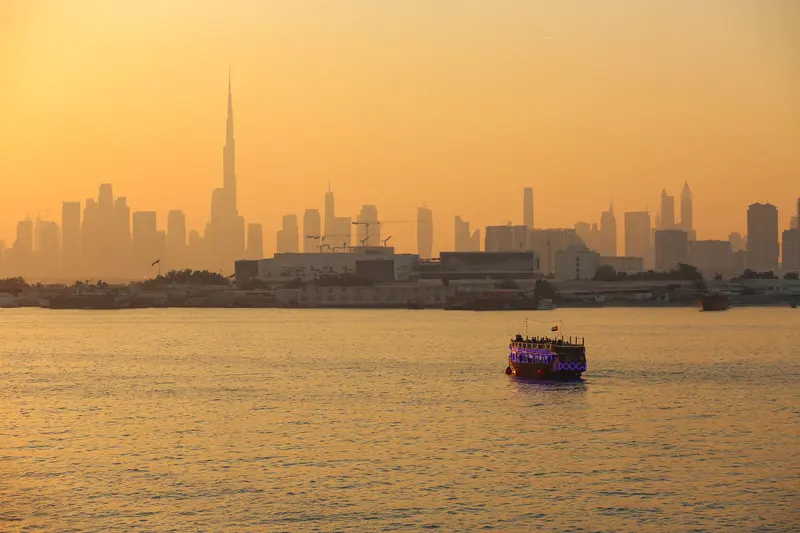
Photo: Massimo, Pexels License
Coffee imports into the United Arab Emirates have been climbing fast. Jamie Brown of Coffee Planet told the Sintercafé conference in 2023 that 50 million kg of green beans entered the country in 2022, after average growth of 33% a year from 2018, including a doubling between 2021 and 2022.1 He put consumption at 3.5 kg per person, and said only 7% of it happens at home.1
Much of the trade passes straight through. UAE coffee re-exports passed Dh3.5 billion in 2024, Gulf News reported, in a coffee market it valued at more than Dh12 billion.2 In March 2022 Dubai's Department of Economy and Tourism counted 615 companies trading coffee in the emirate, after new licences rose from 69 in 2020 to 171 in 2021.3
The oldest coffee here is gahwa (قهوة, Arabic coffee). UNESCO first inscribed Arabic coffee as intangible heritage in December 2015,4 at the same session as the majlis, the sitting room where it is served, on a file from the UAE, Saudi Arabia, Oman and Qatar.5
United Arab Emirates's café cities
Gahwa: the mihmasa, the najr and the dallah
Gulf coffee starts over a fire. The beans are roasted slowly in a mihmasa (محماسة), a metal pan with a long iron handle, turned with two iron rods, then ground in a metal vessel called a najr (نجر).4 They are mixed with spices in a large pot, the qamqum or mubhar, before the coffee goes into the dallah (دلة) for serving.4 Dallahs are named for where they were made, such as Hasawi or Omani, and cardamom, saffron and cloves are the usual spices.4
The host pours standing, dallah in the left hand and cup offered with the right, and does not sit until every guest has finished.4 A cup that tastes burned has to be replaced at once; the guest's complaint is qahwatak sayda (قهوتك صايدة), "your coffee is spoiled".4 The pot is on the money too: the 1-dirham coin has shown a dallah since 1973.6
The majlis, where gahwa is served
In the majlis, neighbors discuss local affairs, share news, receive guests, settle disputes, pay condolences and hold wedding receptions.5 UNESCO's file describes large carpeted rooms with cushions along the walls, and a hearth or stove kept going so the host can brew coffee for whoever arrives.5
The space is open to all, and women hold majlis of their own. Children learn its manners by going along with adults and watching the elders, who also pass on folk stories and Nabati poetry there.5
Jebel Ali and the green-coffee trade
The Emirates handle coffee long before it reaches a cup. The DMCC Coffee Centre operates in the Jebel Ali Free Zone under a DMCC licence, with temperature-controlled storage for 9,500 tonnes of green coffee, which DMCC calls a first for the Middle East.7 It cleans, de-stones, blends and re-bags beans, roasts from 50 g samples upward, and runs barista training and Q Grader cupping.7
Roasting and training are now part of the business, not only storage. Nandini Roy Choudhury of the consultancy Future Market Insights told the Tea & Coffee Trade Journal in December 2025 that the country "now adds value through roasting, training, and re-export, rather than just importing beans".8
From cafeteria to specialty bar
Café numbers keep rising. At the end of 2018 Dubai had 11,813 restaurants and cafés in operation, up 9.7% in a year, and 468 new cafés opened that year, against 410 in 2017.9 By late 2025 the Tea & Coffee Trade Journal put the emirate at more than 4,000 coffee shops and specialty cafés.8
Record bean prices have not emptied them. Kona Haque, head of commodities research at the trading house ED&F Man, told Gulf News in December 2025 that drinkers had "not necessarily been cutting back" but trading down.2 Across the region, the branded coffee-shop market grew 11% in a year, according to Shoug Bin Redha, director of World of Coffee Dubai.8
Dubai, on both sides of the creek
Dubai puts the whole range within a short drive: heritage cafés and cafeterias in the old districts by the creek, roasters among the Al Quoz warehouses, and terraces along the Jumeirah coast. In 2018 the Bur Dubai licensing sector, west of the creek, had 7,312 restaurants and cafés in operation, and Deira, on the north bank, had 4,457.9
Sources
- Middle East coffee consumption booms in the face of struggling global demand, StoneX Coffee Network (Alexis Rubinstein, November 9, 2023), accessed October 2026
- Why UAE's café culture keeps growing despite price pressure on coffee beans, Gulf News (Justin Varghese, December 27, 2025), accessed October 2026
- Dubai has 615 coffee trading businesses reinforcing its reputation as global hub, Dubai Media Office (March 15, 2022), accessed October 2026
- قهوة عربية, ويكيبيديا (Arabic Wikipedia), accessed October 2026
- Majlis, a cultural and social space, UNESCO Intangible Cultural Heritage (inscribed 2015), accessed October 2026
- United Arab Emirates dirham, Wikipedia, accessed October 2026
- DMCC Coffee Centre, DMCC, accessed October 2026
- The Middle East is Thirsty for More Coffee, Tea & Coffee Trade Journal (Vladislav Vorotnikov, December 12, 2025), accessed October 2026
- Dubai's restaurant numbers continue to grow, Khaleej Times (Rohma Sadaqat, February 7, 2019), accessed October 2026
Cafés in the United Arab Emirates: questions
How is Arabic coffee made in the UAE?
Gahwa, the Arabic coffee of the UAE, starts with beans roasted slowly in a mihmasa, a long-handled metal pan, then ground in a metal vessel called a najr. The grounds are mixed with spices, usually cardamom, saffron and cloves, and the coffee is served from a dallah. The host pours standing and offers the cup with the right hand.
How much coffee does the UAE import?
About 50 million kg of green coffee entered the UAE in 2022, according to Jamie Brown of Coffee Planet, after average growth of 33% a year from 2018. Only about 7% of UAE coffee is drunk at home. Much of the trade passes through: UAE coffee re-exports passed Dh3.5 billion in 2024, and Dubai had 615 coffee-trading companies in 2022.
When did UNESCO recognize Arabic coffee and the majlis of the UAE?
UNESCO first inscribed Arabic coffee on its intangible heritage list in December 2015. The majlis, the sitting room where gahwa is served, was inscribed at the same 2015 session on a joint file from the UAE, Saudi Arabia, Oman and Qatar. UNESCO's description includes a hearth kept going so hosts can brew coffee for visitors.
Your café deserves better than a pin someone else dropped
Free listings are free for good. A featured page gives you photos, a menu and your own URL, in your café's own design, for less than a coffee a day.