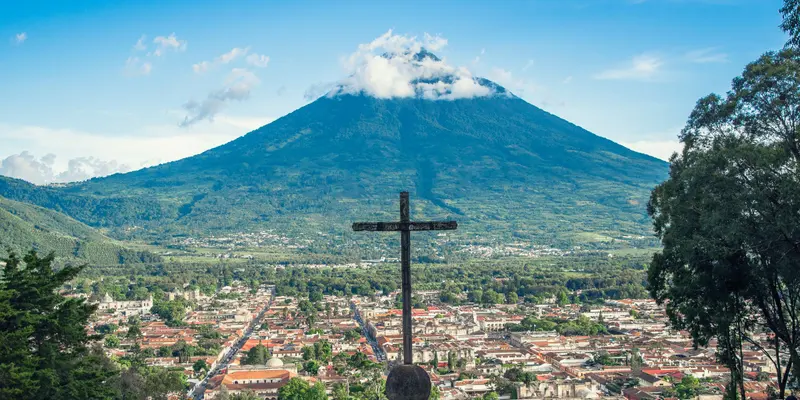
Cafés in Guatemala Antigua Guatemala
From Antigua's courtyard roasters to Huehuetenango and Cobán beans, plus café puro, pan dulce at the refacción and coffee history.
Photo: Saulo Zayas, Pexels License
Coffee is Guatemala's leading export. In the 2024–25 crop year it earned a record US$1,281 million, 42.5% more than the year before, on 3.72 million quintales (46 kg sacks), by Anacafé's count.1 About 125,000 producer families grow it, and the harvest supports more than 500,000 jobs a year.1 In the first half of 2025 coffee was the country's top export product, at US$993.94 million.2
Guatemalans long drank little of it. In 2017 Anacafé, the national coffee association, said about 10% of the crop stayed in the country, where a decade earlier almost all of it went to the United States, Europe and Japan.3 Pedro Martínez, who later opened a café in Antigua, told NPR that his family always kept a jar of instant coffee at home.3
Guatemala's café cities
From cochineal to coffee
Coffee replaced a dye. In 1850 cochineal, the red dye made from insects, made up 93% of Guatemala's exports, while coffee was still only 1% in 1860; poor cochineal harvests and the invention of aniline dyes pushed growers toward coffee.4 The Liberal Revolution of 1871 brought Justo Rufino Barrios, himself a coffee planter, to power, and by 1880 coffee made up 92% of export value.4
The boom was built on land and labor taken by law. Decree 170 of 1877 abolished censo enfiteusis, a form of perpetual lease, and led to mass dispossession of communal Indigenous land, and Decree 177 of the same year legalized debt peonage and revived mandamientos, labor drafts that obliged governors to supply workers to export farms.4 Anacafé was founded in 1960 to represent all of the country's producers.4
Anacafé's eight regions
Anacafé divides the country into eight coffee regions: Acatenango Valley, Antigua, Traditional Atitlán, Rainforest Cobán, Fraijanes Plateau, Highland Huehue, New Oriente and Volcanic San Marcos.5 Huehuetenango is one of three non-volcanic regions and the highest and driest of them, farmed up to 2,000 m; hot, dry winds from Mexico's Tehuantepec plain keep frost away, and farms are so remote that nearly every producer processes their own coffee.6
Cobán, in the north, grows at about 1,300–1,700 m in limestone and clay under 3,000–4,000 mm of rain a year, and Anacafé describes its two seasons as rainy and rainier, with a fine mist locals call chipichipi.7 In Acatenango, Fuego's constant eruptions keep the coarse, sandy soil rich in minerals, and Pacific winds let farmers sun-dry their coffee.8
San Marcos is the warmest region and the wettest, with up to 5,000 mm of rain; its rains come early, so it flowers first, and because harvest-time showers are unpredictable, much of its coffee is sun pre-dried and finished in a Guardiola, a rotating mechanical dryer.12 Around Lake Atitlán, 90% of the coffee grows on the slopes of the three volcanoes that border the lake, where a daily wind called the Xocomil stirs the cold water.13
Café, pan dulce and the refacción
Coffee and bread meet at the refacción, or refa, a snack break with a morning and an afternoon version. In Antigua, warm bread is delivered on rainy afternoons for it, and a cubilete or a champurrada, both pan dulce (sweet bread), goes into the cup for dunking.9
Cafés serving the country's own top coffee came late. The Aguirre family has owned the El Injerto farm in Huehuetenango since 1874 and opened its first El Injerto coffee shop in 2009.3 Rojo Cerezo, opened in 2013, was one of the first independent cafés in Guatemala City, and by 2017 the Cuatro Grados Norte neighborhood had more than a dozen independents, the city's densest cluster.3
Antigua Guatemala
Antigua, the colonial capital in the department of Sacatepéquez, had 60,608 inhabitants in 2023 and is one of Anacafé's eight regions in its own right.10 Its farms get only 810–1,220 mm of rain a year at about 65% humidity, and the shade over the coffee is especially dense, which helps protect it from occasional frost.11 Pedro Martínez opened Café Sol there in December 2016, after five years as a barista at the chain &Café, asking why Guatemalans didn't drink their own great coffee themselves.3
Sources
- Cosecha cafetalera 2024-2025 deja divisas históricas para Guatemala, Prensa Libre (October 7, 2025, citing Anacafé), accessed October 2026
- Exportaciones de café de Guatemala superan cifras de últimos 10 años, Prensa Latina (September 1, 2025), accessed October 2026
- Their Coffee Is World-Renowned. Now More Guatemalans Are Actually Drinking It, NPR, The Salt (October 10, 2017), accessed October 2026
- Coffee production in Guatemala, Wikipedia, accessed October 2026
- Regions and profiles, Anacafé, Guatemalan National Coffee Association, accessed October 2026
- Highland Huehue, Anacafé, Guatemalan National Coffee Association, accessed October 2026
- Rainforest Cobán, Anacafé, Guatemalan National Coffee Association, accessed October 2026
- Acatenango Valley, Anacafé, Guatemalan National Coffee Association, accessed October 2026
- Buying the Afternoon Delivery Guatemalan Bread, Antigua Daily Photo (Rudy Giron, July 3, 2008), accessed October 2026
- Antigua Guatemala, Wikipedia, accessed October 2026
- Antigua Coffee, Anacafé, Guatemalan National Coffee Association, accessed October 2026
- Volcanic San Marcos, Anacafé, Guatemalan National Coffee Association, accessed October 2026
- Traditional Atitlán, Anacafé, Guatemalan National Coffee Association, accessed October 2026
Cafés in Guatemala: questions
How important is coffee to Guatemala's economy?
Coffee is Guatemala's leading export. In the 2024–25 crop year it earned a record US$1,281 million on 3.72 million quintales, and in the first half of 2025 it was the country's top export product. About 125,000 families grow coffee in Guatemala, and the harvest supports more than 500,000 jobs a year.
What are Guatemala's eight coffee regions?
Anacafé names eight coffee regions in Guatemala: Acatenango Valley, Antigua, Traditional Atitlán, Rainforest Cobán, Fraijanes Plateau, Highland Huehue, New Oriente and Volcanic San Marcos. Huehuetenango is the highest and driest of the three non-volcanic regions, Cobán is cool and very wet, and Antigua's coffee grows under especially dense shade.
What is a refacción in Guatemala?
A refacción, or refa, is Guatemala's snack break, with a morning and an afternoon version. In Antigua, warm bread is delivered on rainy afternoons for the afternoon refa, and a cubilete or a champurrada, two kinds of sweet bread, is dunked in a cup of coffee.
Your café deserves better than a pin someone else dropped
Free listings are free for good. A featured page gives you photos, a menu and your own URL, in your café's own design, for less than a coffee a day.