
Cafés in Bolivia La Paz
Coffee from Caranavi and the Yungas, sultana brewed from dried coffee husks, and La Paz, where water boils at about 87°C.
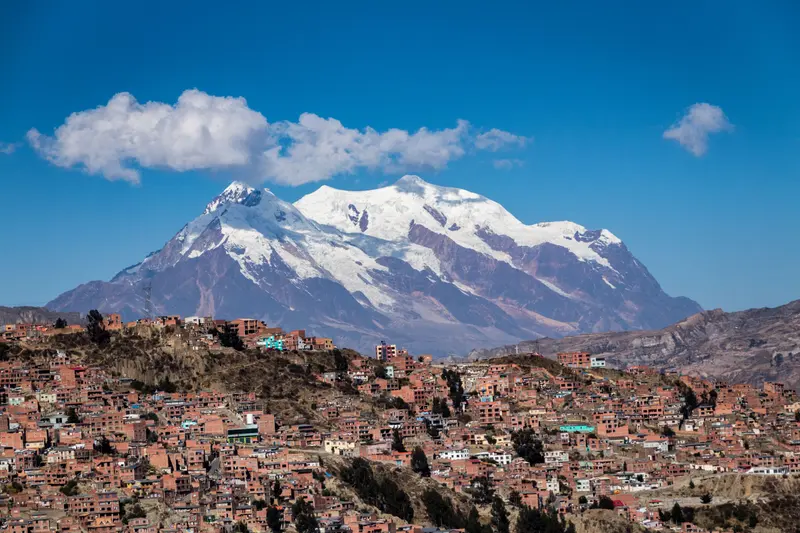
Photo: Loïc Alejandro, Pexels License
Bolivia grows a small crop, and nearly all of it in one department. About 96% comes from La Paz, from Caranavi and the Nor and Sud Yungas provinces, with Santa Cruz at 3% and Cochabamba at 1%.1 Caranavi has been the capital cafetalera de Bolivia (the country's coffee capital) by law since July 2006.2
Coffee exports reached a record of more than US$17 million in 2025, up 13% on 2024, although volume fell 12%. The United States took 31%, Belgium 17% and France 13%.3 One importer puts the annual total at about 30,000 bags of 60 kg, grown by about 12,000 families on farms of 1 to 8 hectares.4 Much of what Bolivians drink comes from abroad: in 2018 the country imported 3.2 million kilos of instant coffee for US$15.5 million, most of it from Brazil.5
Bolivia's café cities
From hacienda crop to smallholder coffee
Bolivia's first coffee grew on haciendas in the Yungas valleys, and it was drunk by the landowners.46 Production was tiny, and the yanaconas, the servants and farmhands bound to the estate, had no access to it.6 By 1900 La Paz had a machine to roast and grind coffee, which was sold in home-made tins.12
Growing expanded after 1950, when a crisis in the coca market and the agrarian reform ended the landlord system and Yungas peasants gained land of their own.6 The 1953 reform redistributed parcels of 1.5 to 8 hectares, largely to Indigenous families.7 In the 1970s, as world consumption rose, planting spread through Caranavi and La Asunta.4
Coffee still competes with coca, which is harvested year-round.7 In 2013 the federation of export coffee growers, Fecafeb, said exports had fallen to about 70,000 bags a year from 110,000 in 2005 as farmers switched crops.8 In 2022 a quintal of coffee sold for Bs 800 and a quintal of coca for Bs 1,500.1
Sultana, the husk tea of the Yungas
Denied the coffee, the yanaconas are thought to have used what was left of it: the dried husk of the cherry. Brewed as an infusion, it is called sultana and was long known as el té del pobre (the poor man's tea), a drink for Yungas peasants while coffee went to the elite.6
Families moving from the Yungas brought sultana to La Paz, where it is better known than in any other Bolivian city. As coffee culture grew in La Paz, sultana gained ground, and baristas and cooks now use it in their own recipes.6 Slow Food Bolivia, which published a guide to producing it in 2019, notes that output is still small because the husk sells cheaply.6
High-grown lots and the cup at home
Bolivia's quality push came in the 2000s. The Cup of Excellence competition arrived in 2004 and was replaced by the President's Cup in 2010.7 Caranavi grows coffee at 1,400–1,800 m and Sud Yungas at 1,600–2,100 m, and the harvest runs from June to October. Typica and Caturra dominated for decades; many farmers have since switched to the more productive Catuaí, and some plant Gesha.7
In 2019 about 80% of the crop was exported, and Los Tiempos reported that a traditional cup could cost as little as Bs 3 while a gourmet coffee could pass Bs 50.5
La Paz: coffee at 3,600 meters
La Paz is Bolivia's seat of government, while Sucre is the constitutional capital. Alonso de Mendoza founded it on 20 October 1548, and the city fills a canyon at about 3,650 m, with El Alto above it on the Altiplano.9 At this height water boils at about 87°C, which changes how coffee and tea are made.10
Plaza Murillo, the main square, holds the Palacio Quemado, the Congress and the Metropolitan Cathedral.9 Sopocachi, about 10 minutes from the center, is one of the oldest residential neighborhoods, and its businesses cluster around Plaza Abaroa. Zona Sur, with Calacoto and Obrajes, is the city's second commercial center.9 The beans come up from Caranavi, at 976 m on National Route 3 north of Coroico.11
Sources
- ¿Chuquisaca puede ser un departamento productor de café?, Correo del Sur (June 16, 2022), accessed October 2026
- Ley Nº 3452, 21 de julio de 2006, Lexivox (Gaceta Oficial de Bolivia), accessed October 2026
- Bolivia: Exportación de Café, período 2016-2025 (Cifras Nº 1.428), Instituto Boliviano de Comercio Exterior (IBCE), June 25, 2026, accessed October 2026
- Origins: Bolivia, Cafe Imports, accessed October 2026
- Bolivia produce café de alta calidad, pero no se queda en el país para degustarlo, eju.tv / Los Tiempos (Omar Pereyra, February 26, 2019), accessed October 2026
- La Sultana: Buenas Prácticas y Otras Curiosidades, Slow Food Bolivia / SNIS (July 2019), via ZHAW Digital Collection, accessed October 2026
- Bolivia (origin), Melbourne Coffee Merchants, accessed October 2026
- Bolivia Coffee Production Declines, Coca Cultivation Goes Up, InSight Crime (Marguerite Cawley, May 10, 2013), accessed October 2026
- La Paz, Wikipedia, accessed October 2026
- A capital mais alta do mundo, onde até ferver água é diferente, Olhar Digital (Ana Beatriz Paes, July 1, 2026), accessed October 2026
- Caranavi, Wikipedia, accessed October 2026
- Coffee production in Bolivia, Wikipedia, accessed October 2026
Cafés in Bolivia: questions
Where is coffee grown in Bolivia?
About 96% of Bolivia's coffee comes from the department of La Paz, from Caranavi and the Nor and Sud Yungas provinces; Santa Cruz grows 3% and Cochabamba 1%. Caranavi, declared Bolivia's coffee capital by law in 2006, grows at 1,400 to 1,800 m, and the harvest runs from June to October.
What is sultana in Bolivia?
Sultana is a Bolivian infusion of dried coffee-cherry husks from the Yungas. Hacienda workers, denied the coffee itself, are thought to have brewed it, and it was long called the poor man's tea. Migrants brought it to La Paz, where it is better known than in other Bolivian cities and baristas now use it.
How much coffee does Bolivia export?
Bolivia's coffee exports reached a record of more than US$17 million in 2025, up 13% on 2024, though volume fell 12%. The United States, Belgium and France were the main buyers. One importer puts annual exports at about 30,000 bags of 60 kg, down from about 110,000 in 2005.
Your café deserves better than a pin someone else dropped
Free listings are free for good. A featured page gives you photos, a menu and your own URL, in your café's own design, for less than a coffee a day.