
Cafés in Czechia Prague
Brno's first coffeehouse of 1702, Kafka's Café Arco, Melta and the Jihlava roastery, and the kavárny and roasters of Prague.
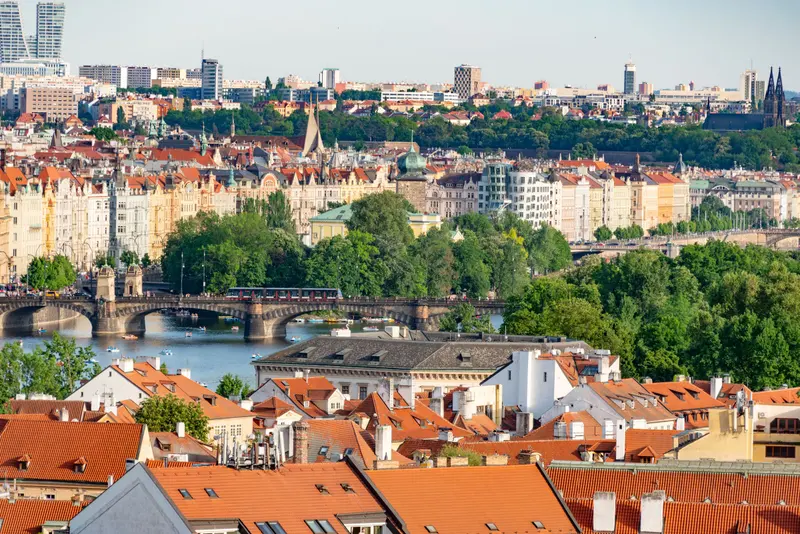
Photo: Sergey Guk, Pexels License
Czechs drink more coffee than they did a decade ago, though less than at the 2022 peak. The Czech Statistical Office put coffee consumption at 2.1 kg per person in 2024, against 1.9 kg in 2015, 2.6 kg in 2022 and 2.5 kg in 2023. Tea is a distant second, at 0.2 kg per person.1
Coffee reached Bohemia and Moravia as part of the Habsburg monarchy, and Moravia had it first. The first permanent coffeehouse in the Czech lands opened in Brno in 1702. Its owner was a Turk named Achmet, who got his license from the city council after the archbishop of Vienna spoke up for him.2 That was about twelve years before Prague, where the Armenian merchant Georgius Deodatus of Damascus is said to have opened the city's first public coffeehouse in 1714.35
Czechia's café cities
Brno, the Moravian coffee town
Brno's coffee trade grew fast after Achmet. By 1717 the town had three burgher coffeehouses, and two years later it had six.2 Around 1900 Brno had 37 cafés, of which only three were in Czech hands. Its kavárny (cafés) were at their most famous in the first half of the 20th century. After the First World War, architects including Fuchs, Kumpošt and Wiesner designed functionalist cafés that rank among the best modern buildings of the period.3
Café Era, at Zemědělská 30 in Černá Pole, is the one that survives. Josef Kranz designed it in 1927 and it was built in 1928–1929, with a restaurant on the ground floor, a café with billiards and a terrace above, and a façade that borrows from the Dutch De Stijl group.6 It was nationalized in 1959, listed as a cultural monument in 1977 and closed in 1978. After a rebuild partly paid for by EU regional funds, its café reopened in spring 2011.6
Brno's newer cafés roast their own beans. The city's tourist board lists Punkt., which pours coffee from its own roastery, and Rebelbean Pole, which roasts on site.11
Czech and German tables in Prague
Two lost Prague cafés show the city's two literatures. Kavárna Union, on the corner of Národní and Na Perštýně, was the Czech one. The writer Alois Jirásek, the painter Mikoláš Aleš and the sculptor Josef Václav Myslbek were regulars, and a younger set followed: the architects Pavel Janák and Josef Gočár, the painter Josef Lada and the writer Jaroslav Hašek.7 Karel Čapek defended the café in a 1923 editorial. It closed around 1941, and the house was demolished in 1949–1950.7
Kavárna Arco opened in autumn 1907 at the corner of Dlážděná and Hybernská, near today's Masaryk station. From 1908 it was the base of Prague's German-language writers: Franz Werfel and Max Brod were regulars, Franz Kafka came now and then, and the Viennese critic Karl Kraus nicknamed the crowd the Arconauts.8 After the Second World War it became a fourth-class pub, and by 2017 it was a self-service restaurant run for the Interior Ministry.8
Kávovina and the Jihlava roastery
When beans were scarce, Czechs drank kávovina (coffee substitute). Melta was created in the 1940s from roasted chicory root, sugar beet, barley and rye, and is still made by Kávoviny in Pardubice. It has no caffeine and is usually drunk with milk or cream.9
One of the best-selling Czech coffee brands grew out of a 1950s plant. In 1958 a packing and roasting plant opened in Jihlava, and its coffee carried only the letter B, for the Balírny obchodu works. Tchibo bought the operation in 1991 and created the Jihlavanka brand in 1993.10 Roasting in Jihlava stopped in 2005, and the headquarters moved to Prague in 2011; Jihlavanka is now roasted in Poland and other EU countries.10
Prague
Prague's coffee story begins on Liliová in the Old Town. Deodatus first sold coffee informally in front of a house there, on the site of today's house U Zlatého hada (At the Golden Snake).4 He then took rooms across the river in the House at the Three Ostriches in Malá Strana, where he reportedly opened Prague's first public coffeehouse in 1714.5
The old center still holds a café of a kind found nowhere else. The kavárna in the House of the Black Madonna is described as the only cubist café in the world.4 Outside the capital, Český Těšín on the Polish border has a restored interwar café, the Avion.4
Sources
- Spotřeba potravin: data za rok 2024 (Tab. 1, consumption of food and non-alcoholic beverages per capita; released 1 December 2025), Český statistický úřad (Czech Statistical Office), accessed October 2026
- Založení první stálé kavárny v Brně (1702), Encyklopedie dějin města Brna, accessed October 2026
- Nostalgická procházka světem brněnských kaváren (22 February 2008), Co se děje v Brně (City of Brno), accessed October 2026
- Kavárna, Wikipedia (Czech), accessed October 2026
- Dům U Tří pštrosů, Wikipedia (Czech), accessed October 2026
- Kavárna Era, Wikipedia (Czech), accessed October 2026
- Kavárna Union, Wikipedia (Czech), accessed October 2026
- Kavárna Arco, Wikipedia (Czech), accessed October 2026
- Melta, Wikipedia (Czech), accessed October 2026
- Jihlavanka, Wikipedia (Czech), accessed October 2026
- Cafés (Taste Brno), GO TO BRNO (TIC Brno), accessed October 2026
Cafés in Czechia: questions
Where did the first coffeehouse in Czechia open?
The first permanent coffeehouse in the Czech lands opened in Brno in 1702. A Turk named Achmet ran it, after the archbishop of Vienna spoke up for him to the city council. Prague followed about twelve years later: the Armenian merchant Georgius Deodatus reportedly opened the city's first public coffeehouse in 1714, in the House at the Three Ostriches in Malá Strana.
How much coffee do people in Czechia drink?
The Czech Statistical Office put coffee consumption in Czechia at 2.1 kg per person in 2024. That is less than the 2.6 kg of 2022 and the 2.5 kg of 2023, but more than the 1.9 kg of 2015. Tea is far behind, at 0.2 kg per person.
What is Melta, the Czech coffee substitute?
Melta is a kávovina, a coffee substitute, created in Czechia in the 1940s. It is made from roasted chicory root, sugar beet, barley and rye, has no caffeine, and is usually drunk with milk or cream. Kávoviny in Pardubice still produces it.
Your café deserves better than a pin someone else dropped
Free listings are free for good. A featured page gives you photos, a menu and your own URL, in your café's own design, for less than a coffee a day.