
Cafés in Switzerland Zurich
The café crème and Schale, Kafi Luz with schnapps, Nescafé and Nespresso, the coffee traders, and Zurich's Odeon and roasters.
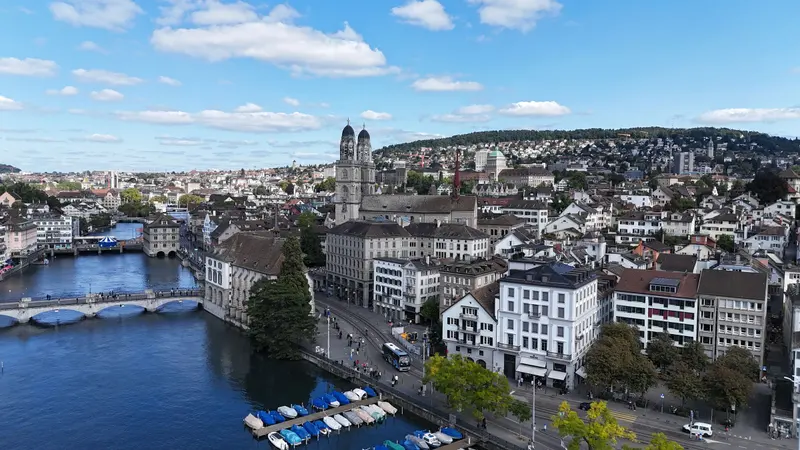
Photo: Sergey Guk, Pexels License
Switzerland grows no coffee, yet coffee is its largest agricultural export. Exports have run at about CHF 3.3 billion a year recently, just behind Brazil, and coffee makes up about a third of Swiss agricultural exports, ahead of cheese and chocolate.1 Green beans arrive through Antwerp, Rotterdam or Hamburg and travel up the Rhine to Basel. They come in at about $5 a kilo and leave Swiss plants roasted at about $26.80.1
The Swiss drink a good share themselves: 1,237 cups per person in 2025, counting cups made at home, according to the café owners' association CafetierSuisse.2 Its annual survey of 670 cafés, bakeries and restaurants in German-speaking Switzerland put the average café crème at CHF 4.65 in 2025, seven centimes more than a year earlier and 45 centimes more than ten years before. A cappuccino, surveyed for the first time, averaged CHF 5.37.2
Switzerland's café cities
A trading hub without a harvest
An estimated 60 to 70% of the world's green coffee trade passes through Swiss trading desks, and the more than 40 members of the Swiss Coffee Trade Association control over half of the green coffee traded worldwide.1 Many of the large green coffee traders have set up in Basel, the Rhine port where the beans arrive.1
The ties are older than the trading houses. Switzerland never had colonies, but Swiss families owned plantations abroad. The Escher family, whose Alfred Escher is regarded as one of the architects of modern Switzerland, owned a coffee plantation in Cuba.1
Nescafé, Nespresso and the machines
Instant coffee is a Swiss product of the 1930s. Nestlé launched Nescafé in 1938 as a powdered extract of pure coffee, developed by Max Morgenthaler after the Brazilian government asked the company to find an outlet for its coffee surplus.3 The Nespresso capsule system followed in 1986, sold first in Japan, Italy and Switzerland.3 Nespresso still makes its capsules only in three Swiss factories, and capsules explain most of the sharp rise in Swiss coffee exports since the early 2000s.1
The country also builds the equipment. About 70% of the fully automatic coffee machines sold worldwide are made in Switzerland, by firms such as Jura, Schaerer and Thermoplan, and Thermoplan supplies the machines in every Starbucks.1
Café crème, Schale and Kafi Luz
Ask for a coffee in a Swiss café and you get a café crème: an espresso drawn long, to about 120 ml instead of 25 ml, served with coffee cream of about 10% fat. The crème in the name is that cream, not the foam on top.4 In German-speaking Switzerland it is also called a Schümli. About one in three coffees served is one, and the drink is hardly known abroad.5
A Schale, often called by its French name café au lait, is milk coffee, and a café mélange comes with whipped cream, often in a separate dish. A café complet is a meal rather than a drink: milk coffee with bread, butter, jam, cheese and cold cuts, eaten for breakfast or, traditionally, for supper.4
Coffee with schnapps is the Kafi Luz, also called Luzerner Kafi or Kafi fertig: thin coffee with sugar and a schnapps such as Träsch, plum brandy or kirsch, served in a glass. Topped with whipped cream it becomes a Schümli-Pflümli.4 Träsch is a brandy of pears and some apples from Central Switzerland, where it is mostly drunk mixed with weak coffee.11
Zurich
Zurich is the most expensive city in German-speaking Switzerland for a café crème. CafetierSuisse's 2024 survey put the city average at CHF 4.86, against CHF 4.58 across the region, and some restaurants in the canton charged up to CHF 6.6
Its grand cafés are old. The Café Odeon on Limmatquai, an art nouveau coffeehouse on the Viennese model, opened on 1 July 1911; the founders of Dada were regulars, and so were Einstein, Lenin and James Joyce.7 Confiserie Sprüngli dates from 1836, when David Sprüngli bought a small bakery on the Marktgasse, and has kept its shop on Paradeplatz since 1859. Its house specialty is the Luxemburgerli, a small filled macaron.8
Specialty coffee took hold in Kreis 4 and 5, west of the Old Town. MAME, in Kreis 5 with a second branch in Seefeld, is run by Emi Fukahori, Swiss Barista Champion in 2015 and World Brewers Cup champion in 2018, and Mathieu Theis, a former Swiss Barista Champion.9 Miró, a roastery-café on Brauerstrasse run since 2018 by the brothers Daniel and David Sanchez, was named Switzerland's Roaster of the Year in 2025.10
Sources
- How Switzerland became a land of coffee (Christian Raaflaub, 16 May 2026), SWI swissinfo.ch, accessed October 2026
- Cup of coffee approaches the five-franc mark (Keystone-SDA, 24 November 2025), blue News, accessed October 2026
- Nestlé company history, Nestlé, accessed October 2026
- Liste von Kaffeespezialitäten: Schweiz, Wikipedia (German), accessed October 2026
- So trinken Schweizer ihren Kaffee (2 September 2017), SRF Schweizer Radio und Fernsehen, accessed October 2026
- Café crème: Eine Tasse Kaffee kostet immer mehr (2 December 2024), SRF Schweizer Radio und Fernsehen, accessed October 2026
- Café Bar Odeon, Zürich Tourism (zuerich.com), accessed October 2026
- Where Zurich goes for sweet treats (2011), SWI swissinfo.ch, accessed October 2026
- Zurich-based barista crowned world's best coffee brewer (21 November 2018), The Local Switzerland, accessed October 2026
- Best cafés in Zurich (updated 14 June 2026), The Way to Coffee, accessed October 2026
- Träsch, Wikipedia (German), accessed October 2026
Cafés in Switzerland: questions
What is a café crème in Switzerland?
The café crème is the standard coffee in Swiss cafés: an espresso drawn long, to about 120 ml, served with coffee cream of about 10% fat, which is what the crème refers to. In German-speaking Switzerland it is also called a Schümli, and about one in three coffees served is a café crème.
How much does a coffee cost in Switzerland?
In 2025 a café crème cost CHF 4.65 on average in cafés, bakeries and restaurants in German-speaking Switzerland, according to CafetierSuisse, and a cappuccino CHF 5.37. Zurich is the most expensive city: the 2024 survey put its average café crème at CHF 4.86, with some restaurants in the canton charging up to CHF 6.
Why is Switzerland important to the world coffee trade?
Switzerland grows no coffee, but an estimated 60 to 70% of the world's green coffee trade passes through Swiss trading desks. Coffee exports run at about CHF 3.3 billion a year, about a third of Swiss agricultural exports, driven largely by Nespresso capsules made in three Swiss factories.
Your café deserves better than a pin someone else dropped
Free listings are free for good. A featured page gives you photos, a menu and your own URL, in your café's own design, for less than a coffee a day.