
Cafés in Rwanda Kigali
Bourbon arabica from 400,000 smallholder families, washing stations and Lake Kivu lots, and Kigali's cafés in Kiyovu and Kimihurura.
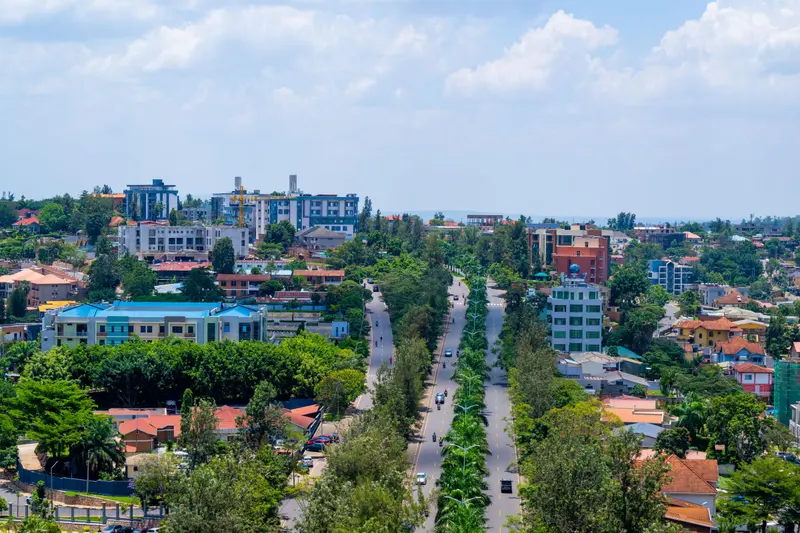
Photo: Rwanda Lens, Pexels License
Rwanda grows Bourbon-type arabica on about 42,000 hectares, and about 400,000 smallholder families depend on it.1 The country has no large estates.5 In 2025 it exported 23,860 tonnes of green coffee for more than US$148.6 million, a record for revenue, up from 17,142 tonnes and US$89.8 million in 2024; the average export price reached US$6.2 a kilo.2
Farmers were paid an average of Rwf 900 a kilo for cherry in 2025, above the Rwf 600 minimum set by the National Agricultural Export Development Board (NAEB), which aims for 32,000 tonnes of exports by 2029.2 Rwandans drink a small share of the crop: about 5% in 2024/25, over 1,000 of roughly 21,000 tonnes, up from 2% in 2023. NAEB's goal is 15%.3
Rwanda's café cities
From Mibirizi to compulsory planting
German missionaries planted Rwanda's first coffee in 1904 at Mibirizi, in what is now Rusizi District in the Western Province.4 Under Belgian rule, high-yield, low-cost varieties were introduced in the 1930s and growing them was made compulsory, while the colonial government controlled exports and taxed growers heavily.6
By 1970 coffee was the largest export, bringing in 70% of export revenue, and uprooting coffee trees became illegal in 1973.5 Farmers processed their cherry at home into low-grade semi-washed coffee.5 Almost all of it left the country: the economist Teddy Kaberuka told Al Jazeera that farmers "were never taught to drink coffee" because the whole crop went to the international market.8
After 1994: washing stations and Cup of Excellence
The 1994 genocide, in which nearly a million people were killed, brought coffee exports close to collapse.65 The recovery ran through central washing stations, the first of which opened in 2001.5 Between 2001 and 2006 USAID put US$10 million into washing stations and farmer training, alongside the PEARL partnership.11 Rwanda now has more than 300 stations.3
In 2008 Rwanda became the first African country to host a Cup of Excellence competition.7 When the contest returned in 2018 after a two-year break, 344 washing stations entered coffees; the winner, from Twumba Coffee in Karongi, scored 90.53.7
Where Rwandan coffee grows, and the potato defect
The coffee map is often split into five regions: Lake Kivu, Virunga, Muhazi, Akagera and Kizi Rift.4 Smallholders typically farm less than a quarter of a hectare, and Bourbon types make up about 95% of the trees, alongside French Mission Bourbon, Caturra, Catuai and Mibirizi.5 The Western Province, on the shores of Lake Kivu, starts picking in late February, and the Northern Province can run into August.1
The region's known flaw is the potato defect, caused by bacteria in the cherry. It is virtually undetectable in green coffee and mostly confined to single beans, but after roasting an affected bean smells and tastes of raw potato; it turns up in Rwanda, Burundi and, less often, DR Congo.6 Rwanda is landlocked, so its exports travel about 1,500 km overland to a port in Kenya or Tanzania.5
Kigali, where Rwanda learned to drink its coffee
Coffee long counted as a luxury and tea as a utility. In 2018 a cup cost from Rwf 1,500 at a Kigali coffee house, against Rwf 100 for tea at a common stall, and in 2016 the country had only 15 roasting companies.8
Bourbon Coffee opened its first café in 2007 at the Union Trade Centre in Kiyovu, later adding branches at the MTN Centre in Nyarutarama and at the airport.9 Question Coffee, a social enterprise set up by Sustainable Harvest, roasts on site at its cafés in Gishushu and Kiyovu and reinvests in training women farmers.10 Kivu Noir, in Kimihurura, belongs to Caferwa, founded in 1995 to support genocide survivors and now running five farms.10 In 2025 NAEB's chief executive put a café cup at about Rwf 2,000.3
Rubia Coffee Roasters, founded by Mathias Kalisa, works from a leafy courtyard on KG 2 Ave with the stated aim of promoting a coffee culture at origin, and Golden Coffee Roastery, a brand from Addis Ababa, opened its first Rwandan café on KG 9 Ave.10
Sources
- About Rwanda coffee, National Agricultural Export Development Board (NAEB), accessed October 2026
- Rwanda's coffee export revenues hit record $150m in 2025, The New Times (Emmanuel Ntirenganya, January 7, 2026), accessed October 2026
- Rwanda: Why Rising Domestic Coffee Consumption Matters, The New Times via allAfrica (Emmanuel Ntirenganya, November 11, 2025), accessed October 2026
- Coffee plantation, Rwanda Museums on Google Arts & Culture, accessed October 2026
- Rwanda origin, Sucafina, accessed October 2026
- Origins: Rwanda, Cafe Imports, accessed October 2026
- After Hiatus, Rwanda Cup of Excellence Returns with 340+ Coffee Submissions, Daily Coffee News (Nick Brown, August 21, 2018), accessed October 2026
- Rwanda's reluctant love affair with coffee, Al Jazeera (Azad Essa, September 11, 2018), accessed October 2026
- Bourbon Coffee, Wikipedia, accessed October 2026
- The Sprudge Guide to Coffee in Kigali, Rwanda, Sprudge (Tidenek Haileselassie, February 17, 2026), accessed October 2026
- Coffee production in Rwanda, Wikipedia, accessed October 2026
Cafés in Rwanda: questions
When did coffee arrive in Rwanda?
German missionaries planted the first coffee in Rwanda in 1904 at Mibirizi, in what is now Rusizi District. Under Belgian rule in the 1930s, high-yield varieties were introduced and growing them was made compulsory. By 1970 coffee earned 70% of Rwanda's export revenue, and uprooting coffee trees was made illegal in 1973.
How much coffee does Rwanda export?
Rwanda exported 23,860 tonnes of green coffee in 2025 for more than US$148.6 million, a revenue record, up from 17,142 tonnes in 2024. The average export price was US$6.2 a kilo. The crop comes from about 400,000 smallholder families, and NAEB aims for 32,000 tonnes of exports by 2029.
How much of Rwanda's coffee is drunk in Rwanda?
About 5% of Rwanda's coffee was drunk at home in 2024/25, a little over 1,000 of roughly 21,000 tonnes, up from 2% in 2023. NAEB wants local consumption to reach 15%. Kigali's café habit is recent: Bourbon Coffee opened its first café there in 2007, and in 2025 NAEB's chief executive put a café cup at about Rwf 2,000.
Your café deserves better than a pin someone else dropped
Free listings are free for good. A featured page gives you photos, a menu and your own URL, in your café's own design, for less than a coffee a day.