
Cafés in Morocco Marrakech
Café noir and nouss-nouss in a mint-tea country, terrace kahwas, French pastries and Marrakech, from Jemaa el-Fna to Guéliz.
Morocco buys its coffee abroad. In 2024 it imported 51,191 tonnes for 2.26 billion dirhams, according to the Office des changes, against 44,580 tonnes and 1.41 billion dirhams in 2023: volume rose 16% and value 38% as world prices climbed.1 Robusta makes up about 85% of imports and arabica 15%, and roasters often blend the two to keep costs down.1 Green coffee comes from Brazil, Colombia, Ethiopia, Vietnam and Côte d'Ivoire, roasted coffee mostly from Spain, Italy, France and the Netherlands.2
Moroccans drink 800 to 900 grams of coffee per person a year, says Mohamed Astaib, president of the Moroccan association of tea and coffee industries (AMITC), against 1.5 kg in Tunisia and 3 kg in Algeria.1 Green tea is the bigger habit, at about 1.9 kg per person and close to 70,000 tonnes a year, and coffee remains a city drink that appears only now and then on rural tables, where tea rules.2
Morocco's café cities
Atay first: how tea took the Moroccan table
Historians place tea's first appearance in Morocco in the 18th century, under Sultan Moulay Ismail.5 It spread in the 1850s, when the Crimean War blocked the Baltic ports and British merchants sold their surplus Chinese green tea, gunpowder above all, in Tangier and Essaouira; by the late 19th century imports had multiplied several times over.5
Mint tea, atay b naa naa in Darija, the Moroccan Arabic dialect, remains the most culturally important drink.3 It is poured at any hour, in the countryside and in town, and China counts Morocco as its biggest tea customer, taking 25% of the tonnage it exports.2
Café noir or nouss-nouss: ordering in a kahwa
Kahwa (قهوة) is the Darija word for coffee, and ordering one comes down to two questions: milk or no milk, sugar or no sugar.3 A café noir, also called a normale, is a short, strong black coffee in a small glass with sugar on the side.3 Nouss-nouss means half-half: half espresso, half steamed milk, closer to a cappuccino.3 The glass is half filled with hot milk frothed until it rises over the rim, then the espresso drips in or is poured slowly on top, with sugar cubes alongside.4
Iced coffee is spreading among young people at upscale cafés, usually sweet and milky. At home or on the go, many Moroccans drink Nescafé with sugar and fresh or powdered milk.3
The terrace, the pastry case and who sits where
A café visit means taking a table for a while, not standing at a bar or walking off with a cup.4 Coffee is rarely a breakfast drink, though men often order espresso from mid-morning.4 The outdoor tables are still filled mostly with men, but women are increasingly seen there reading, smoking and talking, a change led by younger generations.34 Women's coffee has a home setting too: friends gather around 17:00 to 19:00 for coffee time.4
About four decades of French rule left the pastry case. Cafés serve croissants, mille-feuille, Paris-Brest and madeleines, and the café complet is a set breakfast of fresh orange juice, a hot drink, a savory and a sweet pastry, and a baguette with butter and jam.10
What beans cost Moroccan cafés
The average import price rose from 31.68 to 43.78 dirhams a kilo between 2023 and 2024, and Khalid Mouratib of the café and restaurant owners' federation in Casablanca-Settat said the price cafés pay rose by 30 to 40 dirhams a kilo.1 On 1 April 2025 distributors added a further 25% across their ranges: coffee sold at 120 dirhams a kilo went to 150, and 200-dirham coffee to 250.6
By June 2025 the cheapest beans on the market cost up to 150 dirhams a kilo, and café owners feared another rise in bean prices.7 Some working-class cafés chose to cut their margins rather than raise the price of a cup.1
Marrakech: Jemaa el-Fna and Guéliz
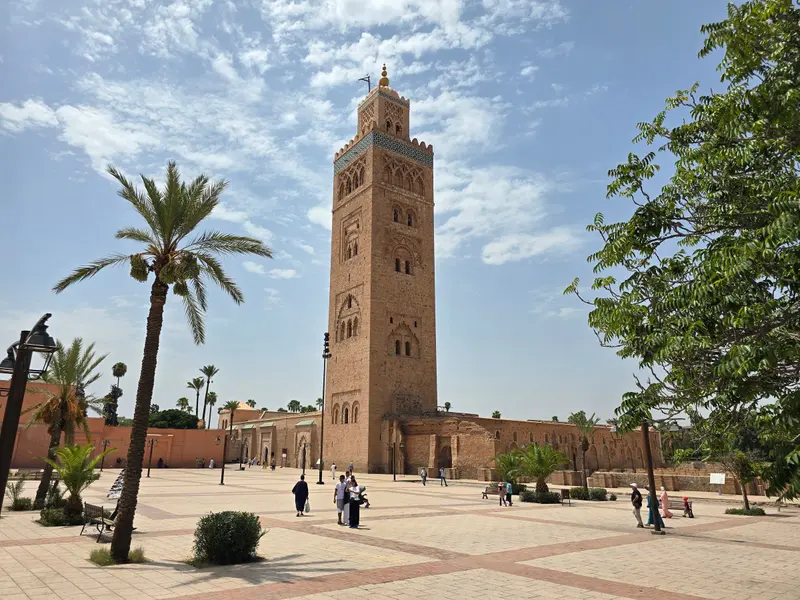
Café de France opened on Jemaa el-Fna in 1915, three years after the French protectorate began, and was frequented mainly by French settlers while most Moroccans stayed away.8 Winston Churchill painted the Koutoubia mosque from its roof terrace, and Elias Canetti, George Orwell and Alfred Hitchcock sat there.8 Bacha Coffee traces its origins to 1910 at Dar el Bacha; the original coffee room reopened under that name in 2019, two years after the building became a museum.9
Guéliz, the new town northwest of the medina, was designed in 1913 by Albert Landais and Henri Prost, with buildings capped at three floors and ocher facades required; its Art Deco buildings include the Café des Négociants.11 At Le Grand Café de la Poste, a 1920s café in the former main post office, a nouss-nouss cost 30 dirhams and a cappuccino 40 as of April 2026.10
Sources
- Café : les importations augmentent, les prix flambent, Le360 (Lamia Elouali, January 20, 2025), accessed October 2026
- Boissons chaudes : le thé vert continue de l'emporter largement sur le café, Le360 (Lahcen Oudoud, February 22, 2025), accessed October 2026
- From 'Normale' to 'Nouss-Nouss': How to Order Coffee in a Moroccan 'Kahwa', Morocco World News Lifestyle (Emma de Jong, July 2, 2025), accessed October 2026
- Moroccan coffee: nous nous and café noir, MarocMama (Amanda Mouttaki), accessed October 2026
- Tea's arrival and symbolic status in Morocco, Morocco World News Lifestyle (Ihab Ou-ouda, December 9, 2025), accessed October 2026
- Hausse soudaine du prix du café, la Fédération crie à l'entente illicite, Hespress Français (Khadija Khettou, April 10, 2025), accessed October 2026
- أرباب المقاهي والمطاعم يتوجسون من زيادة جديدة في أسعار البن, هسبريس (Hespress, Hamza Fawzi, June 19, 2025), accessed October 2026
- "كافيه دو فرانس".. تشرشل وهتشكوك وأورويل مرّوا من هنا, الشرق للأخبار (Asharq News, Ali Abbas, May 22, 2024), accessed October 2026
- Bacha Coffee, Wikipedia, accessed October 2026
- Forget tagines and couscous. Morocco's cafe culture is its best-kept culinary secret, Hyphen (Zaynab Asaadi, April 28, 2026), accessed October 2026
- Guéliz ou Nouvelle Ville, le quartier occidental de Marrakech, Vanupied, accessed October 2026
Cafés in Morocco: questions
What is a nouss-nouss coffee in Morocco?
Nouss-nouss means half-half in Darija, Moroccan Arabic: half espresso and half steamed milk, served in a glass, closer to a cappuccino. The milk is frothed until it rises over the rim and the espresso goes in on top, with sugar cubes on the side. In Marrakech's Guéliz it cost 30 dirhams at Le Grand Café de la Poste as of April 2026.
Do Moroccans drink more tea or coffee?
Tea, by a wide margin. Moroccans drink about 1.9 kg of green tea per person a year, close to 70,000 tonnes, against 800 to 900 grams of coffee. Coffee is mainly a city drink. Morocco imported 51,191 tonnes of coffee in 2024, about 85% of it robusta, and mint tea remains the drink that carries the culture.
Which historic cafés are in Marrakech, Morocco?
Café de France has stood on Jemaa el-Fna since 1915; Winston Churchill painted the Koutoubia from its roof terrace. Bacha Coffee traces its origins to 1910 at Dar el Bacha and reopened its coffee room in 2019. In Guéliz, the new town designed in 1913, Le Grand Café de la Poste occupies the former main post office.
Your café deserves better than a pin someone else dropped
Free listings are free for good. A featured page gives you photos, a menu and your own URL, in your café's own design, for less than a coffee a day.