
Cafés in Norway Oslo
Filter coffee and kokekaffe, karsk in Trøndelag, Friele's cod-for-coffee trade, the first World Barista Champion, and Oslo's roasters.
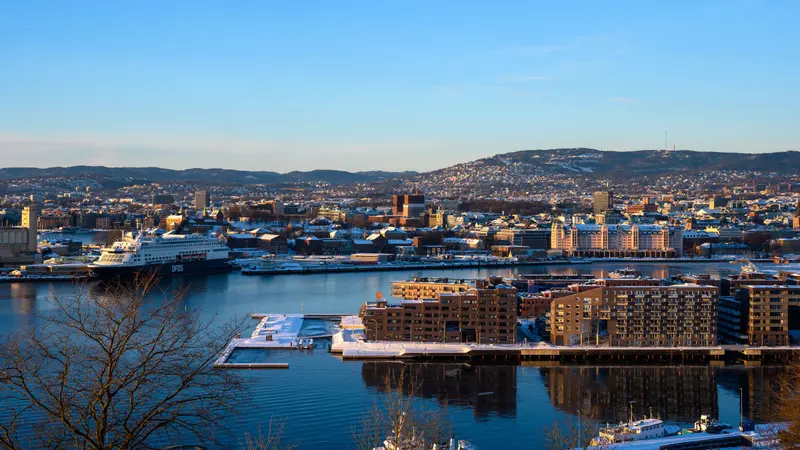
Photo: Chuck Henjes, Pexels License
Norway imported 31,000 tonnes of green coffee in 2022. Norwegians get through about 8.6 kg of coffee per person a year, around 3.1 cups a day, and drink it mostly black, as across Scandinavia.1 Consumption has slipped from over 10 kg of green coffee per person and will probably settle around 8 kg this decade, according to Norsk Kaffeinformasjon, the industry's information office.2
In its 2026 survey, run by Ipsos among 1,203 adults, 69% said they drink coffee daily: 83% of those over 60 but only 44% of those under 30. The average was 4.3 cups a day, 2.0 at home and 1.9 at work or school.3 The drip machine rules the kitchen: 66% own one and 60% usually use it, against 27% for a French press or a bean-to-cup machine and 21% for capsules.3
Norway's café cities
A coffee kettle in 1694
Coffee first appears in Norwegian records in 1694, as a coffee pot in the estate of a customs official in Christiania, today's Oslo.4 For decades it stayed a drink of merchants and the nobility. A Danish royal ordinance of 1783 against luxury, from the years when Norway was ruled from Copenhagen, banned it along with other extravagances and hit the peasants hardest. It was repealed in 1799.4
Coffee became a common drink only in the 1850s, helped by the 1842 vote to ban home distilling, which made it the everyday substitute for spirits.5 Consumption had already reached about 2.5 kg per person by 1845.4 An 1888 survey found adults drinking 3.95 kg a year, with workers highest at 5.78 kg.5 In the Second World War coffee was rationed to 50 grams a week, cut to 10 grams in 1941; by the end of that year there was none.4
Kokekaffe and karsk
Before the drip machine, coffee was boiled. Kokekaffe (boiled coffee) is still made the old way: bring water to the boil, take the kettle off the heat, add coarse-ground coffee, let it steep for about six minutes without boiling, stir, then pour carefully or strain so the grounds stay behind.6
Karsk is coffee mixed with spirits, usually home-distilled. It took hold in rural Norway in the late 1800s and is most common in Trøndelag, around Lake Mjøsa and further north.7 In much of the country it is called kaffedoktor (coffee doctor); around Mjøsa the usual word is knikt. The traditional recipe says to put a coin in the cup, pour in coffee until it disappears, then add spirits until it shows again. The coin never reappears.7
Friele, Johannson and the cod trade
Two family firms built the trade. Herman Friele, a ship's captain, landed in Bergen in 1799 and set up an import business centered on coffee. Seven generations later, in 2013, the family sold the company, which now belongs to JDE Peet's.8 In the 1850s Friele began trading cod for Brazilian coffee, and bartering salted, dried cod for Brazilian beans continued under a joint trading agreement that was dissolved in 1960.4
Joh. Johannson, founded in 1866, makes the Evergood and Ali brands. In 2016, its 150th year, the family company said that one in three cups of coffee drunk in Norway came from its roastery.9
Barista champions
Norway established the World Barista Championship.1 A Norwegian, Robert Thoresen, won the first one, held in Monte Carlo in 2000. Oslo hosted the third in 2002, and Tim Wendelboe won for Norway in Trieste in 2004.10
Wendelboe had won the Norwegian Barista Championship in 2001, 2002 and 2004 and finished second at the world championship in 2001 and 2002.11 Friele and Joh. Johannson remain the large importers and roasters, while Nordic Approach, a specialized importer, sells high-grade green coffee to roasters around the world.1
Oslo
Tim Wendelboe opened his espresso bar and roastery at Grüners gate 1 in Grünerløkka on 30 June 2007. The roastery moved a few blocks east to Tøyengata in 2018, while the espresso bar stayed in the original shop.11
Fuglen began in 1963 as Kaffefuglen, a coffee and tea shop in central Oslo. New owners renamed it in 2008, added a cocktail bar and a vintage furniture shop in 2010, and opened in Shibuya, Tokyo, in 2012. A second Oslo branch with its own roastery opened in Gamlebyen, the old town, in 2018.12
More adults drink coffee daily in Oslo than in any other region, 73% against 66 to 69% elsewhere, and Oslo residents buy more of their coffee in cafés and restaurants than other Norwegians do.3
Sources
- What is the demand for coffee on the Scandinavian market? (updated 23 April 2024), CBI, Netherlands Ministry of Foreign Affairs, accessed October 2026
- Forbruket av kaffe i Norge (21 May 2026), Norsk Kaffeinformasjon, accessed October 2026
- Kaffeundersøkelsen 2026 (21 May 2026), Norsk Kaffeinformasjon, accessed October 2026
- A History of Coffee in Norway (Chris Kolbu, 21 May 2016), Brewminate, accessed October 2026
- «En overvættes Nydelse af Kaffe» (Ragnhild Rein Bore and Hege K. Fosser Pedersen, 20 February 2006), SSB, Statistics Norway, accessed October 2026
- Kokekaffens renessanse (6 July 2017), Norsk Kaffeinformasjon, accessed October 2026
- Karsk, Wikipedia (Norwegian Bokmål), accessed October 2026
- Friele, Wikipedia, accessed October 2026
- Joh. Johannsons kaffehistorie 1866–2016 (Bjørn Grydeland, 20 September 2016), Norsk Kaffeinformasjon, accessed October 2026
- World Barista Championship, Wikipedia, accessed October 2026
- A short introduction (our story), Tim Wendelboe, accessed October 2026
- Fuglen, Wikipedia, accessed October 2026
Cafés in Norway: questions
What is karsk in Norway?
Karsk is coffee mixed with spirits, usually home-distilled, most common in Trøndelag, around Lake Mjøsa and in northern Norway. It took hold in rural areas in the late 1800s. Much of Norway calls it kaffedoktor, and around Mjøsa it is knikt. The old coin-in-the-cup recipe is a myth: the coin never reappears.
How much coffee do people drink in Norway?
Norwegians consume about 8.6 kg of coffee per person a year. In a 2026 Ipsos survey for Norsk Kaffeinformasjon, 69% of Norwegian adults drank coffee daily, averaging 4.3 cups a day, about half at home. Most brew it in a drip machine, which 66% own, and drink it black.
What role did Norway play in the World Barista Championship?
Norway established the World Barista Championship, and a Norwegian, Robert Thoresen, won the first one in Monte Carlo in 2000. Oslo hosted the competition in 2002, and Tim Wendelboe won for Norway in 2004 before opening his espresso bar and roastery in Oslo's Grünerløkka in 2007.
Your café deserves better than a pin someone else dropped
Free listings are free for good. A featured page gives you photos, a menu and your own URL, in your café's own design, for less than a coffee a day.