
Cafés in Greece Athens
Greek coffee from the briki, the 1957 frappé, freddo espresso on every table, the 2017 coffee tax, and Athens from Loumidis to Taf.
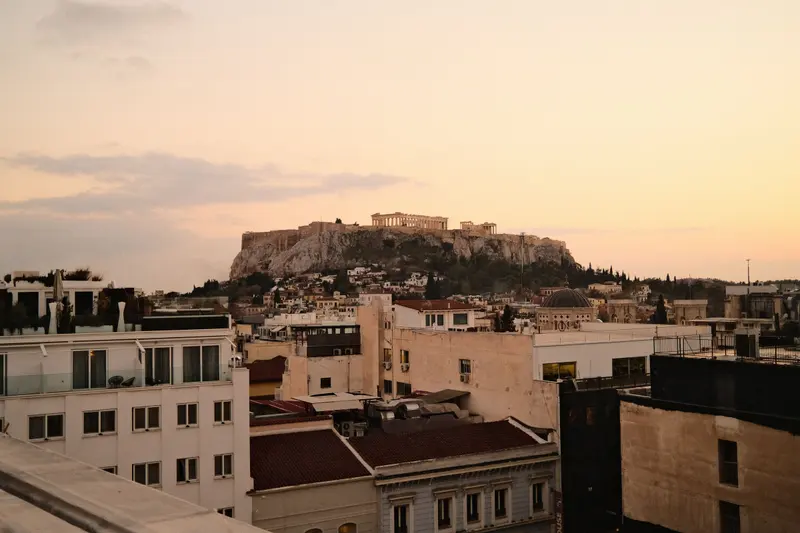
Photo: Konrad W, Pexels License
Greece drinks coffee daily and in quantity. Figures published by Proto Thema in 2026 show 84% of Greeks drinking coffee every day, half of them more than once, and put consumption at about 40,450 tonnes in 2023.1 What they drink depends on where: in cafés espresso drinks lead with 53% against 22% for Greek coffee, while at home Greek coffee leads with 36%, ahead of instant at 26%.1
The shift shows on supermarket shelves. By NielsenIQ's count, Greek coffee fell below half of retail sales by volume for the first time in 2020, at 49.3%, while espresso's share rose from 6.2% in 2016 to 10.6%.2
Coffee arrived in the 16th century, under Ottoman rule, and the word for coffeehouse, kafeneío (καφενείο), comes from the Turkish kahvehane.35 The food writer Albert Arouh recalls that in the 1960s everyone in Greece called it Turkish coffee, and dates the change of name to after Turkey's invasion of Cyprus in 1974; by the 1980s, ordering a “Turkish coffee” in a Greek café was no longer done.3
Greece's café cities
Ellinikós: Greek coffee from the briki
Ellinikós kafés (ελληνικός καφές, Greek coffee) is finely ground coffee brought almost to a boil with water and sugar in a bríki (μπρίκι), a small pot. The foam on top, the kaïmáki (καϊμάκι), is the sign of a good cup, and kafeneía once simmered it on embers for 10 to 20 minutes.4
Because the sugar goes into the pot, you order by sweetness: skétos (plain, no sugar), métrios (medium, half a teaspoon of sugar) or glykýs (sweet, a full teaspoon). A double doubles everything.4 By the early 1990s, Bravo was selling it on television with sea, sun and village scenes and the line “in the most beautiful country in the world, we drink Greek coffee.”3
The kafeneío
The traditional kafeneío is a family business with plain furniture and often whitewashed walls. It serves Greek coffee and frappé but also beer, retsina and ouzo, usually with meze or a free snack rather than meals.5 In villages and on islands it works as a social center, where people meet after work or play cards. In earlier centuries women were not welcome; today women and girls go too.5
From frappé to freddo
The frappé is instant coffee shaken with cold water and sugar until it foams, then served with ice and, if you like, milk.6 Nestlé dates it to the 1957 Thessaloniki International Fair.7 By the familiar story, Dimitris Vakondios, who worked for Nestlé's Greek agent, found no hot water there and shook his Nescafé cold. Nestlé newspaper ads from before the fair already promoted a Nescafé frappé, though, and a 1951 film shows one being made in a shaker.6
The frappé is ordered like Greek coffee, skétos, métrios or glykýs.6 Its place has gone to the freddo espresso, Italian espresso with ice added. Freddo drinks made up 68% of espresso and cappuccino sales by NielsenIQ's 2021 count, and about seven in ten coffee drinkers now prefer freddo espresso all year round.21
What coffee costs in Greece
Greece has the highest café prices in its region. In 2024 the average cappuccino cost €3.35, VAT on served coffee went back to 24% from 1 July, and the hospitality federation POESE warned that a €4 freddo would reach €5.10 On top of VAT sits an excise tax introduced on 1 January 2017: €2 per kg of green coffee, €3 per kg of roasted and €4 per kg of instant.9
Athens, from Loumidis to Taf
Three Loumidis brothers from Kárystos came to Piraeus in 1910 and sold roasted coffee from a cart. Their coffee shop on Stadíou Street later drew the city's writers, artists and journalists, and Nestlé bought the company in 1987.8
Taf began as a family roastery in the 1990s and opened its café at Emmanouil Benaki 7, on the edge of Exárcheia, in 2009.12 Tailor Made roasts on site at Agías Irínis Square, and Warehouse Project on Valtetsíou Street sits near the big museums and embassies.13
In 2023 Athens hosted four World Coffee Championships beside the World of Coffee trade show, where Savina Giachgia of Greece placed second in the World Brewers Cup.14 In a 2022 survey of takeaway prices across Attica, a freddo espresso cost €1.20 to €4.10, and the dearest freddo cappuccino, €4.50, was in Kolonaki.11
Sources
- Freddo, ο διάδοχος του φραπέ: Ο καφετζής έγινε... baristas (Giorgos Karagiannis, 13 May 2026), Proto Thema, accessed October 2026
- Ελληνικός καφές: Η πανδημία έφερε το τέλος της παντοκρατορίας του (Kostis Christodoulou, 29 May 2021), Powergame.gr, accessed October 2026
- Don't Call It 'Turkish' Coffee, Unless, Of Course, It Is (Joanna Kakissis, 27 April 2013), NPR, accessed October 2026
- Ελληνικός καφές, Wikipedia (Greek), accessed October 2026
- Καφενείο, Wikipedia (Greek), accessed October 2026
- Φραπέ, Wikipedia (Greek), accessed October 2026
- Η ιστορία της Nestlé στην ελληνική αγορά άρχισε να γράφεται πριν από 125 χρόνια (7 November 2024), Ta Nea, accessed October 2026
- Λουμίδης: Από το θρυλικό πατάρι της Σταδίου στις ηλεκτρονικές πωλήσεις (3 July 2021), Powergame.gr, accessed October 2026
- Ανεπηρέαστα από τον κορωνοϊό τα έσοδα από τον ΕΦΚ στον καφέ (Athanasios Koukakis, 29 June 2020), CNN Greece, accessed October 2026
- Καφές: Ο ακριβός freddo και οι κυοφορούμενες ανατιμήσεις στο ράφι (Sofia Emmanouil, 10 September 2024), Powergame.gr, accessed October 2026
- Καφές στα ύψη οι τιμές για καπουτσίνο και εσπρέσο (21 June 2022), Newmoney, accessed October 2026
- Taf Coffee (Kimberly Bradley), AFAR, accessed October 2026
- The Athens Coffee Guide (28 February 2018), The Coffeevine, accessed October 2026
- The Winners of the 2023 World Coffee Championships in Athens (26 June 2023), Daily Coffee News, accessed October 2026
Cafés in Greece: questions
How do you order Greek coffee in Greece?
In Greece you order Greek coffee by sweetness, because the sugar is boiled with the coffee in a briki: skétos is plain with no sugar, métrios has about half a teaspoon of sugar and glykýs a full teaspoon. A double doubles everything. A good cup keeps its foam, the kaïmáki, when it reaches the table.
What is the difference between frappé and freddo espresso in Greece?
A Greek frappé is instant coffee shaken with cold water and sugar until it foams, served with ice and optional milk; Nestlé dates it to the 1957 Thessaloniki International Fair. A freddo espresso is Italian espresso with ice. Freddo drinks make up about two-thirds of espresso and cappuccino sales in Greece, and about seven in ten coffee drinkers prefer freddo espresso all year.
Why is Turkish coffee called Greek coffee in Greece?
The food writer Albert Arouh recalls that in the 1960s everyone in Greece called it Turkish coffee, and that the name changed after Turkey's invasion of Cyprus in 1974, and by the 1980s ordering a Turkish coffee in Greece was no longer done. In the early 1990s, Bravo advertised it as Greek coffee on television.
Your café deserves better than a pin someone else dropped
Free listings are free for good. A featured page gives you photos, a menu and your own URL, in your café's own design, for less than a coffee a day.