Ginza & Yūrakuchō
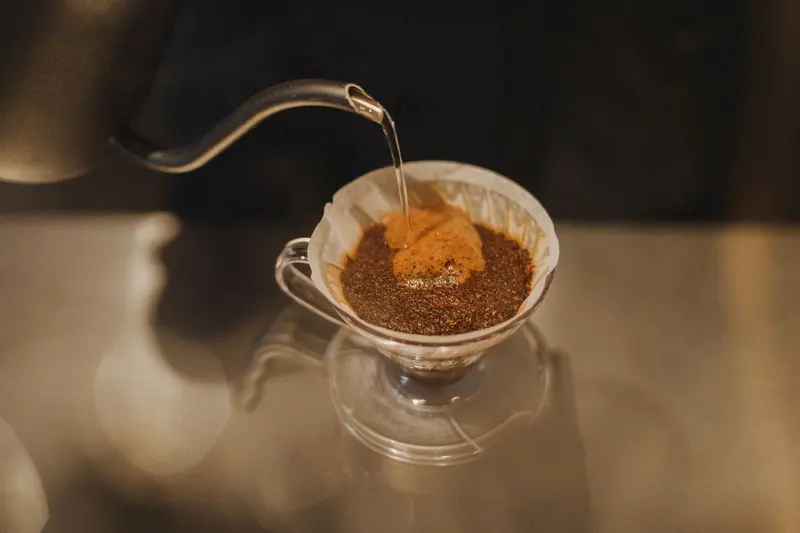
スペシャルティコーヒー · Tokyo
Specialty coffee cafés in Tokyo
Warehouse roasteries in Kiyosumi, espresso bars in Tomigaya, single origins by the cup.
Photo: Gu Ko, Pexels License
The Specialty Coffee Association of Japan (SCAJ) defines specialty coffee by what reaches the drinker: the liquid in the cup has to taste outstanding, with quality managed from seed to cup.1 Tokyo is where the trade gathers. SCAJ 2026 filled four halls of Tokyo Big Sight from 14 to 17 October 2026 with about 560 exhibitors, its largest number yet, and hosted the Japan Barista Championship and the Japan Brewers Cup.2 The association itself dates from 2003.2
In the cafés, the change shows in who roasts. Many specialty shops practice jika baisen (自家焙煎, roasting their own beans), often in light roasts called asairi (浅煎り). Glitch, for one, roasts light single origins in-house at its Jimbōchō shop.6 Jiyūgaoka & Gakugei-daigaku has the most specialty cafés, followed by Shibuya, Nihonbashi & Tokyo Station and Gōtokuji & Kyōdō, while in Gōtokuji & Kyōdō and Kiyosumi-Shirakawa they make up a larger share of the cafés than in any other area.
Local tip: KOFFEE MAMEYA Kakeru's tasting courses are by reservation, so book before you go; the shop is about ten minutes on foot from Kiyosumi-Shirakawa Station.4
Where these cafés are: Jiyūgaoka & Gakugei-daigaku (15), Nihonbashi & Tokyo Station (10), Gōtokuji & Kyōdō (10), Shibuya (10), Ginza & Yūrakuchō (9), Shinagawa & Gotanda (9), Asakusa & Kuramae (9), Kanda & Jimbōchō (8), Kōenji & Nakano (8), Sangenjaya (7), Kiyosumi-Shirakawa (7), Shimokitazawa (6), Oshiage & Ryōgoku (6), Ueno & Yanaka (6), Shinjuku (4), Nerima & Egota (4), Nakameguro & Daikanyama (4), Takadanobaba & Waseda (3), Shinbashi & Toranomon (3), Akasaka (3), Sugamo & Ōtsuka (3), Kita-Senju (3), Yotsuya & Kōjimachi (3), Harajuku & Omotesandō (2), Ikebukuro (2), Kagurazaka & Iidabashi (2), Itabashi (2), Roppongi & Azabu (1).
At a glance
159Cafés listed
28With opening hours
07:30Earliest opening
23:00Latest closing
- Opens earliest: Chouette Torrefacteur Laboratoire, from 07:30 (Mon 07:30–17:00 · Wed–Sun 07:30–17:00).
- Closes latest: Cherry Core Roaster+Bar, until 23:00 (Tue–Wed 11:00–23:00 · Thu 11:00–18:00 · Fri–Sun 11:00–23:00).
- Most common features: wi-fi (6%), takeaway (6%), outdoor seating (5%).
Nihonbashi & Tokyo Station
Berth Coffee
- Outdoor seating
- Takeaway
- Partial wheelchair access
- Specialty
Shimokitazawa
Brooklyn Roasting Company [Shimo-Kitazawa]
Sangenjaya
Cherry Core Roaster+Bar
Gōtokuji & Kyōdō
Chouette Torrefacteur Laboratoire
Gōtokuji & Kyōdō
coffee & roaster
- Wheelchair access
- Smoke-free indoors
- Specialty
Shinjuku
Dimlight Espresso
Kanda & Jimbōchō
Glitch
- Wi-Fi
- Outdoor seating
- Indoor seating
- Partial wheelchair access
- Toilets
- Specialty
Shimokitazawa
Grass
Kiyosumi-Shirakawa
KOFFEE MAMEYA Kakeru
Shinagawa & Gotanda
Mitsumata Coffee Roaster
Shibuya
Next Door
Shibuya
Paddlers Coffee
- Outdoor seating
- Toilets
- Specialty
Jiyūgaoka & Gakugei-daigaku
PEAK Swell Coffee Roasters
Shimokitazawa
PostCoffee
Kanda & Jimbōchō
Rec Coffee
Oshiage & Ryōgoku
Single O
Single O Ryōgoku Tasting Bar
- Takeaway
- Indoor seating
- Toilets
- Brunch
- Specialty
Nihonbashi & Tokyo Station
Single O
- Outdoor seating
- Takeaway
- Indoor seating
- Wheelchair access
- Specialty
Harajuku & Omotesandō
The Roastery by Nozy Coffee
- Outdoor seating
- Takeaway
- Wheelchair access
- Toilets
- Smoke-free indoors
- Specialty
Takadanobaba & Waseda
アカアマコーヒー
Akha Ama Coffee Roasters
- Takeaway
- Card payment
- Vegetarian options
- Specialty
Nihonbashi & Tokyo Station
ディゾン人形町店
10 Dixans
Oshiage & Ryōgoku
マキネスティコーヒー
Macchinesti Artisan Coffee Roaster
Kanda & Jimbōchō
神田伯剌西爾
KANDA BURAJIRU
Kiyosumi-Shirakawa
莫珈琲焙煎所
BAKU Coffee Roasters
Nerima & Egota
67焙煎所
Kiyosumi-Shirakawa
Allpress Espresso Cafe
- Wheelchair access
- Specialty
Shinbashi & Toranomon
Allpress Espresso Cafe
Jiyūgaoka & Gakugei-daigaku
Amameria Coffee Roaster
Shinagawa & Gotanda
Amameria Espresso
Ginza & Yūrakuchō
And Coffee Roasters Hibiya
Akasaka
b.s.b Coffee Roasters
Shinjuku
Be a Good Neighbor Coffee Kiosk Roaster
Jiyūgaoka & Gakugei-daigaku
Bean Hut. OKUSAWA
Oshiage & Ryōgoku
Berth Coffee Roastery Haru
Ginza & Yūrakuchō
Bongen
Nihonbashi & Tokyo Station
Brooklyn Roasting Company Tokyo International Forum
- Wheelchair access
- Specialty
Nothing matches those filters here. See all cafés in Tokyo.
How Kiyosumi-Shirakawa became a roasting district
Kiyosumi-Shirakawa grew up around timber. Canals dug in the Edo period carried wood into the district, warehouses for storing it lined the banks, and the canal network kept its shape into the early Shōwa era.3 After the Museum of Contemporary Art Tokyo opened there in 1995, some warehouses became storage or galleries, and later roasteries.3 Their height left room for the exhaust ducts a roaster needs, and the ducts could point at the water instead of the neighbors.3
A Nihon University study traced the district's first café roasting its own beans to 2012 and counted eight openings in 2015, the busiest year, when Blue Bottle arrived.3 Allpress, founded in Auckland in 1986, had already opened in a converted timber warehouse in 2014.4 Allpress is at 7-2 Hirano 3-chōme and KOFFEE MAMEYA Kakeru at 16-14 Hirano 2-chōme (daily 11:00–18:00), where tasting courses are by reservation.4
What a cup costs at a Tokyo roaster
At Onibus Coffee's Nakameguro shop, a hot hand-drip Peru cost ¥1,430 as of 2026, a double espresso ¥660 and a double iced latte ¥803.5 Its house espresso, Step Blend, mixes Guatemalan, Ethiopian and Kenyan beans, and about five single origins rotate every one to two months.5 Onibus started in Okusawa and buys directly from producers it visits.5
Sarutahiko Coffee opened in Ebisu in 2011 in a room of about 26 m², where founder Ōtsuka Tomoyuki painted the walls and made the chairs himself; by 2025 the company ran 24 shops across Japan.7
Where Tokyo's specialty cafés cluster
Part of Shibuya's group sits around Tomigaya: Little Nap Coffee Roasters at 43-15 Tomigaya 2-chōme, Switch Coffee Tokyo at 53-2 Tomigaya 1-chōme and Coffee Supreme at 42-3 Kamiyama-chō. WAVY COFFEE ROASTERS is at 14-7 Jinnan 1-chōme, Paddlers Coffee opens at 07:30 from Tuesday to Sunday, and Next Door, on the second floor of The OneFive Tokyo Shibuya, at 08:00 from Wednesday to Sunday.
Around Nihonbashi, Single O is at 16-7 Nihonbashi-Hamachō and opens at 07:30 on weekdays, Berth Coffee is at 15-2 Nihonbashi-Ōdenmachō (daily 08:00–18:00), and Passage Coffee runs 07:30–17:00. SR Coffee Roasters is at 6-5 Nihonbashi-Kabutochō. In Asakusa & Kuramae, the specialty shops include nano coffee roaster, February Coffee Roastery and two Leaves Coffee branches. Near Shinjuku, Dimlight Espresso in Yoyogi 1-chōme pulls its first shots at 09:00.
Light roasts and tasting flights
Glitch offers single origins from about 15 varieties, roasted at its Jimbōchō shop, and at its Ginza branch you can order a flight of two or three; the beans are grouped as Innovation, Hard to Find and Competition.6 The Jimbōchō shop opens weekdays 08:00–19:00 and weekends from 09:00.
Nearby in Kanda, Rec Coffee opens at 07:30 on weekdays and 09:00 at weekends, closing at 20:00 Monday to Friday and 19:00 on Saturday and Sunday. Social Good Roasters Chiyoda runs Monday to Saturday 10:00–18:00.
Sources
- スペシャルティコーヒーの定義, Specialty Coffee Association of Japan (SCAJ), accessed October 2026
- 「Brew the Future」をテーマに過去最多の国内外約560社が集結 スペシャルティコーヒーの祭典「SCAJ 2026」開催, SCAJ press release via ORICON NEWS (October 2, 2026), accessed October 2026
- 清澄白河の歴史や文化と結びつくカフェまちづくりに関する研究, Hiyama Akira and Kogiso Yutaka, Nihon University College of Science and Technology, proceedings (FY2020), accessed October 2026
- 清澄白河で行くべきコーヒーショップ5選, Time Out Tokyo (May 2, 2022), accessed October 2026
- ONIBUS COFFEE 中目黒駅前店, るるぶ&more. (updated October 5, 2026), accessed October 2026
- 5 best specialist cafés for coffee tasting courses in Tokyo, Time Out Tokyo (July 30, 2024), accessed October 2026
- 猿田彦珈琲 恵比寿本店, Time Out Tokyo (March 10, 2025), accessed October 2026
Keep exploring
Other ways to browse Tokyo
By area: Shimokitazawa Harajuku & Omotesandō Shibuya Shinjuku Ginza & Yūrakuchō Nihonbashi & Tokyo Station Kanda & Jimbōchō Ueno & Yanaka Kiyosumi-Shirakawa Asakusa & Kuramae
FAQ
Specialty coffee in Tokyo: questions
Why is Kiyosumi-Shirakawa known for specialty coffee in Tokyo?
The district's Edo-period canals were lined with timber warehouses. After the Museum of Contemporary Art Tokyo opened in 1995, some were converted, and their height suited a roaster's exhaust ducts, which could point at the canal. The first café roasting its own beans there dates from 2012, and eight shops opened in 2015, the year Blue Bottle arrived. Allpress had opened in a timber warehouse in 2014.
How much does a specialty coffee cost in Tokyo?
At Onibus Coffee's Nakameguro shop, a hot hand-drip Peru cost ¥1,430 as of 2026, a double espresso ¥660 and a double iced latte ¥803. The shop keeps about five single origins at a time and rotates them every one to two months.
Which Tokyo neighborhoods have the most specialty coffee cafés?
Jiyūgaoka & Gakugei-daigaku leads, with Shibuya, Nihonbashi & Tokyo Station and Gōtokuji & Kyōdō level behind it; relative to their size, Gōtokuji & Kyōdō and Kiyosumi-Shirakawa have the highest shares. In Shibuya, Little Nap Coffee Roasters, Switch Coffee Tokyo and Coffee Supreme are all around Tomigaya. In Kiyosumi-Shirakawa, Allpress and KOFFEE MAMEYA Kakeru are both in Hirano.
For café owners
Your café deserves better than a pin someone else dropped
Free listings are free for good. A featured page gives you photos, a menu and your own URL, in your café's own design, for less than a coffee a day.