
Cafés in Sri Lanka Colombo
The coffee island that leaf rust turned to tea, arabica from Kandy and Badulla, and the cafés of Colombo and Cinnamon Gardens.
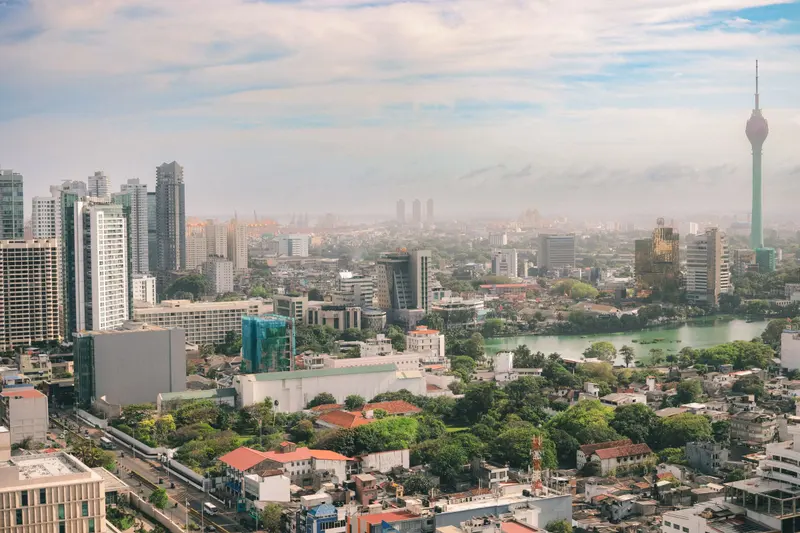
Photo: Asiri Dissanayaka, Pexels License
Sri Lanka is known for tea, but in the 19th century it was a coffee island. By 1860 it ranked with Brazil and Indonesia as one of the three largest coffee producers in the world, and the area under coffee peaked in 1870 at more than 111,400 hectares (275,000 acres).1 That year Ceylon, as the British colony was called, exported some 118 million pounds of coffee.2
The crop is far smaller now. Department of Export Agriculture figures put coffee on 4,787 ha, producing 2,537 tonnes in 2022 against 2,439 tonnes in 2021; exports rose from 30.47 to 50.56 tonnes over the same two years.4 Most of it is grown as an intercrop among tea and coconut, and nearly 80% comes from smallholdings.41
Sri Lanka's café cities
From temple flowers to the British estates
Accounts of coffee's arrival differ. Sinhala sources date it to Arab traders in 1503; others say Muslim pilgrims brought it from Yemen, via India, in the early 17th century.51 Sinhalese villagers first used the young leaves in curries and the flowers as temple offerings, not the beans. The Dutch made the first attempt at systematic cultivation in 1740.1
The British, who took control of the island in 1815, made it a plantation crop. George Bird was the first to grow coffee commercially, at Singhapitiya; Governor Edward Barnes, in office from 1824, set up an estate at Gannoruwa in 1825; and large-scale production followed the Colebrooke–Cameron reforms of 1833.1
The railway to Colombo was built for coffee. Governor Sir Henry Ward called it "an absolute and imperative necessity" if Ceylon was not to "cease to exist as a coffee producing colony", and the first train reached Kandy on April 25, 1867.8
Devastating Emily: the leaf rust of 1869
In 1869 small, pale-yellow spots began to appear on coffee leaves in the south-center of the island. It was the first global outbreak of Hemileia vastatrix, the coffee leaf rust fungus, which weakens the bushes rather than killing them: the leaves drop and yields fall.2 Planters called it "Devastating Emily".1
Output began a rapid decline in 1879, the year Kew Gardens sent the 25-year-old mycologist Harry Marshall Ward to the island. In two years he proved the fungus caused the disease and worked out its life cycle, but could offer no cure.2 By 1886 exports were down 80%, by 1890 planters had abandoned 90% of the land under coffee, and by 1900 coffee covered only 4,610 ha.21
How tea took over the coffee estates
Tea was already in the ground. In 1867 James Taylor planted 19 acres of it on Loolecondera Estate at Galaha, in the hill country; a fully equipped tea factory opened there in 1872, and in 1873 twenty-three pounds of his tea reached London.3
In the 1880s planters from across the hill country visited Loolecondera to learn tea growing, and by the late 1880s almost all coffee plantations had been converted. By 1899 nearly 400,000 acres were under tea.3 The first public tea auction in Colombo was held in 1883.3 Sri Lanka is now the world's fourth-largest tea producer.2
Kōpi in the hill country today
Coffee, කෝපි (kōpi) in Sinhala, is still a hill-country crop.5 Arabica grows above about 400 m in Nuwara Eliya, Kandy, Matale and Badulla districts, and robusta below 600 m in Kegalle, Kurunegala, Kandy and Matale.4
The revival is slow. The Department of Export Agriculture began supplying saplings, finance and training in the 1970s; by the 1990s most coffee came from home gardens, often a few bushes kept by tea farmers, and was sold cheaply through trading houses in Colombo.6 Its arabica variety Lak Parakum has been planted since the early 2000s.9 As of 2023, quality coffee fetched about Rs 1,200–1,300 a kilo, against about Rs 400 five years earlier.4
Colombo: the tea port drinks coffee
In 2017 Sri Lanka still imported more coffee than it exported. When the pandemic brought a ban on green-coffee imports, cafés turned to local producers,6 and the rising cost of imported coffee has since pushed popular Colombo coffee houses toward local blends.4 The city's newer cafés pair coffee with food, and all-day brunch draws local families as well as visitors.6
Colombo 7, or Cinnamon Gardens, about 3 km south-east of the center, is a district of tree-lined streets and mansions around Viharamahadevi Park, the Town Hall and the National Museum. It takes its name from a cinnamon plantation that covered 289 acres in 1789.7
Sources
- Coffee production in Sri Lanka, Wikipedia, accessed October 2026
- Coffee Rust Threatens Latin American Crop; 150 Years Ago, It Wiped Out An Empire, NPR, The Salt (Jeff Koehler, October 16, 2018), accessed October 2026
- History of Ceylon Tea: 1867–1877, Pure Ceylon Tea (Sri Lanka Tea Board), accessed October 2026
- Brewing a special cup with Sri Lankan coffee, Daily FT (Randima Attygalle, May 18, 2023), accessed October 2026
- කෝපි, විකිපීඩියා (Sinhala Wikipedia), accessed October 2026
- Field Report: Sri Lanka—Exploring Coffee Culture in Kandy and Colombo, Barista Magazine (Jen Roberts, December 22, 2025), accessed October 2026
- Cinnamon Gardens, Wikipedia, accessed October 2026
- Railway replaced bullock carts, The Sunday Times (Sri Lanka), Funday Times (November 21, 2004), accessed October 2026
- Sri Lanka's Department of Coffee makes international debut with Oman outlet, World Coffee Portal (November 19, 2024), accessed October 2026
Cafés in Sri Lanka: questions
Why did Sri Lanka switch from coffee to tea?
Coffee leaf rust, the fungus Hemileia vastatrix, appeared in Ceylon in 1869 and wrecked the plantations. By 1886 coffee exports were down 80% and by 1890 planters had abandoned 90% of the coffee land. Tea, first planted commercially by James Taylor at Loolecondera in 1867, replaced it, and by 1899 nearly 400,000 acres were under tea.
Where is coffee grown in Sri Lanka today?
Sri Lankan arabica grows above about 400 m in the Nuwara Eliya, Kandy, Matale and Badulla districts, and robusta below 600 m in Kegalle, Kurunegala, Kandy and Matale. Most coffee is grown as an intercrop among tea and coconut, and nearly 80% comes from smallholdings.
How much coffee does Sri Lanka produce?
Department of Export Agriculture figures put Sri Lanka's coffee on 4,787 hectares, producing 2,537 tonnes in 2022, up from 2,439 tonnes in 2021. Exports rose from 30.47 to 50.56 tonnes over those two years. At its peak in 1870, coffee covered more than 111,400 hectares of the island.
Your café deserves better than a pin someone else dropped
Free listings are free for good. A featured page gives you photos, a menu and your own URL, in your café's own design, for less than a coffee a day.