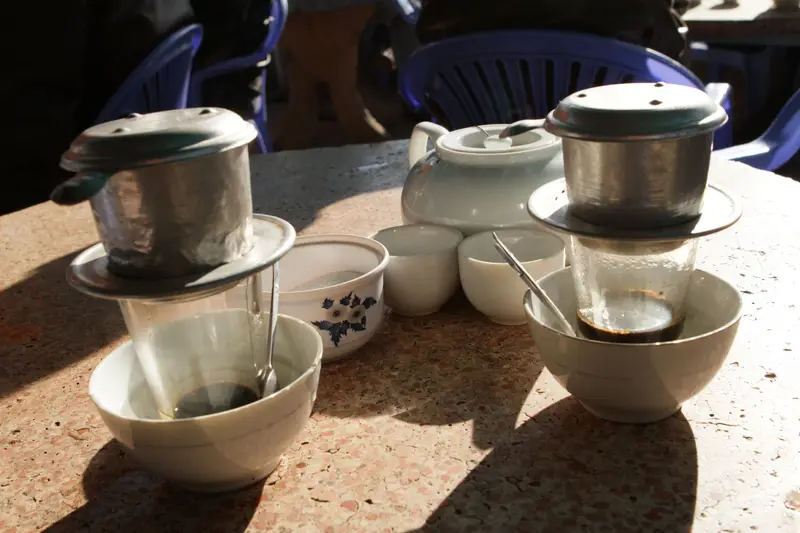
Cafés in Vietnam from Hanoi to Ho Chi Minh City
Egg coffee in Hanoi, salt coffee in Huế, alley cafés in Da Nang and cloth-filtered cà phê vợt in Ho Chi Minh City.
Photo: Frank Fox, CC BY-SA 4.0

Only Brazil grows more coffee than Vietnam. The US Department of Agriculture forecasts a record 32.5 million 60-kg bags from Vietnam's 2026/27 harvest, about a sixth of world output, and 25.4 million bags of bean exports, behind Brazil's 45.0 million.1 Robusta makes up about 97 percent of the crop, and the Central Highlands are its home ground.25
Vietnamese drink a growing share of it themselves: domestic consumption is forecast at a record 5.0 million bags, and the national tourism board counts hundreds of thousands of cafés across the country.19
Vietnam's café cities

Da Nang
Beach town, river city, and a specialty scene that punches above its size. 1916 cafés.
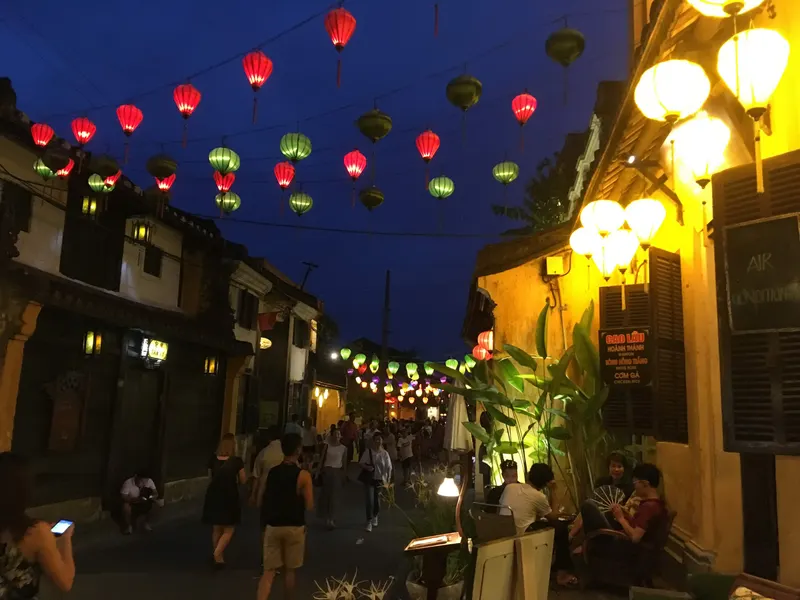
Hội An
Old-town shophouses, cafés among the rice fields, and the beach at An Bàng. 369 cafés.
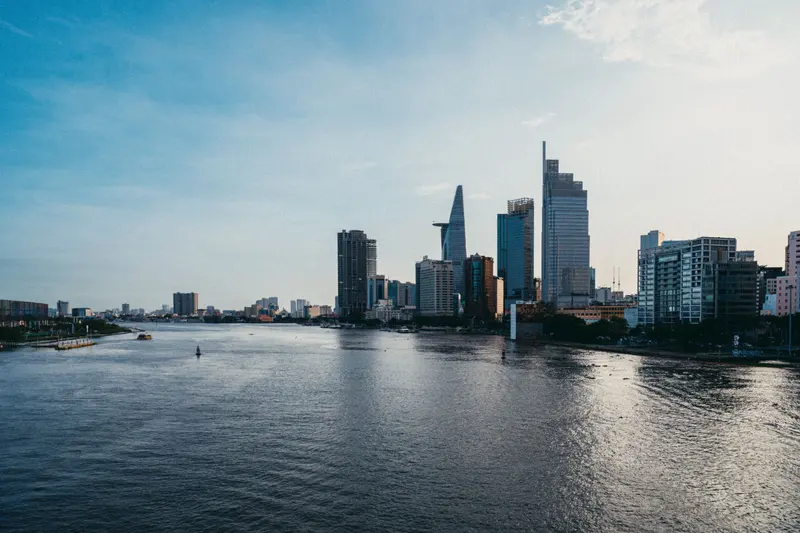
Ho Chi Minh City
Cà phê vợt, sidewalk cafés and specialty roasters from District 1 to Thảo Điền. 4769 cafés.
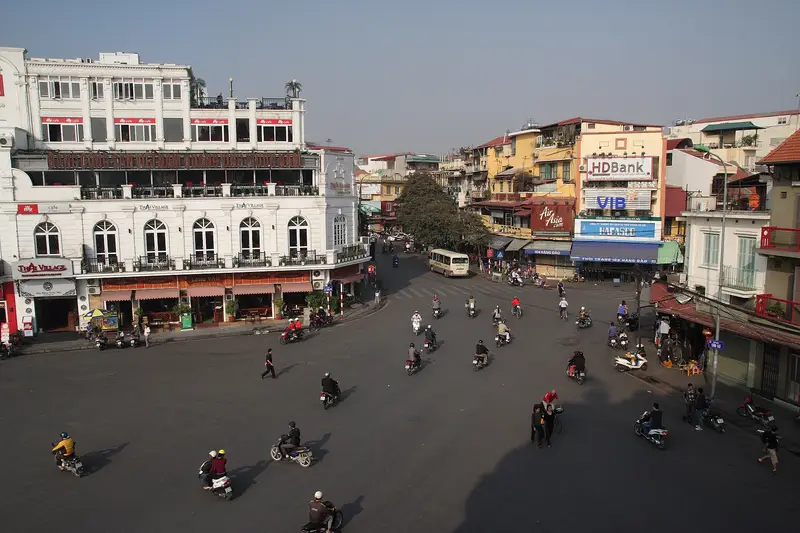
Hanoi
Egg coffee, railway-track cafés and tiny stools on the Old Quarter sidewalks. 2612 cafés.
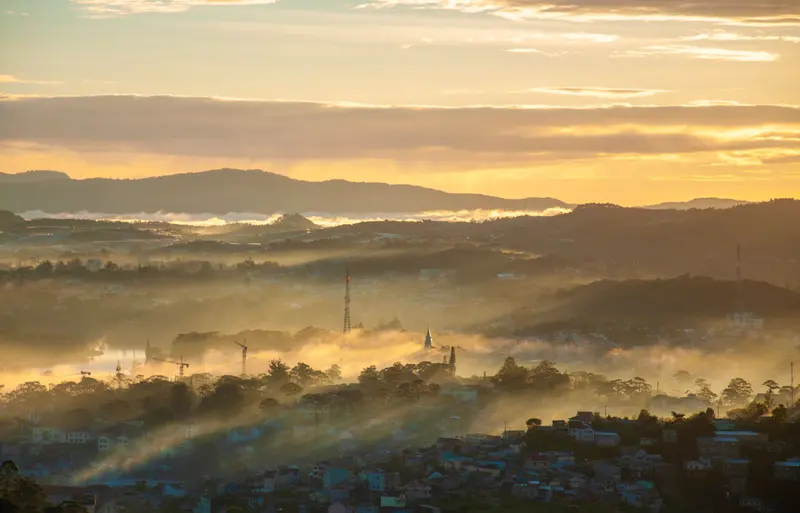
Đà Lạt
Arabica country in the Central Highlands, with cafés among the pines. 800 cafés.
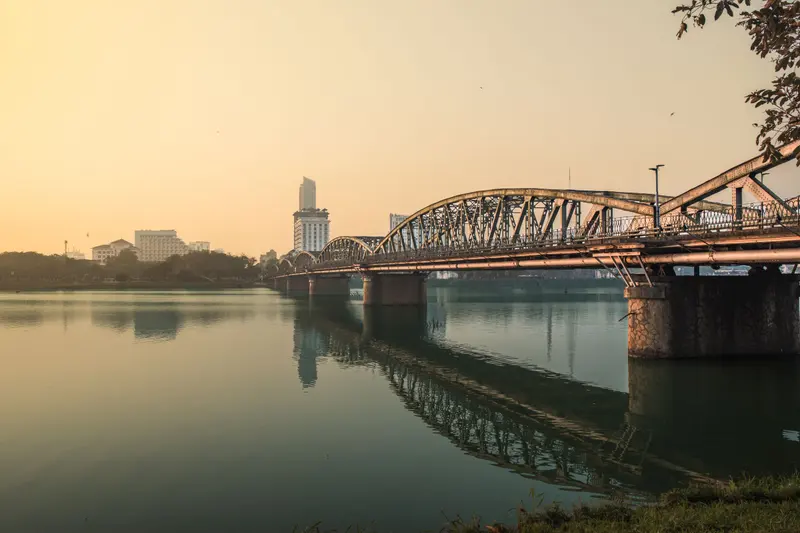
Huế
Home of cà phê muối, salt coffee, and of slow cafés along the Perfume River. 638 cafés.
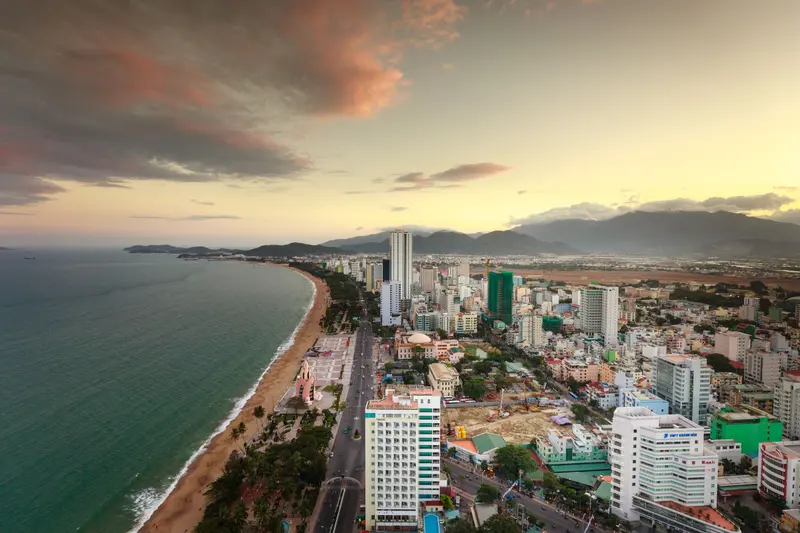
Nha Trang
Iced coffee within sight of the bay, from beachfront terraces to backstreet roasters. 594 cafés.
New to Vietnamese coffee?
Phin, bạc xỉu, egg coffee, salt coffee: what each one is, what it costs, and how to order it without pointing.
Read the coffee guideHow coffee came to Vietnam
French missionaries brought the first coffee plants in 1857, and the first plantations were laid out in 1888 in Ninh Bình and Quảng Bình, in the north. In the 1920s the colonial administration opened coffee zones in the Central Highlands, mainly in Đắk Lắk province, and by 1940 the colony exported about 2,000 tonnes a year.2
Arabica arrived by the same route, from African seed, and took root around Đà Lạt.6 War and then collectivization kept output small until the Đổi Mới reforms of 1986 allowed private farming again, after which the industry grew quickly.2 Production of 32.5 million bags in 2026/27 would be the largest Vietnamese crop on record.1
Buôn Ma Thuột and the Central Highlands
The highlands are robusta country, and the plateau around Buôn Ma Thuột in Đắk Lắk is where the industry centered.52 Trung Nguyên, founded in the town in 1996, grew into one of the leading Vietnamese coffee brands, and its G7 instant coffee launched in 2003.32
Buôn Ma Thuột markets itself as the destination of world coffee, and its coffee festival reached its ninth edition from 9 to 13 March 2025.4 Further north, the Đắk Hà area of Kon Tum, a province merged into Quảng Ngãi in 2025, has more than 9,000 hectares under coffee.511
Phin, butter roast and condensed milk
Most Vietnamese coffee is brewed one cup at a time through a phin, the small metal drip filter, using water at 90–95°C and coarse robusta grounds. Traditional roasters often add a little butter, or even cacao, to the beans, which pushes the flavor toward dark chocolate and nuts.10
The milk is a legacy of colonial shortages. Fresh milk was scarce under French rule and spoiled in the heat, so shelf-stable sweetened condensed milk took its place, and ice was added for the climate.7 Southerners call the result cà phê sữa đá; in the north it is cà phê nâu đá, "brown iced coffee".7
Hanoi, Huế, Da Nang and Hội An
Hanoi has the old cafés and the inventive drinks. Café Thái has served coffee in various forms since the 1920s, and yogurt coffee is a local staple.8 Egg coffee, a sweet foam of yolk over strong coffee, was born here and is a winter favorite.98 Food & Wine has named Hà Nội among the world's top coffee cities.9
Huế, the old imperial capital and since 2025 one of Vietnam's six centrally governed cities, gave the country cà phê muối (salt coffee).119 A local couple devised it around 2010: condensed milk at the bottom, a layer of salted milk, and phin coffee on top. It has since spread to Hanoi, Da Nang and Ho Chi Minh City.13
Da Nang and Hội An have formed a single city since Quảng Nam province merged into Da Nang in 2025.11 Da Nang is a beach city whose first cups go out before 05:30, with kiệt (alley) cafés and riverfront terraces. Hội An is the heritage town of the pair, with shophouse cafés in the Old Town and rice-field and beach cafés a short ride out.
Đà Lạt, Nha Trang and Ho Chi Minh City
Đà Lạt, the hill resort the French founded in 1912, is the cool-climate end of the country, known for its coffee farms and its beans.69 On the slopes of Langbiang mountain, the K'Ho Coffee cooperative, founded in 2012, provides work for 50 K'Ho families and serves its coffee in a garden café on the farm.6
Nha Trang is the beach resort of Khánh Hòa, a province that absorbed Ninh Thuận in 2025.11 Its cafés include one on Nguyễn Trãi built beside the railway; as of 2024, six or seven passenger trains passed each day, usually around 07:00–07:30 and 18:00–20:00.14
Ho Chi Minh City, which took in Bình Dương and Bà Rịa–Vũng Tàu provinces in 2025, keeps its cà phê vợt stalls, where coffee is strained through a cloth filter.119 Vinh Ngo began selling it at Cheo Leo, in an alley off Nguyễn Thiện Thuật, in 1938, and his daughters were running it in 2016.12 Bạc xỉu, a milk-heavy coffee, emerged here in the 1950s among the Cantonese community of Chợ Lớn.7
Sources
- Coffee: World Markets and Trade (July 2026), USDA Foreign Agricultural Service, accessed October 2026
- Coffee production in Vietnam, Wikipedia, accessed October 2026
- Trung Nguyên, Wikipedia, accessed October 2026
- 9th Buon Ma Thuot Coffee Festival, Vietnam National Authority of Tourism (vietnam.travel), accessed October 2026
- Kon Tum: coffee kingdom, Vietnam National Authority of Tourism (vietnam.travel), accessed October 2026
- Da Lat tour for coffee lovers, Vietnam National Authority of Tourism (vietnam.travel), accessed October 2026
- Vietnamese iced coffee, Wikipedia, accessed October 2026
- 5 fantastic Vietnamese coffees, Vietnam National Authority of Tourism (vietnam.travel), accessed October 2026
- Vietnam's coffee culture brews global buzz, Vietnam National Authority of Tourism (vietnam.travel), accessed October 2026
- The secret art of Vietnamese coffee, Vietnam National Authority of Tourism (vietnam.travel), accessed October 2026
- Legislature approves mergers to reduce Vietnam's cities, provinces to 34, Tuổi Trẻ News (June 12, 2025), accessed October 2026
- Hẻm Gems: A Cuppa in Saigon's Oldest Cafe, Saigoneer (September 30, 2016), accessed October 2026
- Cà phê muối xứ Huế, VnExpress (September 3, 2020), accessed October 2026
- Quán cà phê như rừng nhiệt đới có góc ngắm đường tàu 'thần thánh' ở Nha Trang, VietNamNet (July 27, 2024), accessed October 2026
Guides
Bringing coffee home: customs, carry-on and freshness
Roasted vs green coffee at US, EU, UK, Australian, NZ and Japanese customs, carry-on powder rules, roast dates, and what to buy in Vietnam or Ethiopia.
Coffee travelCafé opening hours around the world
When cafés open and close: 06:00 coffee in Vietnam, Italian bars shut by 20:00, Melbourne cafés done by 15:00, Sundays in Berlin, Ramadan in Dubai.
How to orderEspresso drinks from ristretto to café bombón
What each espresso drink really is: ristretto and lungo, americano vs long black, three macchiatos, cortado, gibraltar, piccolo, flat white and bombón.
Cafés in Vietnam: questions
How much coffee does Vietnam produce?
Only Brazil produces more coffee than Vietnam. The USDA forecasts a record 32.5 million 60-kg bags for Vietnam's 2026/27 harvest, about a sixth of world output, with 25.4 million bags of bean exports and record domestic consumption of 5.0 million bags. Robusta makes up about 97 percent of the crop.
When was coffee introduced to Vietnam?
Coffee was introduced to Vietnam in 1857 by French missionaries. The first plantations followed in 1888 in Ninh Bình and Quảng Bình, and in the 1920s the French opened coffee zones in the Central Highlands, mainly in Đắk Lắk. Vietnam's coffee industry grew fastest after the Đổi Mới reforms of 1986 allowed private farming again.
How does coffee in northern Vietnam differ from southern Vietnam?
In northern Vietnam iced milk coffee is called cà phê nâu đá, and Hanoi is known for egg coffee and yogurt coffee. In southern Vietnam the same drink is cà phê sữa đá, Ho Chi Minh City keeps its cloth-filter cà phê vợt stalls, and bạc xỉu, a milk-heavy coffee, emerged there in the 1950s. Salt coffee comes from Huế, in the center.
Your café deserves better than a pin someone else dropped
Free listings are free for good. A featured page gives you photos, a menu and your own URL, in your café's own design, for less than a coffee a day.