
Cafés in Uganda Kampala
Robusta that grew wild by Lake Victoria, Bugisu arabica from Mount Elgon, coffee cherries chewed in Buganda, and Kampala's café hills.
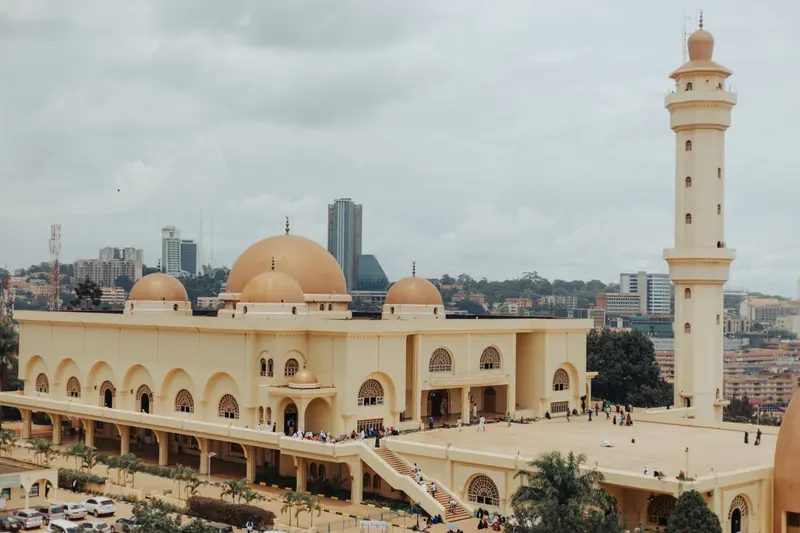
Photo: Workman House, Pexels License
Uganda is Africa's second-largest coffee producer after Ethiopia, and most of what it grows is robusta: about 85% of the crop, against 15% arabica.1 In the 2024/25 financial year it shipped 7.7 million bags of 60 kg, about 462,000 tonnes, and earned US$2.2 billion, roughly double the US$1.14 billion of the year before. Europe took 69% of it, Asia 14% and Africa 12%.1
Around 5 million people, or 1.7 million households, work in coffee, and smallholders with less than 2.5 hectares grow 85% of it.2 Very little stays in the country. The US Department of Agriculture expected Ugandans to drink about 330,000 bags in 2025/26, up from 325,000.5
Uganda's café cities
Robusta's home: Lake Victoria and Buganda
Robusta grew wild along the northern shores of Lake Victoria, where Kampala now stands, and the Baganda kept it in household gardens and used it in ceremonies.2 In Coffee in Buganda (1955), James W. Maina recorded its role in blood-brotherhood: two beans were taken from a berry, each man moistened one with his blood, and the two swapped them before eating.3
Here coffee was chewed long before it was brewed. Chewing was recorded in the time of the explorer John Speke in 1865, and a visitor is still often given coffee to chew: cherries picked just before they ripen, steamed, then smoke-dried.3 The British turned robusta into a cash crop.2 A 1923 policy promoted a robusta selection with seedlings partly from the Ssese Islands, and by 1925 Mengo and Masaka were the main districts.3
Buganda still grows more than half of Uganda's coffee. Its kingdom runs a campaign called Emmwanyi Terimba, "coffee is a sure deal" (emmwanyi is coffee in Luganda), championed since 2016 by the Katikkiro, Buganda's prime minister, Charles Peter Mayiga.4
Bugisu arabica on Mount Elgon
Arabica arrived with missionaries and settlers. Father Moullec brought it from Morogoro to Handere, near Bombo, in 1900,3 and by 1914 European and Asian settlers had established the first plantations.2 Many British-owned estates failed in the 1920s, and Ugandan smallholders became the main growers of both species.2
The best-known Ugandan arabica is Bugisu, grown in the volcanic soils around Mount Elgon in the east.2 The mountain's summit, Wagagai, reaches 4,321 m, and the Bugisu Co-operative Union, registered in July 1954, is based in Mbale.8 The common varieties are Kent, Typica, SL14 and SL28.2 Around Mbale, arabica is planted in March and April and harvested from August to November.9
From the coffee board to the ministry
The state has run Ugandan coffee closely. By December 1988 the Coffee Marketing Board could not pay farmers, and in 1991 the Uganda Coffee Development Authority (UCDA) was formed as the industry was liberalized.9 Arabica planting expanded from the early 1990s.2
On 6 November 2024, Parliament passed the National Coffee (Amendment) Bill with 305 votes, dissolving UCDA and moving its work to a department of the agriculture ministry, with a three-year transition.6 Growers and traders raised concerns that support services would weaken.5 Smallholder robusta comes mainly from central districts such as Mukono and Luwero, shade-grown arabica from Kapchorwa and Mbale in the east, and Kasese and Bushenyi in the west grow both.5
Kampala: a tea city learning coffee
Ugandans have traditionally preferred tea, and the change in Kampala has come through coffee bars filled by younger customers.7 In 2020 Gerald Katabazi, a Kampala roaster, told Africanews that coffee had been seen as "a white man's product and also a rich man's product." He estimated that home consumption had risen from about 1% to close to 6% over a decade, and he was selling through kiosks while training baristas.7
The city's cafés follow its hills. Kololo, a hill of about 1,311 m close to the center, has been an upscale residential district since the 1950s and holds more than a dozen embassies and ambassadors' residences.10 Since the 2000s, hotels, banks, restaurants and bars have moved in among the houses.10
Sources
- Coffee: Uganda Doubles Export Earnings to $2.2 Billion in 2024/2025, Ecofin Agency (July 30, 2025), accessed October 2026
- Uganda origin, Sucafina, accessed October 2026
- Buganda's love affair with coffee, Daily Monitor (Priscilla Maloba, August 20, 2022), accessed October 2026
- Coffee boom in the eyes of Buganda Kingdom, Daily Monitor (Daniel Wandera, October 29, 2024), accessed October 2026
- Uganda Coffee Report: Growth Expected, Supported by Prices, Daily Coffee News (May 20, 2025, summarizing the USDA FAS coffee annual), accessed October 2026
- End of the road for the Uganda Coffee Development Authority – UCDA, The Independent (Uganda) (November 7, 2024), accessed October 2026
- Coffee-Drinking Trend in Uganda Could Boost Economy, Africanews (September 1, 2020), accessed October 2026
- Bugisu sub-region, Wikipedia, accessed October 2026
- Coffee production in Uganda, Wikipedia, accessed October 2026
- Kololo, Wikipedia, accessed October 2026
Cafés in Uganda: questions
What kind of coffee does Uganda grow?
Uganda grows mostly robusta, about 85% of its crop, and about 15% arabica. Robusta grew wild along the northern shores of Lake Victoria. The best-known Ugandan arabica is Bugisu, from the volcanic soils of Mount Elgon in the east, where Kent, Typica, SL14 and SL28 are common and the harvest around Mbale runs from August to November.
How much coffee does Uganda export?
In the 2024/25 financial year Uganda exported 7.7 million 60 kg bags of coffee, about 462,000 tonnes, earning US$2.2 billion, roughly double the year before. Europe took 69%. About 1.7 million Ugandan households work in coffee, and smallholders with less than 2.5 hectares grow 85% of it.
Why do people chew coffee beans in Uganda?
Chewing coffee is an old custom in Buganda, recorded in 1865. Hosts offer coffee cherries picked just before ripeness, steamed and smoke-dried. Robusta also sealed blood-brotherhood among the Baganda: two men each moistened a coffee bean with their blood and swapped them before eating, as James W. Maina recorded in 1955.
Your café deserves better than a pin someone else dropped
Free listings are free for good. A featured page gives you photos, a menu and your own URL, in your café's own design, for less than a coffee a day.