 By Yannick Schroth
Coffee cultures · 5 min read · October 2026
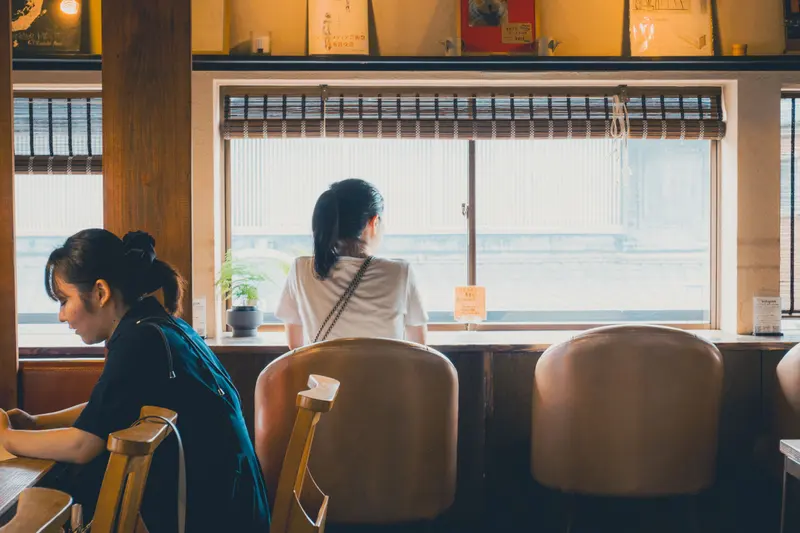
A kissaten (喫茶店, literally a shop for drinking tea) is Japan's old-style coffee house: coffee brewed to order, a short menu of toast, sweets and spaghetti, and a room that changes slowly. At their peak in 1981 there were 154,630 of them. By 2021 the count was 58,669, which means roughly 100,000 closed in 40 years.3
The ones left are not museum pieces. Café de l'Ambre in Ginza has brewed coffee since 1948 under a sign that reads "Coffee Only",6 and in Shinjuku-Sanchōme, Coffee Aristocrat Edinburgh serves siphon coffee 24 hours a day.12
From Kahiichakan to the postwar boom
Japan's first coffee house copied ones its owner had seen abroad. Tei Eikei (鄭永慶), who had studied in the United States, opened Kahiichakan (可否茶館) in Ueno in 1888. He stocked it with newspapers, magazines, playing cards, go and shōgi sets, a washroom and a writing room with paper and pens, and served coffee, tea, bread and sweets.1 He meant it as a salon for ordinary people and students, a counterweight to the Rokumeikan, where the elite gathered.1
The big numbers came much later. In 1986 Japan had 151,051 kissaten businesses employing 529,531 people; by 2012 the count had dropped to 70,454.2 Several Tokyo rooms from the boom years are still family businesses. Coffee Lawn in Yotsuya was started by the current owner's father in 1954, and Stone, in the Yurakucho Building, by the owner's grandmother in 1966.5
Succession is the weak point. In a 2013 government survey, the most common age bracket among kissaten owners was 60–69, at 28.2%, and 46.5% of shops said they had no successor.2 A decade later the writer Namba Rina found that 7 of the 30 cafés in her 2018 book on kissaten sweets had closed within five years, Angelus (アンヂェラス) in Asakusa among them.13
Siphon, flannel and the house blend
Coffee in a kissaten is brewed by hand, cup by cup. The siphon heats water in a lower flask until vapor pressure forces it up into a chamber of grounds; when the heat comes off, the cooling flask pulls the coffee back down through a filter.7 Kōno (河野), first president of Shimaya Shōkai, designed his siphon in 1923 and put it on sale in 1925. It was standard equipment in Shōwa-era kissaten, though few still use one.7
The other method is nel drip, through a flannel cloth. Sekiguchi Ichirō, who opened Café de l'Ambre, chose it over both espresso machines and siphons; beans are ground for each order, and about 18 g go into a cup.5 His menu runs to a single blend, some 15 single origins and a few aged coffees, and a washing machine behind the counter deals with the cloth filters.6
Milk drinks follow house rules too. At Coffee Lawn, café au lait is made by heating coffee and milk together, half and half, in a saucepan, and Café de l'Ambre's iced Blanc et Noir is chilled by rolling hot coffee in a metal shaker on a block of ice.5
Morning sets and Napolitan
Mōningu (モーニング, the morning set) is the kissaten custom most visitors meet first, and Aichi Prefecture takes it furthest: order a drink there in the morning and toast or a boiled egg commonly comes at no charge.8 Ichinomiya calls itself the birthplace. During a wool boom about 60 years ago, the looms were too loud for business talk, so deals moved to coffee shops, and a generous owner is said to have added a boiled egg and peanuts to the morning cup.8
Napolitan (ナポリタン) is spaghetti stir-fried with onion, green pepper and sausage and seasoned with ketchup, now made in cafés and homes across Japan.9 It is a Yokohama dish credited to Irie Shigetada, second head chef of the Hotel New Grand, who took his cue from the plain ketchup spaghetti eaten by American troops stationed in the city after the war. His own version used fresh tomatoes and tomato purée.9
Smoking rules since 2020
Smoke was part of the room for most of the kissaten's history. In 2013 only 36.2% of kissaten were fully non-smoking, and among owner-run shops the most common answer, at 47.8%, was no separation between smokers and everyone else.2 Owners Monocle interviewed in 2015 already feared a smoking ban.5
It arrived on 1 April 2020 with the revised Health Promotion Act, which made indoor smoking the exception. A restaurant may keep a room where people smoke and eat only if it was open on that date, has capital of ¥50 million or less and no more than 100 m² of seating; heated-tobacco-only rooms are a separate category.10 Wherever smoking is allowed, a sign is compulsory, and no one under 20 may enter, staff included.11
Tokyo's own ordinance, in force the same day, is stricter: smoking is allowed only in family-run places or ones without employees. That put 84% of the city's restaurants under the rules, against 45% nationwide.10 A few kissaten still let guests smoke. In October 2025 Time Out listed Coffee Aristocrat Edinburgh, Café Trois Chambres in Shimokitazawa and Metro Kissa in Shibuya among Tokyo's remaining smoke-friendly rooms.12
How to order and behave
Order a drink, even if you came for the cake. Staff at old kissaten have complained to reporters about customers who ordered cake without a drink, ate sweets brought from another shop, or moved the water glasses and hand towels onto a chair to photograph the table.14 Others ordered food mostly for the picture and left it uneaten.14 Ask before you take photos, and leave the table as it was set.
Expect to wait a little. With beans ground for each order and coffee dripped one cup at a time, a nel-drip room works at the speed of the person behind the counter.5 The phrases below cover most orders, and in a room where smoking is allowed, the compulsory sign tells you so before you sit.11
Kissaten and specialty cafés today
Kissaten now compete with specialty bars, chains and convenience stores for the same cup. Starbucks had 1,991 stores in Japan in April 2025,3 and konbini coffee sells for ¥100–150.4 Monocle described the third wave bringing a different café style to Tokyo in 2015, when the Tokyo chapter of the kissaten association had shrunk from about 2,000 members to 200.5
Costs are the sharper problem. Arabica averaged over ¥900 per kilogram in fiscal 2024, 2.5 times the fiscal 2020 level, and 40% of kissaten ran at a loss in fiscal 2023.4 Teikoku Databank counted 68 kissaten bankruptcies that year, about 1.5 times the year before, and 66 more in the first eleven months of fiscal 2024.4
Customers have not gone away. Interest in the Shōwa era and retro design has brought younger people into old kissaten, alongside those nostalgic for the era itself.13
Tip. If smoke bothers you, look for the smoking sign before you sit: any kissaten that allows smoking must display one, and it may not seat anyone under 20.11