 By Yannick Schroth
Coffee cultures · 6 min read · October 2026
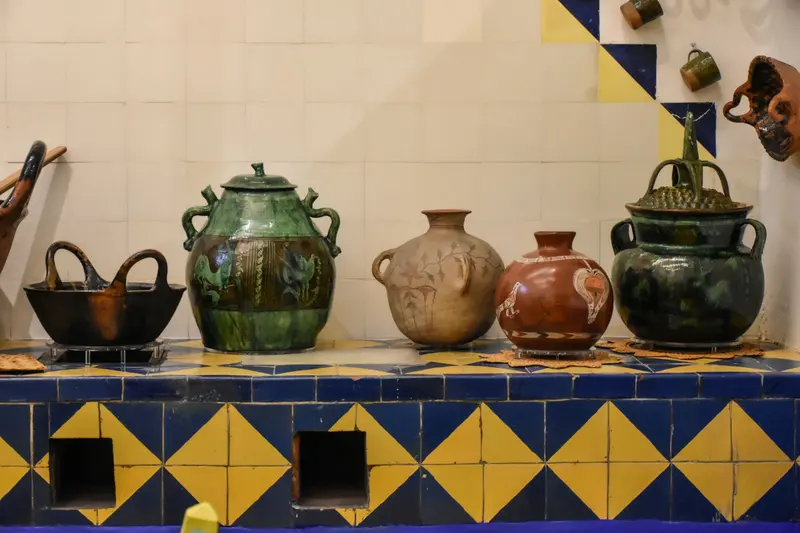
Café de olla is coffee boiled with canela (cinnamon) and piloncillo, an unrefined cane sugar, traditionally in an olla de barro (clay pot) that leaves an earthy taste of its own.1 Some cooks add clove, cardamom or a strip of orange or lemon peel.1 The coffee steeps until it gives up its flavor and is strained through a sieve; a cocol or a bolillo, two everyday breads, usually comes with it.2
It belongs to fondas (small family restaurants), street stalls and home kitchens more than to coffee bars.2 The spice is imported: Mexico bought about 17,000 tonnes of cinnamon in 2023, and 92% of that volume came from Sri Lanka.3 Around the clay pot sit other habits that are good to know before you order, from the Veracruz lechero to the café con leche of Mexico City's cafés de chinos.
Where café de olla comes from
Coffee was a latecomer. El Financiero, drawing on Salvador Novo's gastronomic history of Mexico City, traces coffee in Mexico to 1790, when colonial palates preferred chocolate and atole, a hot corn drink.1 In 1803 Alexander von Humboldt judged that the whole country consumed no more than 400 to 500 quintales a year.1 Coffee caught on once milk was added, after the first café opened on calle de Tacuba and its waiters invited passers-by in for coffee served sweet and with milk, "a estilo de Francia".1
The other ingredients arrived earlier. Spanish cooks brought a taste for spice shaped by centuries of Arab rule in Spain, and sugar cane brought piloncillo, which replaced the honey of Indigenous drinks in atole, in cacao and later in coffee.1 Women selling coffee from clay pots over a fogón (cooking fire) later took the drink onto the street.1 By the mid-20th century, historian Sandra Aguilar Rodríguez found, most women boiled coffee with cinnamon and brown sugar at home, while coffee makers belonged to middle- and upper-class kitchens.1
The most repeated story names the Adelitas, women who followed the revolutionary armies, as the cooks who first mixed coffee, cinnamon and piloncillo for soldiers in night camps between 1910 and 1917.12 El Financiero notes that the creator of a dish like this is close to impossible to identify,1 and México Desconocido dismisses claims of a pre-Hispanic origin, since there was no coffee in Mexico before the 18th century.2
Clay carries one known risk: lead in the glaze. Cofepris, the federal health regulator, signed an agreement with FONART, the national crafts fund, and the restaurant industry on a strategy to end lead glazes on pottery that touches food.2 If you buy an olla to take home, ask for a piece the potter guarantees lead-free, or brew in a pot of another material, as many kitchens now do.2
The lechero at La Parroquia in Veracruz
Veracruz has its own way of adding milk. The Gran Café de la Parroquia dates itself to 1808, when it was founded as a general store and café almost opposite the parish church that is now Veracruz Cathedral, and from 1858 people called it the Café de la Parroquia.4 Its main room today is on the Paseo del Malecón at the corner of Valentín Gómez Farías.4
To order a lechero, tap your spoon against your glass. A waiter comes with two pitchers, one of coffee and one of hot milk, pours as much coffee as you ask for and then fills the glass with milk from as high as he can reach, so it foams.4 The ringing is said to copy the bells tram conductors sounded around 1890 to call for café con leche.4
Porfirio Díaz ate breakfast there before leaving for exile in France.4 José Fernández Fernández bought the café in 1926; in 2014 his great-nephew Marcelino Fernández Rivero ran it, and all of its coffee was high-altitude coffee from Huatusco, Veracruz.5 Franchising began in 2004 at Plaza Américas in Boca del Río, and by 2014 the branches included Xalapa, Coatzacoalcos and Mexico City's Centro Histórico.5
Cafés de chinos in Mexico City
In the 1930s the streets of Dolores and Luis Moya, in the center of Mexico City, were lined with laundries run by Chinese families, kept apart from their neighbors by racism.8 The cafés de chinos (Chinese cafés) grew out of that community in the first half of the 20th century, as cheap rooms where a few centavos bought a café con leche.68
The café con leche comes in two parts. A coffee concentrate goes into the glass first; the server waits for you to say how much you want, then fills the rest with hot whole milk, traditionally poured from an aluminum pitcher into an octagonal glass.68 With it comes pan de chinos: bisquets, panqués (loaf cakes) and small pastries adapted from French baking, plus fortune cookies and choux buns.68 The kitchens also turn out chop suey, fried rice, eggs and enchiladas.7
A handful survive. Café El Popular, at 5 de Mayo 50–52 in the Centro Histórico, opened in 1948 and stays open 24 hours; its owners bought La Pagoda, at 5 de Mayo 10-F and formerly called Café París, in the 1990s.6 Café Allende, at Ignacio Allende 69 in La Lagunilla, has poured café con leche since 1937.67 Rising rents, new chains and a changing city closed many others,7 and most are no longer staffed by people of Chinese descent.8
Chiapas, Veracruz, Oaxaca and Puebla
Three Mexican coffees carry a denominación de origen (protected designation of origin). Café Veracruz was first, in 2000, covering 82 municipalities in Veracruz; Café Chiapas followed in 2003 with 77 municipalities; Pluma, from 30 municipalities in Oaxaca, came in 2020.9
The Pluma decree, signed in January 2020, names Typica as the region's original variety and also lists Pluma Hidalgo, Bourbon, Mundo Novo, Geisha and Java, among others. It describes the cup as having a pleasant bouquet, marked acidity and a light body.10 Coffee has a long record on that coast: in 1891 the estates of the Juquila district produced about 48,000 kg a year from some 365,000 plants, and around 1910 coffee covered about 5,700 hectares in four of its municipalities.10
Puebla's coffee grows in the Sierra Norte, a string of hill towns that works as a road trip. Near Cuetzalan, the Reserva Azul farm walks visitors from the plant to roasting and a cupping. In Pahuatlán, a beneficio (processing mill) in Barrio Unido shows how its arabica, including caturra and bourbon, is processed. Xicotepec, which México Desconocido says smells of coffee, has Caffessisimo, selling coffee and cakes since 1975.11
Specialty coffee and what a cup costs
Mexico's top lots now sell at international auction. In the 2025 Cup of Excellence, the best washed coffee was a Geisha from Finca Santa Cruz in Chiapas, scored 91.36; one of its lots fetched US$73.00 per pound, the top bid in that category.12 Veracruz farms took second place among washed coffees and among honeys and naturals, Puebla's Los Manantiales placed third among washed coffees, and the lots that placed came from Chiapas, Veracruz, Puebla, Oaxaca and the State of Mexico.12
In Mexico City, Time Out counts Almanegra in Narvarte among the city's pioneering specialty bars.13 Café Avellaneda in Coyoacán brews beans from Oaxaca, Chiapas and Veracruz by ripper, AeroPress, French press and espresso; Cumbé in Roma works with V60, Kalita and Chemex; and Libertario, on Plaza Luis Cabrera, puts 3% of its sales toward regenerative farming with coffee-growing families.13
Prices have climbed with the world market. In March 2026, ADN40 found a cup of coffee at MX$72 at Starbucks and MX$54 at Cielito Café, against MX$25 at Mixup. A small cup cost about MX$25 in 2015, and some drinks at the big chains now pass MX$100.14
| Chain (Mexico City) | Cup of coffee, March 2026 |
|---|---|
| Starbucks | MX$72 |
| Cassava Roots | MX$66 |
| Tierra Garat | MX$64 |
| Cielito Café | MX$54 |
| Pickup Coffee | MX$35 |
| Sede Café | MX$30 |
| Mixup | MX$25 |
Prices reported by ADN40 on 4 March 2026; the drink and size were not specified.14
Tip. At a café de chinos, the server pours the coffee concentrate and then waits: say when, and the rest of the glass is filled with hot milk.8