 By Yannick Schroth
Coffee cultures · 9 min read · Updated October 2026
Vietnamese coffee at a glance
Vietnamese coffee is mostly robusta, dark-roasted and dripped slowly through a small metal filter called a phin, then served black or with sweetened condensed milk, usually over ice.11 Vietnam is the world's second-largest coffee producer after Brazil, and robusta makes up about 97% of its crop: 31.4 million of the 32.5 million bags forecast for 2026/27.12
French missionaries brought coffee to Vietnam in 1857, and in the 1920s the French opened plantation zones in the Central Highlands, mainly in Đắk Lắk province.1 The highland town of Buôn Ma Thuột there still markets itself as Vietnam's coffee capital.3 What Vietnam did with the beans is its own: strong, sweet, often iced, and drunk slowly.4
| Drink | What it is | Price, 2026 |
|---|---|---|
| Cà phê đen đá | Iced black phin coffee, sidewalk café | 15,000–25,000₫ |
| Cà phê sữa đá | Iced, with condensed milk | 25,000–45,000₫ |
| Cà phê trứng | Topped with whipped egg cream (Hanoi) | 35,000–60,000₫ |
| Cà phê muối | Topped with salted cream | 30,000–55,000₫ |
| Cà phê cốt dừa | Blended coconut slush with coffee | 45,000–70,000₫ |
| Specialty arabica | Specialty beans or hand-brewed | 70,000–100,000₫ |
National ranges as of 2026: the sidewalk and specialty figures come from an October 2026 survey, the others from a 2026 guide.65 Trendy cafés in Saigon's District 1 and Hanoi's Hoàn Kiếm charge more.5 Vietcombank bought US dollars at about 25,650₫ on 22 October 2026.7
How a phin works
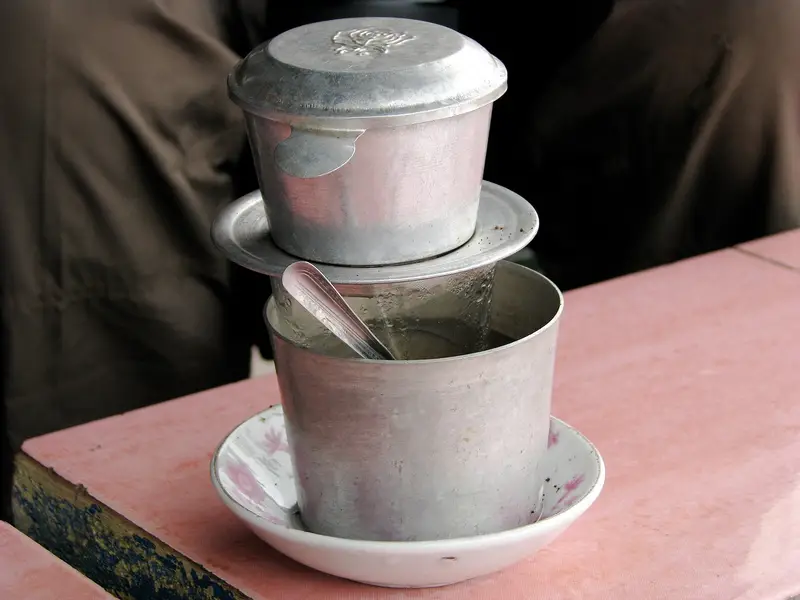
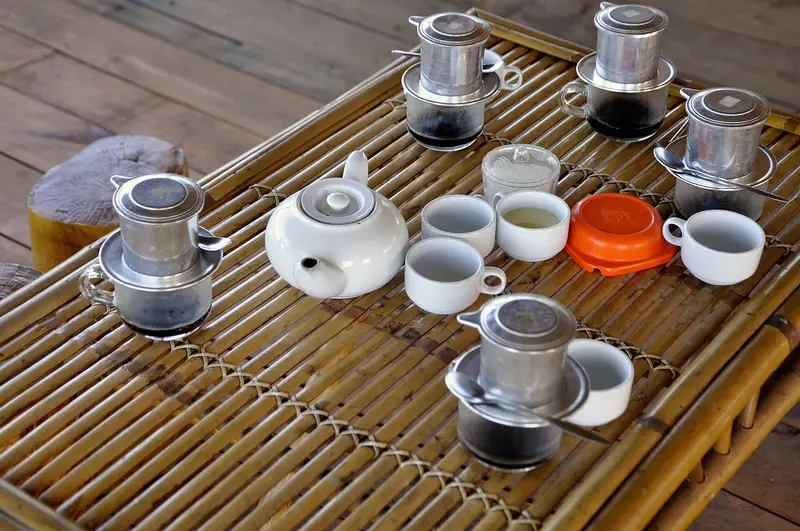
A phin has four parts: a perforated plate that rests on the glass, a brewing chamber on top of it, a perforated insert that presses the grounds down, and a cap to hold in the heat.8 Instructions for Trung Nguyên's 100 ml phin call for two or three tablespoons of ground coffee, a splash of hot water to wet it, a 20-second wait, then a full chamber that drips through in about five minutes.8 The usual water temperature is 90–95°C.9
At a traditional café the phin often drips at your table rather than behind a counter.4 If nothing has dripped after two and a half minutes, lift the press slightly with a spoon, and set the lid off-center if you use one, since a tight seal can stop the drip altogether.10
The Vietnamese coffee drinks to know
Iced black coffee
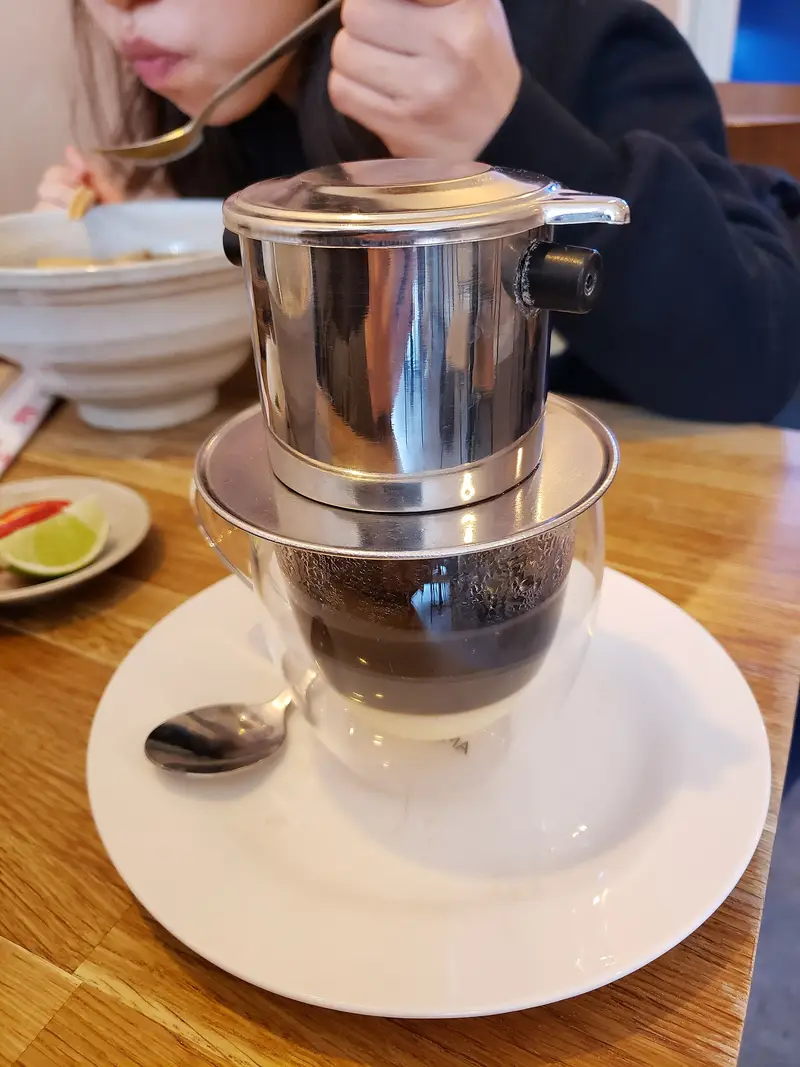
The base of everything else: robusta dripped through a phin and served black over ice.11 It usually comes with a free glass of trà đá, iced jasmine or weak green tea, and refills of that are free too.5 Expect it bitter and intense.5
It still arrives sweetened, usually with sugar, unless you ask otherwise; cà phê đen đá không đường means no sugar.5 Hot, it's cà phê đen nóng.12
Iced coffee with condensed milk
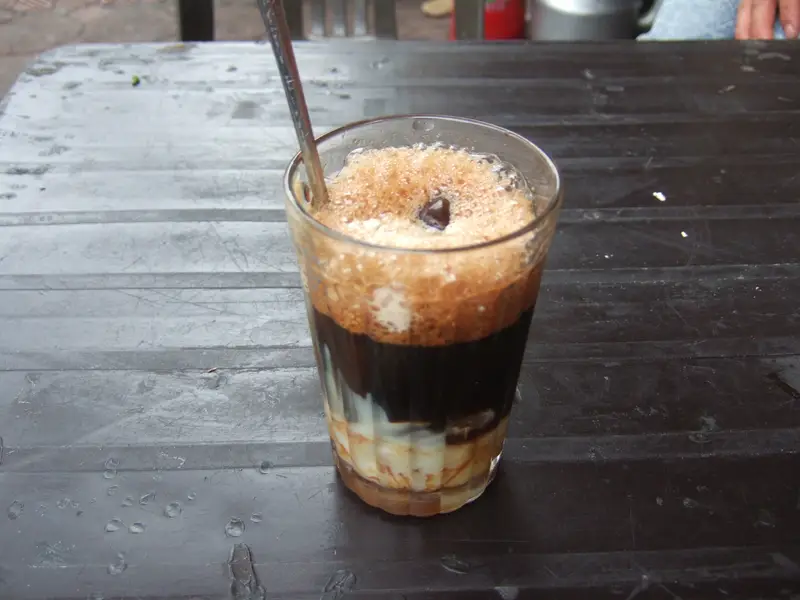
Known abroad simply as Vietnamese iced coffee.11 Sweetened condensed milk goes in the glass first, dark-roast robusta drips onto it from the phin, and you stir it together and pour it over ice.11 Condensed milk took over because fresh milk was scarce and expensive in the tropical climate under French rule.511
Expect 25,000–45,000₫ at a neighborhood café as of 2026, and up to 75,000₫ at trendy places in Saigon's District 1 or Hanoi's Hoàn Kiếm.5 In the north the same drink is cà phê nâu, nâu meaning brown, for the color the milk gives it.12
Milk with a little coffee
A Saigon drink that flips the ratio: phin coffee with condensed and fresh milk, mostly milk, with just enough coffee for the aroma.13 It emerged in the 1950s among the Cantonese-speaking community of Chợ Lớn, and the name is shortened from bạc tẩy xỉu phé, roughly "a cup of white milk with a little coffee".1113 Order it if robusta at full strength is too much.


Egg coffee
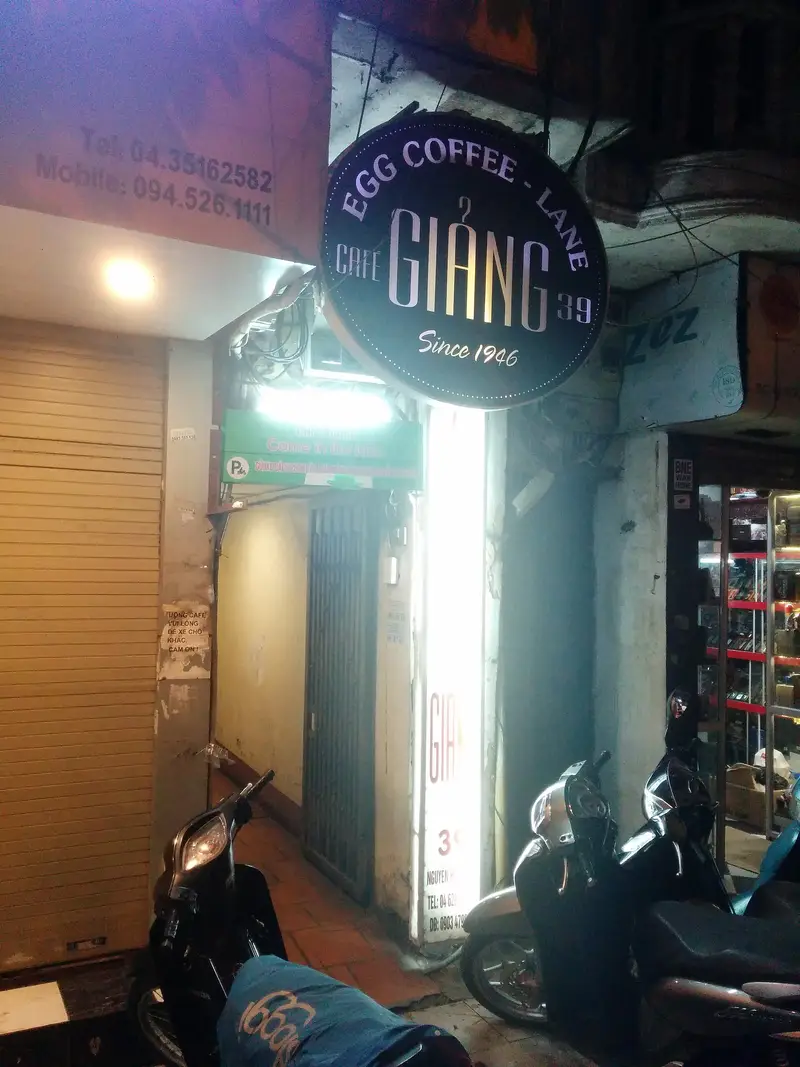
Hanoi's contribution. In 1946, with fresh milk in short supply, Nguyễn Văn Giảng, a bartender at the Metropole Hotel, whisked egg yolk with condensed milk and poured it over coffee.514 Guests liked it enough that he left the hotel to sell it himself, and his family still runs Café Giảng, down a small alley at 39 Nguyễn Hữu Huân Street.14
The house recipe also uses butter and cheese, plus ingredients the family keeps to itself.14 The cup sometimes arrives standing in a bowl of hot water to keep it warm.15 Expect 35,000–60,000₫ in Hanoi as of 2026.5
Salt coffee
From Huế, the former imperial capital, where a small café on Nguyễn Lương Bằng Street is credited with inventing it in 2010.516 Condensed milk goes in first, then a salted cream, with the phin dripping through on top; the salt brings out the sweetness of the milk and tames the bitterness of the coffee.17 It became a nationwide trend after the Covid-19 pandemic, and as of 2026 a cup costs 30,000–55,000₫.165
Coconut coffee
Coconut cream, condensed milk and ice blended into a slush, with coffee mixed in.11 The Cộng Cà Phê chain, founded in 2007, popularized it in the early 2010s and still sells a coconut coffee smoothie as its signature drink.518 Think dessert first and coffee second. Expect 45,000–70,000₫ as of 2026.5
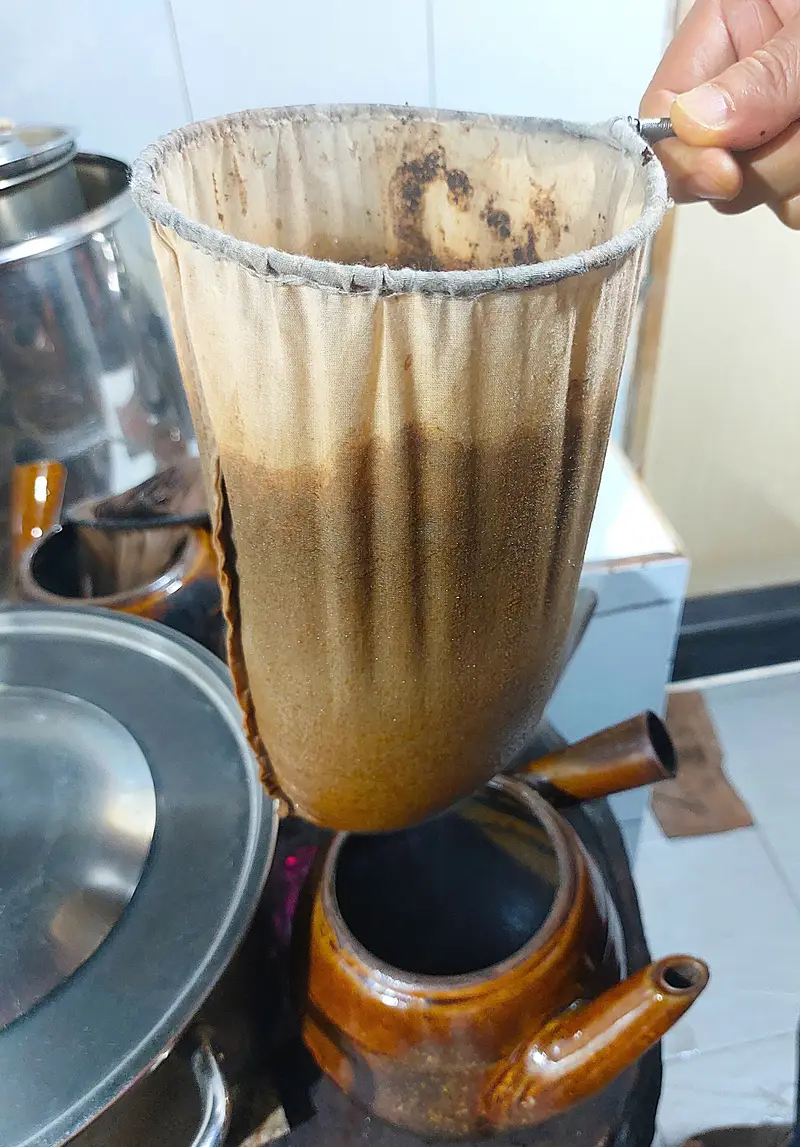
Photo: Trương Minh Khải, CC BY-SA 4.0

Sock-filter coffee
Saigon's other method skips the phin. In cà phê vợt, "stocking coffee", the grounds are strained through a cloth filter.19 Cheo Leo, in an alley at 109/36 Nguyễn Thiện Thuật in District 3, has sold it since 1938; its founder ran each batch through the cloth twice, and the filters are changed every two weeks.19
Saigoneer found Cheo Leo's sữa đá lighter and less syrupy than street coffee, with a clean finish.19
Photo: Alanthebox, CC0 1.0

Specialty arabica
The new wave. Cầu Đất, near Đà Lạt, is the best-known arabica area of Lâm Đồng province, and Sơn La in the northwest has grown into one of the country's large arabica regions, with nearly 40,000 hectares under coffee.2021
Drinks made with specialty beans or brewed by hand cost 70,000–100,000₫ as of 2026, though a plain black coffee at the same places can come in under 50,000₫.6 See the specialty cafés in Da Nang.
Robusta or arabica: which Vietnamese coffee to try
Robusta is what most of Vietnam drinks. It has lower acidity and more bitterness than arabica, and about 2.7% caffeine against arabica's 1.5%, nearly twice as much.22 Arabica is a small crop here, about 1.1 million of the 32.5 million bags forecast for 2026/27, and it costs more partly because robusta is easier to grow, yields more and resists disease better.222 Neither is the "real" Vietnamese coffee. A traditional sữa đá made with good robusta is a different drink from a Đà Lạt pour-over, not a worse one.
If you buy beans to take home, look for a roast date on the bag and a named region such as Buôn Ma Thuột, Cầu Đất or Sơn La. Many traditional roasts are made with a touch of butter or even cacao, which is where the dark-chocolate and nutty notes in a cup of phin coffee come from.9
Drinking your way through Da Nang? Find cafés there by area and hour, from places that open at 05:00 to 24-hour and specialty cafés. Browse cafés in Da Nang.
How to order coffee in Vietnamese
In most cafés you sit first, and the coffee often brews at your table.4 Payment happens at the table or at the counter.26 Cho tôi ("give me") starts any order, and tính tiền asks for the bill.26 The other phrases below cover sugar, ice, temperature, takeaway and the Wi-Fi.232425
Free iced tea is normal and tipping is not expected.526 Nobody expects you to hurry your coffee either; gulping it on the move goes against the custom.4 Cash is still the norm at local places, though many small vendors now take bank transfers from a printed VietQR code.2627 Carry 10,000₫ and 20,000₫ notes.