Ottakring (16.)
AN-DO
- Outdoor seating
- Card payment
- Partial wheelchair access
- Toilets
- Open late
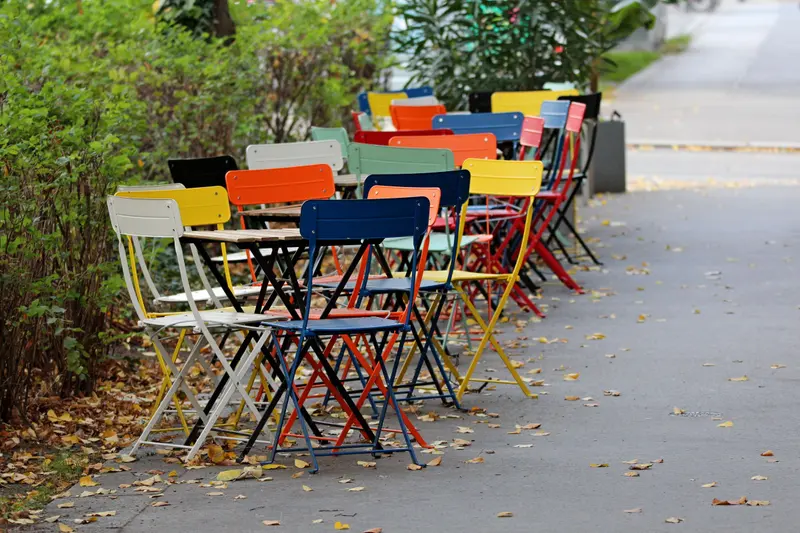
Sidewalk terraces open all year, from the Graben and Stephansplatz to Währinger Straße and Hollandstraße.
Photo: Heinz Reisenhofer, Pexels License
A Schanigarten is the part of a café or restaurant that sits on the public street, on the sidewalk or in the parking lane in front of the premises.1 Vienna traces the custom to the Graben: Johann Jakob Tarone, called Taroni, opened a coffee house there in 1748 and around 1750 was allowed to set tables and chairs outside.2 The origin of the name is unclear. One theory reads it as “Giannis Garten”, another links it to Schani, an old nickname for Johann once given to servants and waiters.2
Vienna had about 3,500 Schanigärten in spring 2024, and the winter before was the first in which they could run normally rather than in a reduced winter version.3 A permit covers the fence, umbrellas and patio heaters, but the sides of a terrace may not be closed in, so even a January Schanigarten stays open to the street.1
Local tip: Sit down outside before 23:00, the standard limit for outdoor service; on quiet side streets the cutoff can be 22:00 or even 19:00.1
Where these cafés are: Innere Stadt (1.) (48), Leopoldstadt (2.) (41), Brigittenau (20.) (26), Alsergrund (9.) (26), Neubau (7.) (25), Rudolfsheim-Fünfhaus (15.) (22), Favoriten (10.) (20), Wieden (4.) (19), Meidling (12.) (18), Landstraße (3.) (16), Mariahilf (6.) (16), Margareten (5.) (16), Josefstadt (8.) (14), Hietzing (13.) (12), Döbling (19.) (12), Ottakring (16.) (11), Hernals (17.) (9), Währing (18.) (8), Penzing (14.) (6), Donaustadt (22.) (2), Floridsdorf (21.) (2), Liesing (23.) (2), Simmering (11.) (1).
Café Europa
Nothing matches those filters here. See all cafés in Vienna.
In September 2023 the City of Vienna and the Vienna Chamber of Commerce agreed to make a pandemic-era special permission permanent: Schanigärten may now operate without separate summer and winter seasons, with an evaluation planned after three years.4 Winter terraces had existed since 2018, at first only with a few tables and chairs.3
The conditions fall on the owners. A terrace has to be usable whenever the café is open, tables and chairs included, in winter and in rain or storm, and it may not be used as storage.14 Repeated breaches can cost the permit for at least six months.4 In April 2024 about half of the city's Schanigärten had stayed up through the winter, and Mayor Michael Ludwig announced more inspections.3
Outdoor service generally ends at 23:00. On quiet streets the authorities can set an earlier limit of 22:00 or 19:00 because of noise from guests, or refuse a terrace altogether.1 Indoors, plenty of cafés keep going much longer: Kleines Café on Franziskanerplatz and café camus on Eschenbachgasse serve until 02:00.
Austrian cafés and restaurants have been smoke-free since 1 November 2019, and smoking is now permitted only in outdoor areas.5 That makes the terrace the one part of a café where guests may light up.
The city charges a Gebrauchsabgabe (fee for using public space), nicknamed the Luftsteuer (air tax), by the square meter and by location. In 2024 it started at €2.40 per square meter a month, rose to €11.70 in pedestrian zones and better locations, and reached €23.10 in top locations.1 Patio heaters cost an extra fee.1
A sidewalk terrace must leave at least 2 m of sidewalk free, and the city asks for subdued colors and no drinks advertising on fences and umbrellas.1 Konditoreien (pastry shops) and food shops may set up a Schanigarten too, but only with up to eight seats.1
The Innere Stadt has the most terraces, ahead of Leopoldstadt, then Alsergrund and Brigittenau. Café de l'Europe sets its tables on the Graben at No. 31, Haas & Haas at Stephansplatz 4 and XCelsior Caffè-Bar at No. 7 face the cathedral, and Demel has outdoor tables on Kohlmarkt.
In Alsergrund, the block at Währinger Straße 2–8 has Cafe Glaser, Café Stein and Café Français, all with outdoor tables. In Leopoldstadt, SALZI and Fett+Zucker are a few doors apart on Hollandstraße, and Nelke sits at Volkertmarkt 38–39. Near Schönbrunn, Café Gloriette has tables in the palace park, and the Schlosscafé on Hietzinger Hauptstraße serves daily 08:00–22:30.

By area: Innere Stadt (1.) Leopoldstadt (2.) Landstraße (3.) Wieden (4.) Mariahilf (6.) Neubau (7.) Josefstadt (8.) Alsergrund (9.)
Yes. In September 2023 the City of Vienna and the Chamber of Commerce agreed to drop the split between summer and winter seasons, so Schanigärten may operate all year. A terrace must be usable whenever the café is open, including in winter and in rain or storm. The winter of 2023/24 was the first in which they ran normally; reduced winter terraces had existed since 2018.
Outdoor service at a Vienna Schanigarten generally ends at 23:00. On quiet streets the authorities can set an earlier limit of 22:00 or 19:00 because of noise, or refuse the terrace entirely. Many cafés keep serving much later indoors: Kleines Café on Franziskanerplatz and café camus on Eschenbachgasse stay open until 02:00.
The origin of the word Schanigarten is unclear. One theory reads it as “Giannis Garten”, after Johann Jakob Tarone, called Taroni, who opened a coffee house on the Graben in 1748 and around 1750 was allowed to put tables and chairs outside. Another links it to Schani, an old nickname for Johann once given to servants and waiters.
Free listings are free for good. A featured page gives you photos, a menu and your own URL, in your café's own design, for less than a coffee a day.