Motomachi & Nankinmachi
アンジー
ANGIE
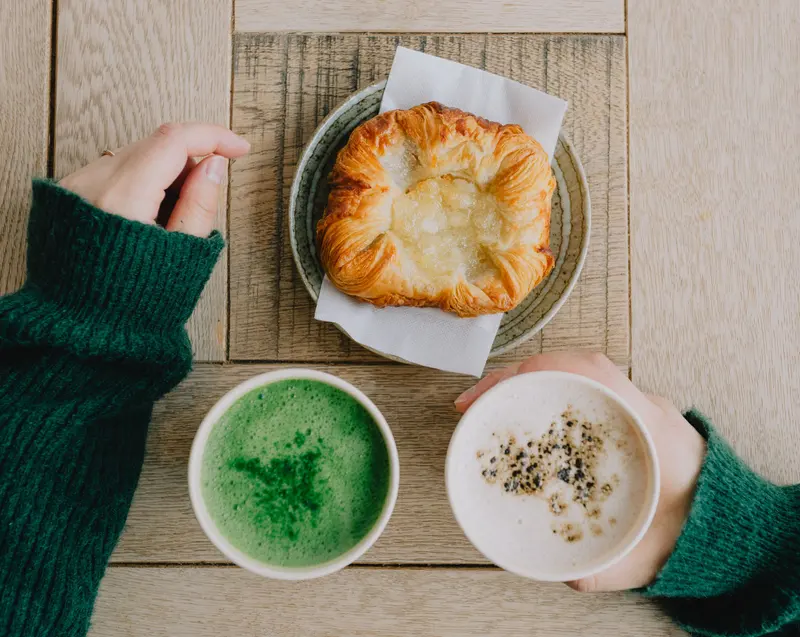
Bread and pastry with coffee, from a German baker's church in Kitano to the patisseries of Sakaemachi-dōri.
Photo: Gu Ko, Pexels License
Kobe buys bread in every form. In 2023–2025 its households spent ¥14,550 a year on shokupan (食パン, sliced white loaves) and ¥27,417 on other breads, the most of any prefectural capital or major city in both categories; the national figures were ¥10,713 and ¥23,530.1
DONQ, a bakery chain still headquartered in Kobe, dates from 1905. In 1965, taught by Raymond Calvel, the baker known in Japan as the god of French bread, and his French team, it began baking proper French bread in Sannomiya; customers at first complained the crust was too hard to eat, until a Tokyo shop in Aoyama started queues in 1966.2 Its bakers still mix the dough from flour each morning, ferment it for hours and bake in French stone-floor ovens.2
Local tip: At Freundlieb, the ground floor is the bakery counter; for a seat with your coffee, climb the stairs to the restaurant in the old chapel.4
Where these cafés are: Motomachi & Nankinmachi (4), Kyū-kyoryūchi (1), Shinkaichi & Hyōgo (1), Mikage & Sumiyoshi (1), Okamoto & Motoyama (1), Kitano & Shin-Kobe (1), Sannomiya (1), Nada & Rokkōmichi (1).
ANGIE
CAFFERA
KOKOSICA
pâtisserie AKITO
patisserie tooth tooth
Nothing matches those filters here. See all cafés in Kobe.
Heinrich Freundlieb (1884–1955) baked on the German cruiser Emden and opened a bakery in Qingdao in 1912. Captured by Japan in World War I, he was held in a camp in Nagoya, stayed on after his release in 1919 as the first chief engineer of Shikishima Baking, and opened his own bakery in Kobe's Nakayamate-dōri 1-chōme in 1924.3
By about 1940 the business had some ten shops, all lost in the air raids. Former staff helped him restart in 1948, and in 1955 his son founded the German Home Bakery company that runs Freundlieb today.3 Its flagship is the former Kobe Union Church at Ikuta-chō 4-6-15, with the shop in the old dining hall and the restaurant in the chapel upstairs.4
Motomachi has the most, two of them on Sakaemachi-dōri: Angie at 2-7-4 (Tuesday to Sunday, 11:00–19:00), Kokosica at 3-2-16 (Wednesday to Sunday, 10:00–19:00) and Pâtisserie Akito at Motomachi-dōri 3-17-6, closed Tuesdays. Motomachi Santos on the arcade, known for its hotcakes, opens 08:00–19:00.
Elsewhere they come one per neighborhood: Caffera inside Daimaru (09:45–21:00), Pâtisserie Tooth Tooth in Sannomiya (11:00–20:30, cards accepted), 月珈 in Nada (08:15–18:30), Café Pensée at Okamoto 8-9-1, Baobab, a pancake café in Mikage-ishi-chō, and Okidokei (置時計) in Arata-chō, which opens at 07:00 on weekdays.
Pan to Espresso to, a bakery and coffee bar that began in Tokyo's Omotesandō, bakes in Kitano in the former Disrefsen house, one of the ijinkan (異人館, foreign residents' houses) at Yamamoto-dōri 3-5-19. Its café and bakery open 08:00–18:00, with the café's last order at 17:00 and irregular closing days.5
The house rules are one order per person and, when it is busy, a 90-minute limit per table. In October 2026 a single espresso cost ¥600, a French toast plate ¥2,400 and the Ijinkan breakfast plate, served 08:00–14:00, ¥2,700.6
DONQ marked 60 years of French bread in 2025 by giving away about 14,000 freshly baked petites ficelles in its shops on 28 November, Japan's French bread day, timed to each shop's baking.2
The habit shows in weight as well as spending: in 2023–2025 a Kobe household bought 23,739 g of sliced bread a year, fourth among the 52 cities and well above the national 19,265 g, and 22,525 g of other breads.1
By area: Kyū-kyoryūchi Kitano & Shin-Kobe Motomachi & Nankinmachi Sannomiya Okamoto & Motoyama Nada & Rokkōmichi
Heinrich Freundlieb was a German naval baker held as a prisoner of war in Nagoya during World War I. After his release in 1919 he became the first chief engineer of Shikishima Baking, then opened his own bakery in Kobe in 1924. His son founded the company that runs Freundlieb today in 1955.
Motomachi, mainly along Sakaemachi-dōri: Angie at 2-7-4, Kokosica at 3-2-16 and Pâtisserie Akito on Motomachi-dōri 3-chōme, plus Motomachi Santos and its hotcakes on the arcade. Angie opens Tuesday to Sunday, 11:00–19:00. Kitano has a bakery café in a former foreign house, and Daimaru has Caffera.
In 2023–2025 Kobe households spent ¥14,550 a year on sliced white bread and ¥27,417 on other breads, the highest of any prefectural capital or major city in Japan in both categories. The national averages were ¥10,713 and ¥23,530. By weight, a Kobe household bought 23,739 g of sliced bread a year, against a national 19,265 g.
Free listings are free for good. A featured page gives you photos, a menu and your own URL, in your café's own design, for less than a coffee a day.
