Nakazakichō
Haiku Coffee Roasters
ハイクコーヒーロースターズ
- Outdoor seating
- Smoke-free indoors
- Open late
- Specialty
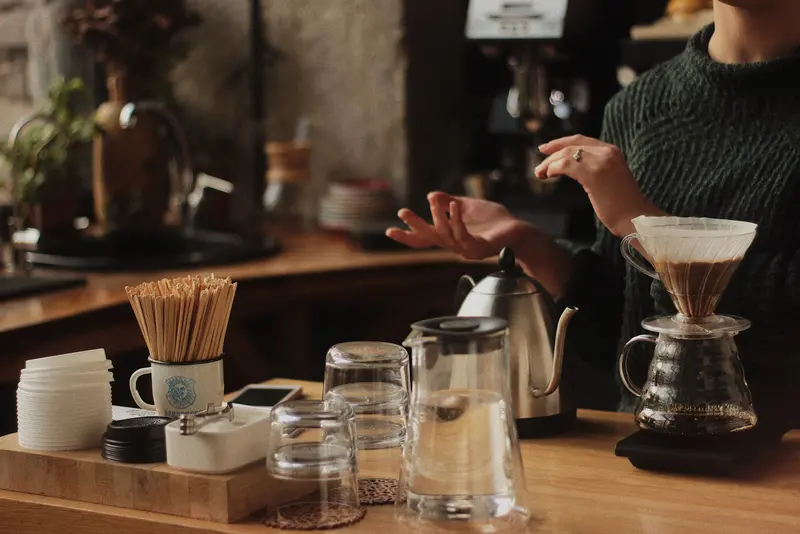
Roasters and coffee bars for hand drip, light roasts and single origins.
Photo: Maksim Goncharenok, Pexels License
Supesharutī kōhī (スペシャルティコーヒー, specialty coffee) has a formal definition in Japan, and it starts with the cup. The Specialty Coffee Association of Japan calls it coffee whose flavor the drinker judges excellent, which depends on consistent quality control at every stage from seed to cup.5 Its tasters score seven things: clean cup, sweetness, acidity, mouthfeel, flavor profile, aftertaste and balance.5
Two of the city's best-known roasters date from the early 2010s. LiLo Coffee Roasters opened in 2014 as the coffee corner of a hair salon in the same Nishi-Shinsaibashi building, with Nakamura Keita roasting and running the bar.1 In 2013, a year earlier, Brooklyn Roasting Company had picked Kitahama for its first street-level shop in Japan, serving the same menu as the New York original.4
Local tip: At Glitch and LiLo the price follows the bean, so read the list before you order: at Glitch in 2022 the same hand drip ran from ¥700 to ¥2,500.3
Where these cafés are: Utsubo & Kyōmachibori (6), Tenma & Tenjinbashi (6), Kujō & Bay Area (5), Karahori & Uehonmachi (4), Nakazakichō (3), Shinsaibashi, Amerikamura & Horie (3), Asahi & Senbayashi (3), Shin-Ōsaka (2), Nakanoshima & Kitahama (2), South Osaka (2), Umeda & Kita (2), Namba, Dōtonbori & Nipponbashi (1), Osaka Castle & Tanimachi (1), Jūsō (1), Tennōji & Shinsekai (1).
ハイクコーヒーロースターズ
Glitch coffee & roasters
Nothing matches those filters here. See all cafés in Osaka.
Menus are organized by brewing method and roast. Expect hando doroppu (ハンドドリップ, hand-poured filter) and a roast scale running from asairi (浅煎り, light) to fukairi (深煎り, dark). Glitch Coffee & Roasters, a Tokyo roaster, serves only light-roasted single origins at its Osaka shop, with no blends.23 Haiku Coffee Roasters in Nakazakichō also leans light and makes no espresso; its milk drinks are AeroPress lattes.2
LiLo goes the other way and roasts across the range, from fruity single origins to dark, chocolatey blends, plus a Mexican decaf.2 Its bar keeps more than 20 coffees, including beans from Yunnan in China and from a farm the company owns in Myanmar, brewed by hand drip, AeroPress or American Press.7 Each drip comes with a card giving the bean's details.1
Ordinary coffee is cheap here by Japanese standards. In September 2026 the government's retail price survey put a cup at an Osaka city kissaten (喫茶店, a traditional coffee house) at ¥470, against ¥640 in Tokyo's 23 wards and an average of ¥514 across 79 cities.6
Specialty bars charge by the bean. LiLo's drip coffee started at ¥500 as of 2023.1 When Glitch opened in Osaka in 2022, a hand drip or iced drip cost ¥700–2,500 from about 15 coffees, lattes started at ¥600, and beans sold from ¥1,800 per 100 g.3 Barista Magazine described its list as exclusive and often expensive.2
Utsubo & Kyōmachibori and Tenma & Tenjinbashi have the most specialty cafés, among them Mel Coffee Roasters in Shinmachi and NOWA coffee roastery on Tenjinbashi, followed by Kujō & Bay Area. Nakazakichō has Haiku Coffee Roasters, MARK COFFEE ROASTERS, open daily 11:00–18:00, and i・yu art space coffee roastery, on a second floor in Honjō-higashi 1-chōme, and Nakanoshima & Kitahama has Brooklyn Roasting Company and Glitch, which opened in June 2022 on the ground floor of Nakanoshima Festival Tower West.3
Brooklyn Roasting Company also has cafés in Shinsaibashi and Namba. LiLo opened a second room nearby in 2018, LiLo Coffee Kissa on Shinsaibashi-suji, a smaller space modeled on the old kissaten, and has roasted at its own facility in Fukushima ward, with a Loring roaster, since 2020.12 West of the center, Peak Roast Coffee is at 京町堀 9-14 in Kyōmachibori.
Specialty coffee here is mostly a daytime trade. Glitch opens earliest, at 08:00 on weekdays and 09:00 at weekends, and Peak Roast opens at 09:00 every day except Thursday, when it is closed. Most of the rest shut between 18:00 and 19:00.
Two keep evening hours. LiLo is open 11:00–23:00 with no regular day off, so it is still serving long after the others close.1 Haiku stays open until 22:00 on Fridays and Saturdays, closes at 17:00 on Sundays and takes Wednesdays off.
By area: Nakazakichō Nakanoshima & Kitahama Shinsaibashi, Amerikamura & Horie Namba, Dōtonbori & Nipponbashi Umeda & Kita Jūsō Tennōji & Shinsekai Asahi & Senbayashi
As of 2023, drip coffee at LiLo Coffee Roasters in Nishi-Shinsaibashi started at ¥500. When Glitch Coffee & Roasters opened in Osaka in 2022, a hand drip cost ¥700–2,500 depending on the bean, and lattes started at ¥600. For comparison, an ordinary kissaten coffee in Osaka city averaged ¥470 in September 2026, against ¥640 in Tokyo's 23 wards.
Utsubo & Kyōmachibori and Tenma & Tenjinbashi have the most, including Peak Roast Coffee in Kyōmachibori. Nakazakichō has Haiku Coffee Roasters, MARK COFFEE ROASTERS and i・yu art space coffee roastery, and Nakanoshima & Kitahama has Brooklyn Roasting Company, whose first street-level shop in Japan opened in Kitahama in 2013, and Glitch Coffee & Roasters in Nakanoshima Festival Tower West. LiLo Coffee Roasters is in Nishi-Shinsaibashi.
LiLo Coffee Roasters in Nishi-Shinsaibashi is open daily 11:00–23:00 with no regular day off. Haiku Coffee Roasters in Nakazakichō stays open until 22:00 on Fridays and Saturdays. Most other specialty cafés in Osaka close between 18:00 and 19:00, and Glitch Coffee & Roasters, the earliest to open, closes at 19:00.
Free listings are free for good. A featured page gives you photos, a menu and your own URL, in your café's own design, for less than a coffee a day.