Tây Hồ (West Lake)
Joma Bakery Cafe
- Wi-Fi
- Outdoor seating
- Takeaway
- Bakery café
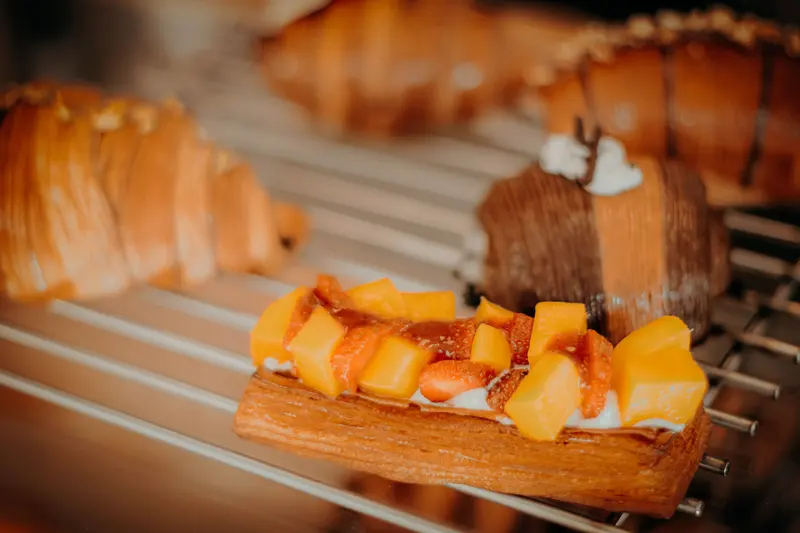
Cafés that bake their own, a legacy of French-era Hanoi.
Photo: Nguyễn Tiến Thịnh, Pexels License
The French brought the baguette to Vietnam in the 1860s, and Hanoi, capital of French Indochina from 1902 to 1945, kept a taste for bread and pastry long after.12 Northerners first called the baguette bánh tây (literally “Western bánh”), and for years it was a luxury, eaten at breakfast with butter and sugar.1 French café culture reached the cities in the same colonial period.5
Half of Hanoi's bakery cafés are in Hoàn Kiếm, around the lake and the Old Quarter, with others in Cầu Giấy, Tây Hồ and Ba Đình. They range from a patisserie in the Old Quarter to a bakery chain with branches across the city.
Local tip: Buy bánh mì at a street stall before 10:00, when most stalls start closing, and save the bakery café for pastry and a cà phê nâu (milk coffee) afterwards.
Where these cafés are: Hoàn Kiếm (12), Cầu Giấy (4), Tây Hồ (West Lake) (3), Ba Đình (2), Hai Bà Trưng (1), Hoàng Mai (1), Đống Đa (1).
Hanoi Coffee Station
Manh - banh mi place
Coffee & Bakery
Nothing matches those filters here. See all cafés in Hanoi.
When wheat imports were disrupted during World War I, bakers began mixing in cheaper rice flour, which also made the bread fluffier.1 Before the 1950s a sandwich stayed close to French taste, usually ham and butter or a liver pâté spread. The 1954 partition sent more than a million northerners south, and in 1958 northern migrants opened Hòa Mã in Saigon, one of the first shops to sell bánh mì thịt (meat bánh mì).1
Hanoi's version stayed leaner. It is smaller and often has one or two fillings, with thinner, crunchier bread, a lighter pâté and a thin, vinegary chili sauce.3
As of 2026, a basic pâté bánh mì at a Hanoi stall costs 15,000–20,000₫ and one with egg or a single meat 20,000–30,000₫, while sandwiches aimed at tourists run 30,000–45,000₫.3 Anything above 50,000₫ usually means a sit-down restaurant.3
Stalls keep baker's hours: most open around 05:30 to 06:30 and close by 10:00 or 11:00, with late-night carts around Tạ Hiện and Lương Ngọc Quyến running until about 23:00 or midnight.3
Joma Bakery Cafe opened its first Hanoi store in 2009, to queues on opening day; its general director, the Canadian Michael Harder, had earlier built the chain in Laos.4 It trains young people with disabilities, who with other disadvantaged staff make up more than 20% of its workforce, and gives 10% of annual profits to charity.4
Joma's branches include 43 Tô Ngọc Vân in Tây Hồ, 38 Phố Liễu Giai in Ba Đình and one in Cầu Giấy. All three open 07:00–21:00 and have outdoor seating.
Hoàn Kiếm's bakery cafés start with Triều Patisserie at 23 Phố Hàng Nón, which opens at 06:00, earlier than the rest, and closes at 19:00. Local Bread at 16C Phùng Hưng runs 07:30–22:30, while Cà Phê Hanoi Station at 31 Phố Hàng Mành, which also bakes, opens at 07:30.
In Ba Đình, Akia Bistro at 16b Phố Ngũ Xã also bakes, and in Cầu Giấy, Harper Seven Coffee and Bakery is at 215 Phố Tô Hiệu and The Dough Bakery Coffee and Tea on Nguyễn Khánh Toàn. In Tây Hồ, Lavender Coffee bakes too, in lane 285 Nguyễn Hoàng Tôn.

By area: Hoàn Kiếm Ba Đình Tây Hồ (West Lake) Đống Đa Hai Bà Trưng Cầu Giấy Hoàng Mai
As of 2026, a basic pâté bánh mì at a Hanoi stall costs 15,000–20,000₫, and one with egg or a single meat 20,000–30,000₫. Tourist-oriented sandwiches run 30,000–45,000₫, and above 50,000₫ usually means a sit-down restaurant. Most stalls open around 05:30 to 06:30 and close by 10:00 or 11:00.
The French introduced the baguette to Vietnam in the 1860s, and Hanoi was the capital of French Indochina from 1902 to 1945. Northerners first called the bread bánh tây, “Western bánh”, and ate it as a breakfast luxury with butter and sugar. Hanoi's bánh mì stayed leaner than Saigon's, often with one or two fillings.
Triều Patisserie at 23 Phố Hàng Nón in the Old Quarter opens earliest, at 06:00, and closes at 19:00. Joma Bakery Cafe's branches in Tây Hồ, Ba Đình and Cầu Giấy open at 07:00.
Free listings are free for good. A featured page gives you photos, a menu and your own URL, in your café's own design, for less than a coffee a day.